6 min read
Stay updated with the latest sports news across Cricket, Football, Chess, and more. Catch all the action with real-time live cricket score updates and in-depth coverage of ongoing matches.

Journalism of Courage



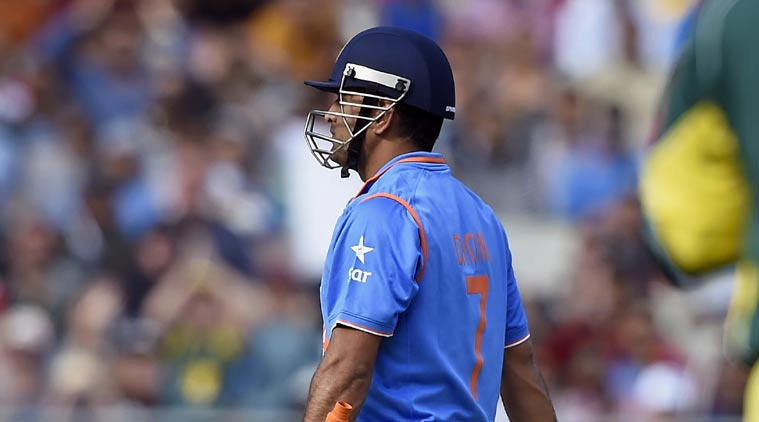 The big hitting towards the end didn’t happen as Dhoni was out early. (Source: AP)
At the end of the 30th over at the MCG, Rohit Sharma and Suresh Raina had taken India’s total to 153/3. The last few overs had been fruitful for the visitors. They had hit a boundary in each of the last four. Rohit was batting on 77 and Raina was seven short of a half-century. The platform had been laid.
Waiting in the wings was MS Dhoni followed by an array of useful lower-order batsmen in Axar Patel, R Ashwin and Bhuvneshwar Kumar. India could now eye 300, maybe even 320. They were used to this scenario after all. If anything, this is the kind of springboard that Dhoni & Co hope to establish at this stage of an ODI innings whenever they bat first.
Only two months ago in Kolkata against Sri Lanka, India were 169/2 with 20 overs and Rohit five shy of a century. They would eventually end up with 404/5 with their opener scoring 264. A few weeks prior to that run-fest, India had piled on 330/6 against the West Indies in Dharamsala after being 157/2 at the end of the 30th over. Or take Cardiff last August. Raina had smashed a century to drag the world champions from 132/4 to 304/6.
So there was a precedent in place for India to vie for a 300+ total at the G. But this wasn’t Kolkata, Dharamsala or Cardiff. This was the MCG with its mighty boundaries, where even hitting fours is a tiring proposition. For, at the G, never can you just strike the ball and assume it will reach the fence, so vast are its dimensions.
And you end up covering at least 44 yards by the time the ball crosses the ropes. And as it turned out, India’s long-standing strategy of delaying the final push on the pedal let them down. They had been found out. It was a lesson that they had learnt the hard way. Down Under, unlike in the subcontinent, they cannot leave too much for late, hoping that the explosive prowess of Dhoni & Co will muscle them to big totals.
Eventually at the MCG, they reached just 267/8, that too getting there with a stutter and a stammer. Remarkably, India could only manage eight fours and a solitary six in the last 20 overs of their innings. In contrast, they had hit 12 fours and 8 sixes in Dharamsala, 18 fours and 3 sixes at Cardiff and an extraordinary 28 fours and 9 sixes at the Eden Gardens — 27 of those boundaries coming off Rohit’s bat.
In the last seven overs of their essay in Melbourne, they actually managed a single six and a single four. The bigger boundaries not only bring the bowlers into the game, they also ensure that it’s a lot more difficult to clear the ropes, even if India might have some of the finest six-hitters going around in world cricket presently. Basically hitting boundaries isn’t quite a taken-for-granted task like it is on Indian grounds.
Fatigue
It also means that even if there’s a set batsman at the crease like Rohit was at the MCG, the fatigue of having already run a lot of runs starts to show. It certainly did in the opener’s case and it further curbed his hitting prowess. On both occasions that he scored double-tons, he made the most of the time spent at the crease by quadrupling his strike-rate in the death overs. At the MCG, he was worse for wear, and as a result his famed timing wasn’t as visible anymore.
Yes, Mitchell Starc played a huge role in it by getting rid of Dhoni and Patel crucially in the same over. A double-wicket maiden in the 45th over will derail any batting team, regardless of whatever their strategy is. But the fact that they couldn’t get any momentum going on either side of Starc’s magic spell was testament to the fact that they will have to rethink their approach to the latter half of the innings in these alien climes.
Yes, Dhoni is handicapped. And he admits it. His lower-order doesn’t have the firepower that Australia, New Zealand or even a West Indies possess. So does he start swinging early and risk getting out? Or does he push the throttle once he’s eliminated the risks of a collapse?
“Once I go in to bat at No. 6, it becomes like you have to hit and you can’t get out. It’s a very difficult thing to match up. I feel with Jadeja coming back, whenever he becomes fit, it becomes slightly easy for us because we all know that he can also hit. We feel a bit comfortable when he is around,” said Dhoni.
And with only three-potentially four if they make the final-ODIs to go before they take on Pakistan in the World Cup opener in Adelaide, they will go into their clash against England at the Gabba with the hopes of finding a balance between setting up the base, and triggering acceleration in 50-over cricket.
Strangely, it will be the first meeting between the two teams on Australian soil since they met in the 1992 World Cup at Perth. Incidentally they had wasted a great position to win even in that game.But as they prepare to launch their World Cup defence, they can’t afford to do so anymore.
Live on star sports 1 at 8.40 am
Stay updated with the latest sports news across Cricket, Football, Chess, and more. Catch all the action with real-time live cricket score updates and in-depth coverage of ongoing matches.