5 min read
Stay updated with the latest sports news across Cricket, Football, Chess, and more. Catch all the action with real-time live cricket score updates and in-depth coverage of ongoing matches.
© The Indian Express Pvt Ltd



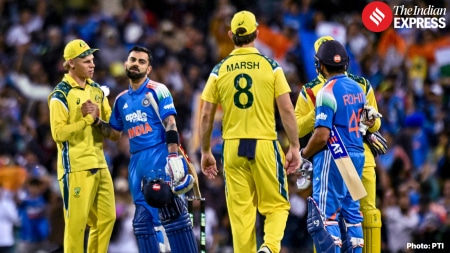
 India’s Rohit Sharma, Virat Kohli and others after the team lost the second ODI cricket match against South Africa, at Shaheed Veer Narayan Singh International Stadium, in Raipur, Chhattisgarh, Wednesday, Dec. 3, 2025. (PTI Photo)
With the series locked 1-1, India had an optional net session on the eve of the decider.
Yashavi Jaiswal, Washington Sundar, Tilak Varma and Nitish Kumar Reddy were the ones to turn up for the session, which lasted for a couple of hours. Their attention, though, was very much on the outfield and what sort of impact the dew could have in the game.
The ground staff at the ACA-VDCA Stadium, for the second evening in succession, used the anti-fog spray to improve visibility in hazy conditions and also more importantly used the anti-dew spray. It is understood that the anti-dew spray could be used hours before the scheduled start of play on Saturday. But during the second ODI in Raipur, anti-dew spray made an appearance just before the game began but it didn’t help matters. By the halfway mark of the chase, dew made life difficult for India’s bowlers.
However, in Visakhapatnam those bowling second have a sliver of hope.
It is learnt that unlike Ranchi and Raipur — where the dew set in very early — at the start of the second innings itself, here in the coastal town, the story is slightly different. According to those at the optional practice session, dew was seen only post 7.30pm. If that’s the case, the impact of the dew could be only in the second-half of the second innings. So even if India happen to bowl second again, they can use the finger spinners early in the game and use their seamers judiciously. On the match eve, India stayed back till 7:45 pm to assess the conditions and seemed relatively relieved about the dew factor.
India’s assistant coach Ryan ten Doechate explained how they have been trying to prepare for the challenge of a wet ball. “The dew factor is, we’re actually trying to put a number on it and it varies between 10 percent and 20 percent in terms of what a big difference it makes. We are doing all the practical prep stuff, guys bowling with wet balls,” he said.
When India hosted Pakistan in a bilateral series in 2012 and more recently in 2017 when Sri Lanka was here, the BCCI had 11.30 am start for ODIs to overcome the dew factor. Ten Doeschate also admitted that having an early start could help stop dew’s influence.
“I think it is, you know, the fact that the dew kind of falls as the second inning starts, it means the dew is there for the whole time. So a different start time could bring that effect down a little bit if you started two hours early. That is a solution but obviously there are so many moving parts at play in terms of broadcasting etc. So I guess it is a futile conversation,” he said.
Though it was an optional net session, there were signals about the team composition. The attention of the support staff was on Washington and Tilak, with head coach Gautam Gambhir having a long chat with both. In the two matches so far, India have appeared to under-utilise Washington with the ball, mostly down to the wet conditions which make it hard for the finger spinners to grip the ball. Going into the final ODI, there is chatter whether to bring in a specialist batsman in Varma, who can also bowl a few overs as a part-timer should the need arise. Going by the indications from the practice session, it is likely to be a toss-up between Washington and Tilak for the No.6 slot.
While including multi-facet players ahead of specialists has been their favoured route in Test cricket, which is uncommon, when it comes to ODIs, the story is contrasting. In an era where top teams prefer players with all-round ability in the XI to lend balance as it takes care of batting and bowling depth, India are an exception still. In the first two ODIs, they had only two all-rounders in Ravindra Jadeja and Washington with the remaining nine being specialists. It means, when it comes to batting, their depth ends at No 7 with Harshit Rana and Kuldeep Yadav still remaining batsmen, who at the best can only give company. With the ball, they have a top five who don’t bowl, which means when it comes to part-timers their options are nil. This sort of imbalance is again uncommon for a top ODI side in this era, and it would be interesting to see how India overcome this going forward.
“I guess that is a bit of an anomaly. You know, you would think Test Cricket, you would have more specialists but it is just where we are at the moment in the cycle and the guys we think at the moment are the best guys to represent the team. Ideally, in Test cricket, you have a more solid base of batters and bowlers but we feel at the moment the guys who are doing the job for us just happen to be all-rounders. I just think it is picking your best XI and that is just the way it is in the world,” Ten Doeschate said.
Stay updated with the latest sports news across Cricket, Football, Chess, and more. Catch all the action with real-time live cricket score updates and in-depth coverage of ongoing matches.