India skipper Mahendra Singh Dhoni is doing all the thinking on field these days. Bowlers bowl to his plan and stick to the angles that are true to fields set for them. Most times in this series, all the big ideas (not always effective) have emerged from the behind the stumps.
Unlike in the past, Dhoni, in this England series, can’t be blamed for switching off or letting things drift. That allegation can now be transferred to the bowlers in the side. From a distance, certainly not a vantage point to gauge the huddle talk, it seems the bowlers shouldn’t be blamed. They are merely listening and, subsequently, following instructions. Thinking, or being imaginative, is the captain’s prerogative.
The first hint of Dhoni’s new assertive approach came after the Lord’s win last month. While experiencing the high of winning an away Test, the usually tight-lipped skipper let down his guard. At a media conference, he spoke (and really spoke in this case) about his crucial on-field interaction with a team-mate — the day’s hero Ishant Sharma. It threw light on the how India ideates these days, specifically how the short ball came into play and how Ishant got four wickets by aiming at the rib cage of the England batsman.
“It’s difficult to convince him (Ishant). When he came to bowl I told him bowl short and he turned the other way. I set the field for him so that he doesn’t even think of bowling up,” said Dhoni, after India’s historic win last month. “The strategy was to give Ishant a field so he is forced to bowl the length that I want him to bowl.”
Buoyed by Lord’s success, Dhoni has continued to set fields for his bowlers and has forced them to stick to the line he wants. Since the plan hasn’t worked, the on-field conversations haven’t again surfaced in press briefings. It’s highly unlikely that the world will ever know if Bhuvneshwar Kumar or Pankaj Singh have been comfortable to bowl with a leg-slip, fine leg and short square leg.
One-trick captain
Story continues below this ad
Old Trafford, on a cloudy day, is ideal for bowling ‘up’ — as Dhoni says. The longer the ball stays in air, they more time it gets to move about. Bhuvneshwar and Pankaj did beat the bat by moving the ball from good length but those three fielders placed behind the square on the leg-side could’ve affected the way they thought. So, ideally, while a bouncer should’ve been a surprise ball it nearly became the stock ball for the two pacers. A miscued pull by night watchman Chris Jordan was the only wicket that the short ball field placements fetched.
The plan that worked when Ishant was around, but it certainly wasn’t bringing success when the relatively slower and less-aggressive bowlers such as Bhuvneshwar and Pankaj were implementing it. Besides, the English batsmen weren’t going to repeat the suicidal horizontal shot hits for two straight Tests in a row. Now, Dhoni was looking like a one-trick captain.
The excessive short-pitch bowling had a side-effect too. Bhuvneshwar, the frail new-ball bowler, looked tired when the second new ball was taken. Exhausted physically and muddled in the mind by constantly changing his length, the talented swing bowler was unable to bowl the ball that came in.
Dhoni’s obsession with the leg-slip too has been puzzling. It’s been a waste as rarely has a catch flown to that fielder so far in the series. Maybe strengthening the slips or plugging holes in the cordon would be a better utilisation of that player.
England pacers, without the baggage of the leg-side theory and with the support of a heavily guarded slip cordon, have concentrated on the off-stump. The pitch map of two teams (England focussing outside off and India spraying it about) brings out the difference starkly.
No excuses
Story continues below this ad
That is also because Cook has a much more disciplined bowling attack than India and they have the world’s best swing bowler in James Anderson. Dhoni, on the other hand, leads an inexperienced side. Still, that can’t ever be an excuse to following up with a strategy that doesn’t work. A strategy that involved Ravindra Jadeja bowling to a 7-2 field during his 21-overs long spell in Southampton. The virtually vacant off-side forced Jadeja to bowl the line his captain wanted. The spinner ended up firing the ball on the legs of the two left-handers in Alastair Cook and Gary Ballance. But was that the right line at that stage of the Test?
Jadeja’s spell started with England at 78/1 and ended with the score at 220/2. Jadeja got Cook in the 19th over of his spell but it was only after he had scored 95. His figures of 21-6-30-1 prove that Jadeja was certainly restrictive but clearly wasn’t allowed to be productive. He didn’t invite the drive through the off-side, neither was there a trap to invite the batsman out of crease. And nor was there a challenge, rendering everything into boring, wasteful throw of darts, that played a big role in the two batsmen settling in comfortably.
There have been enough instances in this series that suggest that Dhoni, during these four Tests, hasn’t been a bowlers’ captain. During the third Test, he made 52 bowling changes as India sent down 163.4 overs. With England making 569/7, it was clear that Dhoni’s tactics hadn’t worked. Over the years, bowlers would want longer spells so that they could set up a batsman and outthink him.
That hasn’t happened often enough enough in this series. With the captain doing the planning, the bowlers tend to hand their thinking caps as well to the umpire as they walk down their run-up.


 7 min read


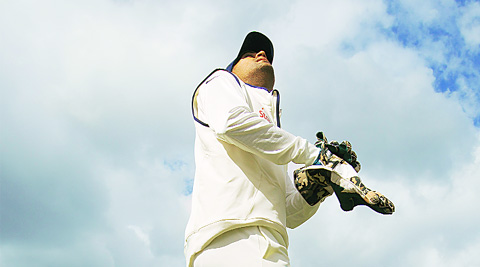 Dhoni hasn’t usually given his bowlers the chance to set their own fields in this series. (Source: Reuters)