12 min read
© IE Online Media Services Pvt Ltd



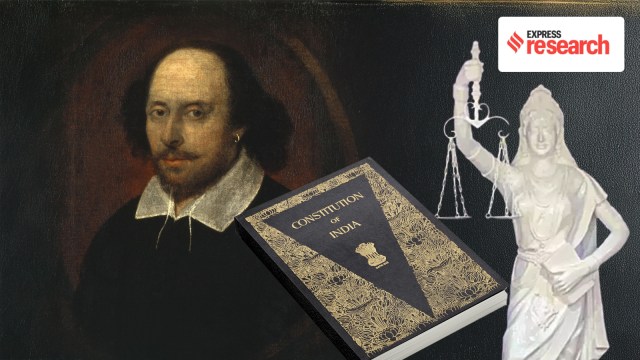 Many luminaries of the Indian judiciary, including the preeminent jurist VR Krishna Iyer, have turned to Shakespeare time and again. (Image edited by Angshuman Maity)
The Elizabethan English playwright, William Shakespeare, has been bewilderingly popular in India since as far back as the early nineteenth century, if not longer. Besides his widespread appeal in Indian cinema — across the films of Vishal Bhardwaj, Girish Karnad, BV Karanth, A Bhimsingh, K Balachander, Gulzar, Rituparno Ghosh, Jayaraj, Ramanand Sagar, and Sanjay Leela Bhansali, to name a few — Shakespeare has enjoyed lasting renown in Indian canons of law. It is all the more important to have a culture of a historiography of sorts dedicated to the bard’s long career in India’s constitutional and juridical parlance.
Among prized recommendations that Indian jurists have acquired is the American jurist Billings Learned Hand’s maxim that it is “important to a judge called upon to pass on a question of constitutional law, to have at least a bowing acquaintance with Thucydides, Gibbon, and Carlyle, with Homer, Dante, Shakespeare, and Milton, with Montaigne and Rabelais, with Plato, Bacon, Hume, and Kant … For in such matters everything turns upon the spirit in which he approaches the questions before him.” Shakespeare stands out in these canonical names, on the Indian horizon, both for his continuing ubiquity and also the dread that young law students (and students in general) feel when encountering that hallowed name. Many luminaries of the Indian judiciary, including the preeminent jurist VR Krishna Iyer, have turned to Shakespeare time and again. This did not happen in a vacuum. Most renowned Indian jurists have also had a good grasp of India’s constitutional history. Their affinity for the English playwright likely stems thenceforth.
Shakespeare in the Constituent Assembly
The Constituent Assembly’s members drew on Shakespeare at several moments. Their purposes were not repetitive but distinct. And their references to Shakespeare were not literary indulgence alone. Shakespeareana in the Constituent Assembly served as shorthand for moral authority, as comparative evidence in debates over language and culture, as a repertoire of metaphors in legal and political argument, and as a familiar touchstone for speakers shaped by English-language education. Undoubtedly, Shakespeare also helped the Assembly’s speakers to anchor arguments in the prestige of the English canon. When the Constituent Assembly met for the first time on December 9, 1946, its provisional chairman, Sachchidananda Sinha, cited Samuel Johnson’s praise of the ‘immortal fame of Shakespeare.’ It was a part of his suggestion that a strong, durable Constitution might endure the tests of time. It was a rhetorical move meant to place the Indian Constitution in a long Western tradition of durable political texts — topped by the likes of the American Constitution — legitimising the cosmopolitan aspirations of the Assembly, at large.
On November 24, 1949, an animated debate in the Assembly, over the language question, produced what L Krishnaswami Bharathi, member from the Madras State, called a ‘Shakespearean double superlative.’ Bharathi described the Assembly’s language resolution as “the most unkindest cut of all,” borrowing Mark Antony’s phrase from Julius Caesar to dramatise his sense of betrayal. Bharathi was referring to what would come to be known as the Munshi-Ayyangar Formula, named after the Assembly’s Drafting Committee members KM Munshi and N Gopalaswamy Ayyangar, which sought a compromise declaring Hindi in Devanagari script as India’s official language, while English was to continue as an associate official language for a transition phase of fifteen years during which non-Hindi speakers could adapt to the new linguistic regime. Bharathi’s Shakespearean resort stemmed from his frustration at the abandonment of the Gandhian guidance on having a neutral state language. By invoking Antony’s denunciation of the betrayal by Marcus Brutus, Bharathi framed the new language policy as ingratitude against a widely admired ideal.
Ironically, a little over a year ago, on November 4, 1948, Algu Rai Shastri, the Assembly’s member from Azamgarh, in Uttar Pradesh (and later a member of the Lok Sabha), had invoked Shakespeare’s name to argue the very opposite. “Just as the English people can take pride in their literature, in Shakespeare and Milton,” he remarked, “we too can be proud of the works of our Kalidas, Tulsidas, Jayasi and Soordas.” The learned Assembly was surely aware of Kalidas having been conferred the sobriquet of the ‘Shakespeare of India’ by William Jones. “It will be a matter of deep shame for a country,” Shastri went on, “which has developed a language of its own, to frame its first free Constitution in a foreign language.” He, therefore, pleaded that “the Hindi version of the Draft Constitution should be placed before this House as the original Draft of the Constitution,” and that the English version should be treated as only a translation.
The very next day, Shakespeare was invoked once again, along with Milton, this time by TT Krishnamachari, the member from Tiruchendur (and later the Minister of Finance), who recalled that he disliked the English language in the past. “I disliked it because I was forced to learn Shakespeare and Milton, for which I had no taste at all, but today it is no longer a matter of duress.” But as much as he disliked Shakespeare once upon a time — the implication being that his apathy had declined — he now dreaded the imposition of “Hindi in order to be a member of the Central Assembly, in order to speak out the grievances of my people.” Not only would it be impossible for him at his “age”, but also that the said language represented mostly Uttar Pradesh and the Central Provinces, and that “a number of people all over India” did not “understand the Hindi language.”
While Shakespeare’s spirit seems to have dawned on the memories of the Constituent Assembly members at most critical junctures amidst debates on sensitive issues, there is little evidence to suggest that the learned members read enough of him, for even if they did, presumably, they never quoted him at length; even invoking his name was more of a political signal than using his wisdom and literary prestige as a testimonies. This makes it harder to decode another Shakespeare reference, by Raj Bahadur, the member for the United States of Matsya — a transient union of four princely states following Rajasthan’s integration into the Indian polity. On June 14, 1949, the subject of Bahadur’s speech in the Assembly was judicial delays, especially in criminal cases. Bahadur was concerned, among other things, with the inordinate delay in the ongoing trial on the killing of Mahatma Gandhi. He also spoke of the otherwise sesquipedalian right of ‘“filibustering’ enjoyed by the Parliamentarians.” Bahadur’s remark that “Law’s delays have been proverbial ever since Shakespeare wrote Hamlet” deserves some attention, for he, besides Bharathi, was a rare speaker who seems to have had Shakespeare’s characters and plots in mind.
Hamlet does abound in legal themes. The play constantly interrogates whether Hamlet’s quest for personal revenge fulfils justice or violates its principles, especially since his resentment is driven by a ghost. Simultaneously, Claudius’s regime, which is preceded by his murder of Hamlet’s father and usurpation of his throne, throws up legal and moral dilemmas for political thinkers. Further, Ophelia’s death by what is potentially a suicide brings into question whether she would receive a Christian burial. Hamlet himself holds up the skull of a lawyer, in one scene, and muses: ‘Why may not that be the skull of a lawyer? Where be his quiddities [spirit] now?’ Unlike Hamlet, Bahadur was disinclined to delay justice and retribution, especially since, as he observed, “that recently there has been an appreciable rise in the incidence of crime in our country.” Had Bahadur’s Shakespearean reference been wholly explained, it might have made for a fascinating cultural study of how much of literary consciousness actually seeped into lawmaking agency in India.
Nevertheless, Zahirul Hasnain Lari, a lawyer who practiced at the Gorakhpur district court, before becoming a member of the Assembly from the United Provinces (from the Muslim League), had given a fuller representation to the bard only the previous month, during the long consideration of the Advisory Committee on Minorities in the Assembly. On May 25, 1949, Lari argued that “the problem of minorities is not unique to India. In all lands and in all climes there have been minorities and they have had to suffer.” A writer, adapting Shakespeare, coined this epigram, “Minorities must suffer, it is the badge of all their tribe,” he remarked, citing a bowdlerised form of Shylock’s plain from The Merchant of Venice: “Sufferance is the badge of all our tribe.” But, as Lari himself added, “it is superficial. It is not a profound truth. To me, it appears that justice to minorities is the bedrock of democracy.” Going on to cite John Stuart Mill on liberty and democracy, Lari questioned the very basis of representations in the Assembly and the future parliaments of India, instead arguing for proportional representation for the minorities. Lari subsequently resigned from the Constituent Assembly and migrated to Pakistan, where, after a brief judicial stint, he was relegated to practicing as a lawyer, once again.
Shakespeare in independent India’s courts
In postcolonial India, judges have turned to Shakespeare as a rhetorical resource to illuminate legal principles about identity, liberty, mercy, diversity, and human frailties. Recent examples from Indian jurisprudence reaffirm the currency of Shakespeare across constitutional, criminal, civil, and administrative judgments. In the Supreme Court’s landmark decriminalisation judgment of Navtej Singh Johar v. Union of India (2018), the top court invoked Romeo and Juliet to argue that labels do not exhaust a person’s essence, for “What’s in a name? That which we call a rose by any other name would smell as sweet.” The oft-quoted line was marshalled to undermine a century-old social stigma and to safeguard the constitutional protection of dignity beyond gendered labels. Previously, a High Court order on renaming and certificate corrections had stressed more or less the same principle, in Ananda Sahu v. State of Orissa, 1997. Judges have appealed to Shakespeare to underline the sanctity of personal freedom, as in Pebam Ningol Mikoi Devi v. State of Manipur, where The Comedy of Errors was quoted to emphasise that arbitrary restraints demand strict scrutiny. In Gaurav Jain v. Union of India (1997), Shakespearean phrases appeared in the judgment as part of a wider moral register that framed the Court’s protection for marginalised children. The Merchant of Venice surfaced again in the triple talaq litigation and other matters when benches discussed discrimination and mercy, as the figure of Shylock and the play’s plea that ‘the quality of mercy is not strained’ informed discourses of compassion and equality (Shayara Bano v. Union of India, AIR 2017 SC 4609; Ajai Shanker Pandey v. Union of India, 2005). Then, Othello has been invoked to dramatise jealousy and chaotic moral collapse in criminal matters (Alli Noushad v. Rasheed; Amina Nahna v. State of Kerala, 2011), while Hamlet has furnished judges with corrosive metaphors — “something is rotten” and related ones — in contexts of corruption and institutional-failure (Shivajirao Nilangekar Patil v. Mahesh Madhav Gosavi, AIR 1987 SC 294).
Lesser-known plays like King John have been referenced in evidentiary discussion, notably to illuminate the force of dying declarations (Amar Singh v. State of U.P., 2010). Meanwhile, the more well-known King Lear was invoked in Priyanka Pandey v. Secretary, Board of Secondary Education (circa 2007), where the High Court questioned whether examination systems were to make of students ‘like a fly to the wanton boys.’ And, Shakespeare’s famous history plays, including Henry VI Parts 1 and 2, have been consulted to reprimand social attitudes towards women and to critique certain aspects of the legal profession itself (Fathima Bibi v. Selvammal, 1981; Damordass Agarwal v. R. Badrilal, 1987). Shakespeare’s salience as a moral lexicon to translate doctrinal points into vivid and canonical images for the bar and the public is indeed redoubtable. As Gurinder Pal Singh, an Indian legal expert, while writing on Shakespeare, said, the Elizabethan playwright’s “influence on Indian jurisprudence is more than just a fleeting fancy. It is a testament to the enduring power of his words, his understanding of human nature, and his ability to capture the essence of complex emotions and situations.” One may struggle with Shakespeare, early on, as some Constituent Assembly members seemed to, yet, “perhaps there’s something to be said for injecting a bit of poetry and drama into the often dry” and, occasionally, Shakespeare-fearing precincts of lawyers.