4 min read


© IE Online Media Services Pvt Ltd



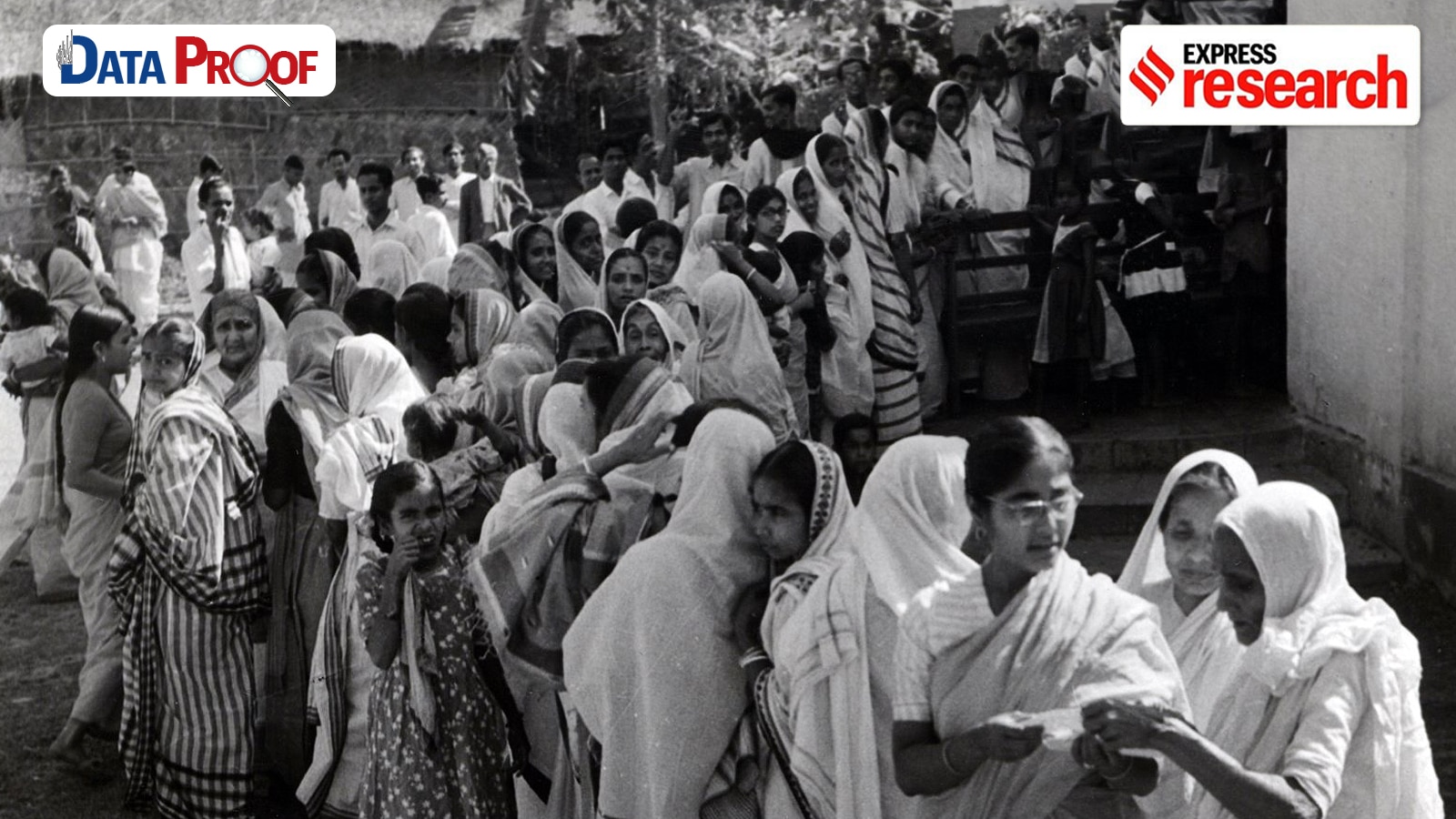 Among the 80 million women voters in the country during the first general election, close to 2.8 million had to be delisted from the rolls since they failed to register their proper names. (Express Archives)
There is a powerful role that numbers can play in narrating the life of a democracy. As India votes in the 18th Lok Sabha elections, we dig out some key numbers that have shaped the country’s electoral politics over the decades. Data Proof, a seven-part series, will tell the story of elections in India through numbers.
One can argue that one of the biggest achievements of independent India’s experiments with democracy has been its commitment to universal adult franchise since its first general election in 1951-52. The fact that all adult women in India were eligible to vote since the birth of the nation, and without much opposition, was indeed historic given that in most developed and powerful countries of the world such as Great Britain and America, suffrage for women was achieved through a long, tiresome and violent process.
Despite the remarkable achievement in women’s voting rights, till about the 1990s, women voter turnout in India remained significantly lower compared to men. That trend, though, appears to have changed through a major shift in more recent years.
The data for women voter turnout in the first and second general elections remain undocumented since the practice of recording voters in terms of gender was started by the Election Commission only from 1962 onward. However, reports of the first election reveal some of the unique challenges faced by the poll panel when it came to female voters. In the preliminary rolls, approximately four million women voters registered themselves as ‘wife of’ or ‘daughter of’. Annoyed at the situation, chief election commissioner Sukumar Sen is known to have called it a “curious senseless relic of the past”. Consequently, special efforts were made to raise awareness and convince women to enlist their own names in the electoral rolls. Eventually though, among the 80 million women voters in the country during the first general election, close to 2.8 million had to be delisted from the rolls since they failed to register their proper names.
(Illustration by Vibha B Madhava)
A peek into polling data in the 1962 and 1967 elections would reveal that in the initial years, the electoral participation of women was much lower than that of men. While in the 1962 election, 46.6 per cent women voters cast their ballots, the number increased to 55.5 per cent in 1967. The women voter turnout percentage underwent a slight decline yet again — 49.1 per cent — in the 1971 election. During these years, the difference between male and female voter turnout remained between 11 and 17 per cent.
From the 1991 election onward, the margin between male and female voter turnout has been narrowing consistently. In the 16th Lok Sabha election in 2014, the difference in turnout came down to 1.4 per cent, whereas in the 2019 election women voters outnumbered men by a margin of 1.7 per cent. There has been a significant increase in the number of constituencies where women voters have outnumbered men. As per a report in the Indian Express in March this year, the number of such constituencies increased from 64 in 2009 to 143 in 2019. At the same time, the number of constituencies where women outnumber men in electoral rolls has increased from 85 in 2009 to 110 in 2019.
Experts have pointed out that the trend of rising female voter turnout is a result of multiple factors. A study published by the think tank Carnegie Endowment for International Peace posits that “rising literacy levels and media exposure have increased awareness among women, who in turn feel more empowered to exercise their political agency.”
Other studies, however, point out to the fact that despite rising women’s voter turnout, much more needs to be done for women’s political participation in India. The National Election Study (NES) conducted by the Lokniti Programme of the Centre for the Study of Developing Societies suggests that women lag behind men in other forms of political engagement such as participation in campaign activities or attending public meetings.