Journalism of Courage
 4 min read


 Only four per cent voters consciously saw these elections as being about Azadi, Article 370, AFSPA, human rights violation, etc
By: Suhas Palshikar, Shreyas Sardesai & Pranav Gupta
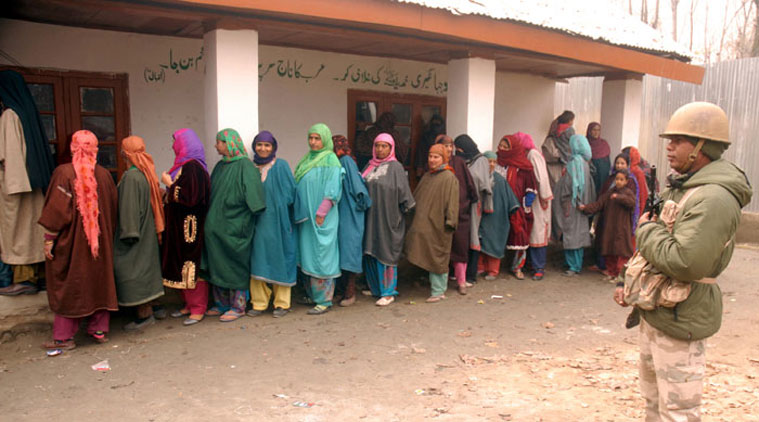
With completion of more or less peaceful elections in which voters in the Kashmir braved the boycott call and came out to vote, deciphering the Kashmiri mind poses tricky issues.
How do we read the fact that 55.5 per cent voters in the Valley turned out to vote? Kashmir-experts had pointed out in 2008-09 itself that the voter in the Valley makes a distinction between voting to elect a government and accepting integration with the Indian union.
Only four per cent voters consciously saw these elections as being about Azadi, Article 370, AFSPA, human rights violation, etc. For most, the elections were about governance and delivery related issues. While some saw elections as about infrastructure issues or more immediate issues of floods, for a majority, elections were about development. The trend in the Valley was not very different from that of Jammu.
The Kashmir issue
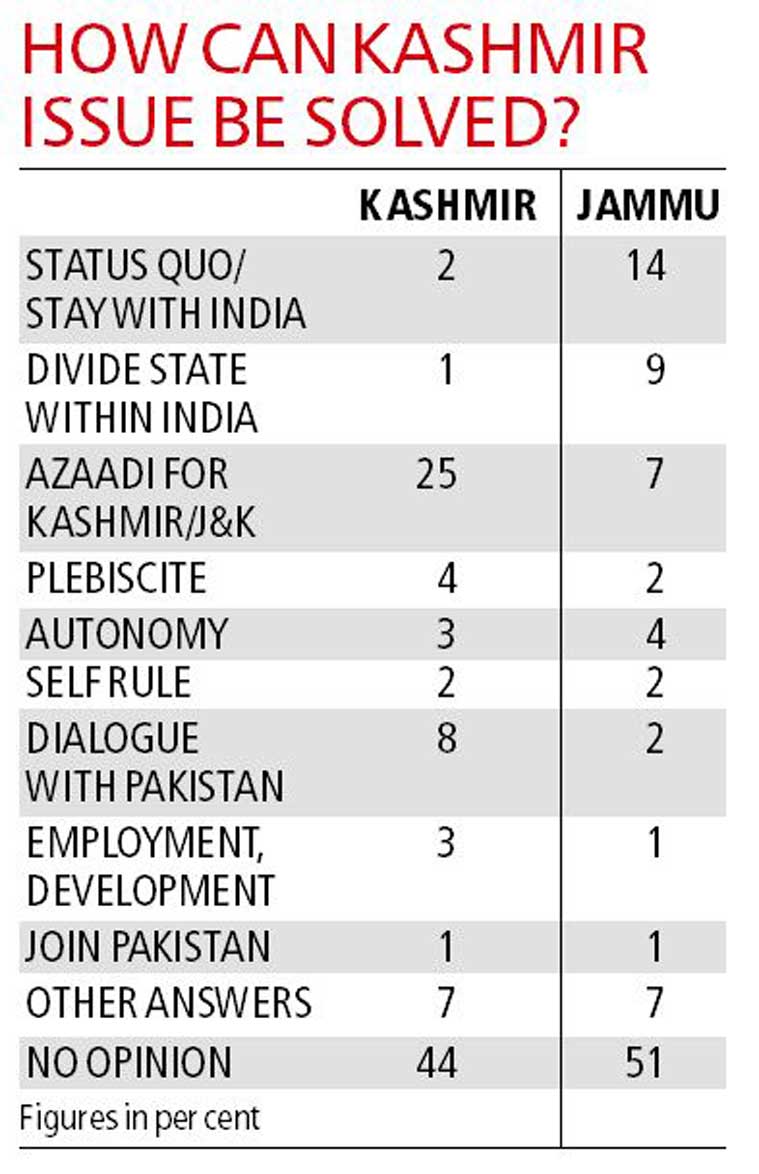
The survey also asked respondents their opinion about the ‘Kashmir issue’ (Kashmir masla). (Table 7) The responses are enigmatic because more than four in every ten persons do not offer any opinion on this. Yet, it needs to be frontally recognised that very few Kashmiris endorse the ‘status quo’. Equally clearly, merger with Pakistan too is not endorsed by more than one per cent respondents. The most dominant theme is ‘azadi’, autonomy, plebiscite, and/or self-rule. There is one clear change from 2008: the proportion of those who did not offer any response has increased manifold now. Whether this represents moderation in pro-azadi opinion or simply reticence is tough to tell.
The ‘separatist space’
The fact that there is enough space for th‘ ‘separatist’ politics in the valley is however evident through other findings of the survey too. A large section in the Valley believes that Hurriyat is best suited for solving the Kashmir issue. (Table 8)Similarly, respondents repose robust trust in th‘ ‘separatists’ — more than they trust the parties and the government. As far as the leaders are concerned, Syed Ali Shah Geelani enjoys greater trust than Ghulam Nabi Azad, Omar Abdullah, Mufti Mohammad Sayeed and Mehbooba Mufti.
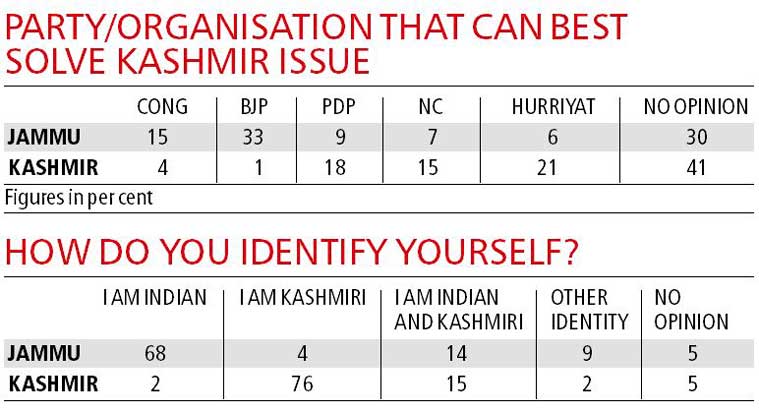
Popular response is unambiguous about the identity of the average Kashmiri. (Table 9) Asked how they identify themselves, three in every four respondents said they are ‘Kashmiris’. Only 15 per cent said they are both Indian and Kashmiri. Clearly, the normal pattern prevalent in rest of India, where people have negotiated with dual identity as Indians and belonging to a region, does not obtain in Kashmir Valley. In contrast, respondents in Jammu do not identify themselves much with Kashmir — they choose to identify more exclusively ‘s ‘Indian’ and only twenty per cent from Jammu region identify with Kashmir. Herein lies the complication of the state called Jammu & Kashmir. As our survey shows, on almost all issues the two regions do not see eye to eye. They think differently, they identify differently, they vote differently too. And the government thus elected has to govern for the entire state of J&K.
(Suhas Palshikar teaches Political Science at the Savitribai Phule Pune University. Shreyas Sardesai and Pranav Gupta are associated with Lokniti, Centre for the Study of Developing Societies)