7 min read


© The Indian Express Pvt Ltd



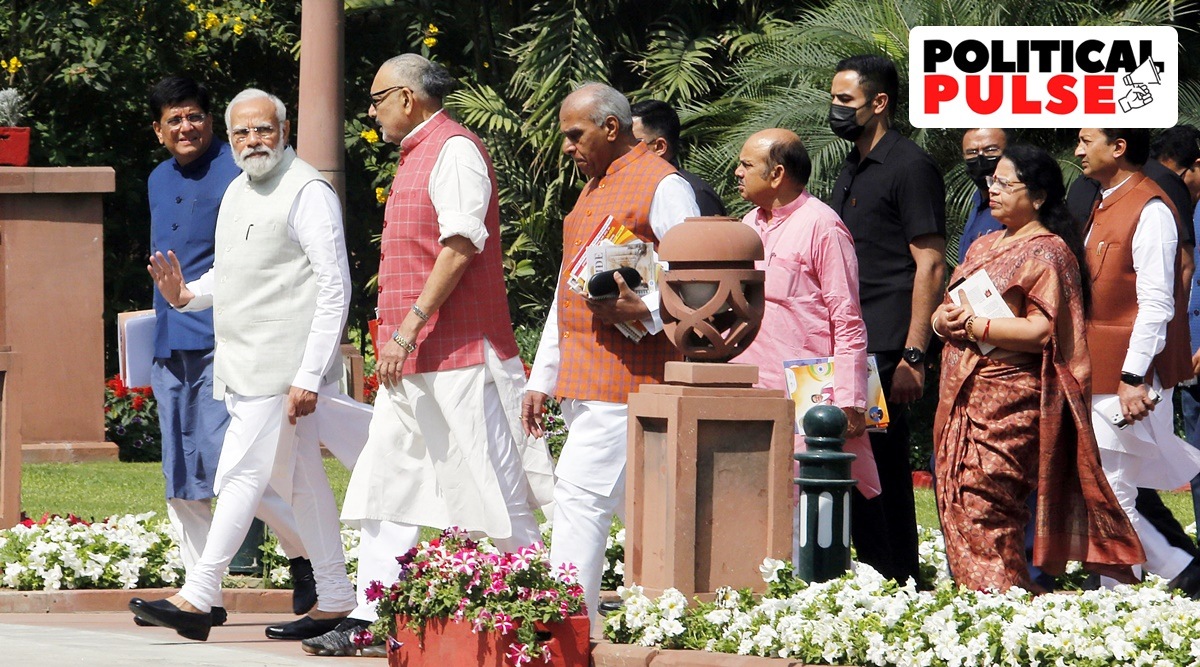 At the pan-India level, being equal allies with a regional party in the BJP’s core regions — northern, western and central India — is a thing of the past. (Express photo by Anil Sharma)
 The National Democratic Alliance (NDA) that once prided itself on its long-standing alliances has been undergoing a churn in recent years amid the BJP’s rise to become the country’s biggest political party.
With the AIADMK announcing its exit from the NDA this week, the BJP has for now lost a crucial ally in Tamil Nadu. The party, however, has stitched an alliance with the Janata Dal (Secular) in Karnataka. The BJP lost the Shiv Sena as an ally in 2019 but the Sena split in 2022 and the breakaway group led by Eknath Shinde, which took away 39 of the Sena’s 56 MLAs and also the party’s poll symbol, returned to the NDA fold last year.
“How can you say that the Shiv Sena left us? Eknath Shinde is the leader of the Shiv Sena and he is with the NDA,” said a BJP leader, focusing on the fact that it was Shinde rather than Uddhav Thackeray who had the official symbol. The Sharad Pawar-led Nationalist Congress Party (NCP), never a BJP ally, also split earlier this year and the larger faction under Ajit Pawar is now a part of the Maharashtra government.
In the last four years, the NDA has also lost the Shiromani Akali Dal that quit the alliance in 2020 after the Narendra Modi government introduced three farm laws — now withdrawn — that sparked protests in Punjab. The Aam Aadmi Party (AAP) at present is accusing the SAD of having decided to re-enter the NDA, which the Sukhbir Singh Badal-led party has vociferously denied. The SAD will also have concerns regarding Sikhs in Canada after the diplomatic stand-off between India and Canada.
Former ally Janata Dal (United) led by Bihar Chief Minister Nitish Kumar also walked out of the NDA for a second time in August 2022, with the JD(U) now a part of the Opposition INDIA bloc.
The NDA is seeing local patterns in how it’s losing and gaining allies. “In areas where we have become very powerful, some allies have felt threatened that we are eating up their space, as more and more people are voting for us,” said a BJP insider. “Look at Uddhav Thackeray. Since people in Maharashtra had made the BJP their first choice, he changed his party’s ideology and went with the Congress to survive. But he could not keep his party united and the larger chunk of his legislators came to us.”
Officially, the BJP took a measured line. “Any political outfit based on a family has a limited span. We saw that in the Sena split, with self-made Eknath Shinde convincing the majority of legislators and family-centric Uddhav Thackeray losing support within the party. As for the BJP, Atal Bihar Vajpayee had given the principle of coalition dharma and we have always followed it,” BJP spokesperson Guru Prakash Paswan told The Indian Express.
At the pan-India level, being equal allies with a regional party in the BJP’s core regions — northern, western and central India — is a thing of the past. It has become much bigger than its now-former allies Shiv Sena, pre-split, and the JD(U). In these states, the BJP gaining ground generated tensions with its now-former allies who once saw themselves as equal partners. In the 2019 Maharashtra Assembly elections, the BJP won 105 seats out of the 164 seats it contested and the Sena bagged 56 of 124. In the 2020 Bihar Assembly elections the BJP and the JD(U) contested 110 and 111 seats respectively in an alliance. The BJP won 74 seats while the JD(U) won just 43.
The new NDA in the BJP’s core regions is about “unequal” alliances with smaller parties, generally catering to a caste group. Some examples are the Suheldev Bharatiya Samaj Party of Om Prakash Rajbhar, the Nishad Party of Sanjay Nishad, and Apna Dal (Sonelal) of Anupriya Patel in Uttar Pradesh, and Jitan Ram Manjhi’s Hindustan Awam Morcha, Chirag Paswan’s Lok Janshakti Party (Ram Vilas) and his estranged uncle Pashupati Paras’ Rashtriya Lok Janshakti Party in Bihar. The Republican Party of India (Athawale) in Maharashtra, the Jannayak Janata Party of Haryana Deputy CM Dushyant Chautala, and the Haryana Janhit Party of Gopal Kanda are also with the NDA.
“In the Vajpayee-Advani era, the BJP was ready to do business with regional parties even as a junior partner. The Shiv Sena would get 171 seats and the BJP 117, as per the 1999 formula. In Bihar, they made Nitish Kumar the CM in perpetuity,” said political scientist Sajjan Kumar. “Under Modi, it is no longer willing to be a junior partner. In fact, it either makes regional parties irrelevant or situates itself as their challenger. It is, however, willing to ally with very small, caste-based, sub-regional parties that bring a small chunk of votes and are not dominant regional players.”
However, Kumar adds the BJP’s old template of allying with dominant regional parties continues in the northeast, where it has damaged the Congress through such alliances.
In Tamil Nadu, the aggressive politics of BJP state president K Annamalai complicated matters for the AIADMK. BJP insiders said the AIADMK’s walkout might not be final but believe that Annamalai provides visibility to the party in a state where it has been non-existent. “In a context of the dominance of the Dravidian ideology that talks about a fundamental difference between the state and the Hindi belt, it may not be a bad idea to explore (alternative ideological pitches),” said a BJP leader on the condition of anonymity.
The addition of the JD(S) to the NDA is a response to the strong position of the Congress in Karnataka after its victory in the Assembly elections earlier this year in which part of the core JD(S) voter base of Vokkaligas is believed to have shifted to the Congress. So, the BJP and the JD(S) need each other if they have to take on the Congress.
So, there is no single NDA pattern across India, rather regional patterns depending on the BJP’s strength. In the core regions, where the BJP has been sweeping in the Lok Sabha elections since 2014, it is too strong to depend on allies who feel threatened by it.