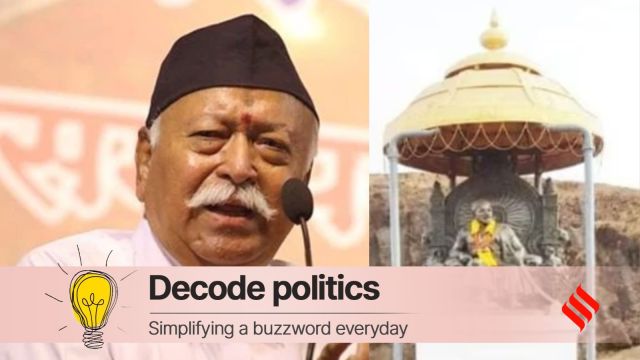
RSS chief Mohan Bhagwat’s claim during a speech in Pune earlier this week that freedom fighter Bal Gangadhar Tilak discovered Shivaji Maharaj’s samadhi has sparked a controversy in Maharashtra, with Other Backward Class (OBC) leaders alleging a conspiracy to take the credit away from social reformer Jyotirao Phule. “A movement of awakening was begun so that Shivaji is remembered. A celebration was started at Raigad. Tilak discovered all this,” Bhagwat said.
The dispute highlights a deeper struggle over historical narratives, social justice, and representation.

Where is Shivaji’s samadhi located?
After Shivaji Maharaj died in 1680, he was cremated at Raigad Fort, where a samadhi was later constructed. During Maratha rule, the samadhi was a modest structure consisting of a small raised platform of stone. There are no contemporary records detailing the appearance of the samadhi immediately following Shivaji’s death.
A decade later, the fort fell into Mughal hands and from 1689 to 1733, it was under Mughal and Siddi control. The Marathas recaptured the fort in 1733 and it remained under their control till 1818, when the British Army took over. The British are said to have incessantly shelled the fort during its takeover, damaging many structures inside, including the samadhi. One of the earliest detailed accounts of the samadhi comes from Lt Col David Prother who led British troops into Raigad Fort after their victory. In his correspondence with British authorities, Prother noted the deteriorated condition of the samadhi. Following this, the British imposed regulations on access to the fort.
What do British accounts say?
There are claims that the samadhi, which was already neglected under Peshwa rule, fell further into ruin under the British. Writer James Douglas, in his 1883 book A Book of Bombay recounted his visit to the fort. “Here he was crowned, married, died, and burned to ashes with a holocaust of his wives, elephants, and camels. His mausoleum is on yonder knoll, its interior a mass of weeds, trees growing up through the pavement of its dharamshala; its temple foul and dishonored, and its god cast down to the ground. No man now cares for Seevajee,” Douglas wrote.
He also questioned later Maratha rulers about the neglect of the fort and the samadhi: “Over all these domains which once owned him lord and master, acquired by so much blood and treasure and which he handed down with care to the Rajahs of Kolhapur, the Bhoslas of Satara, and their Peshwas in Poona, not one man now contributes a rupee to keep or repair the tomb of the founder of the Maratha Empire,” Douglas wrote.
Douglas appealed to the British government for the upkeep of the fort: “The British Government conserves the architectural remains of Tudor and Stewart. Will not the Bombay Government do as much for the tomb, the temple, and the arch of Seevajee? A few crumbs that fall from the archaeological bureau of Western India would suffice to keep in repair memorials of a dashing and most romantic period,” he wrote in his petition.
Story continues below this ad
Arthur Crawford, the Collector of Mumbai, described the abject condition of the samadhi in his 1897 book Our Troubles in Poona and the Deccan and questioned its neglect. “ … why the Peishwa’s caste have forgotten for 300 years to restore the monument, or even to keep it in repair,” Crawford wrote. Describing the samadhi, he noted it was an insignificant platform when he saw it: “A mangy, ill-clad, highly flavoured old ‘poojaree (worshipper)’ led us to what people call the tomb of Siwajee; an insignificant platform of decaying stones and mortar,” Crawford wrote.
When did Jyotiba Phule visit the samadhi?
The records thus indicate that the British were aware of the location of the samadhi although it was not frequently visited. In 1869, Jyotirao Phule is said to have visited the memorial. Phule was a pivotal figure in 19th-century India, with a profound and lasting impact on the socio-political landscape, particularly for OBCs and marginalised communities. He was a fierce critic of the caste system and focused on the empowerment of the lower castes, including OBCs, through social and educational reform.
The same year that he visited the Raigad Fort, Phule penned a ballad titled “Chhatrapati Shivaji Raje Bhosale Yancha Powada” that recounted Shivaji’s history from the perspective of the common man, portraying him as a leader of the ryots (peasants) rather than a king dedicated to the welfare of Brahmins, as described by Brahmin historians of the time.
“For well over half a century, the premises of Raigad had been overtaken by dense foliage. It was under these conditions that Mahatma Jyotiba Phule went to Raigad in 1869. He then sought out the samadhi, as no one had visited the place for a substantial period. The entire visit has been documented in the Deenbandhu newspaper,” said historian Indrajit Sawant, who has authored a book on the samadhi titled Shivchatrapatinchya Samadhicha Shod wa Bodh.
Story continues below this ad
What was Tilak’s role?
James Douglas’ description of the memorial’s dilapidated condition sparked an interest in the subject, leading to various initiatives by the Marathi-speaking population.
One such initiative was by Govindrao Babaji Joshi of Bassein, who visited Raigad Fort on April 3, 1885, and prepared a rough estimate of Rs. 45,046 for constructing an umbrella over the memorial. The Archaeological Survey of India said that structures of this kind, “having no architectural features of interest, should not be the objects of expensive repairs”. The ASI did agree, however, that due to the place’s historical significance, “the tomb of the great Maratha hero ought to be protected from further destruction”. Repairs worth Rs 50 were carried out, with the British government allocating Rs 5 annually for the upkeep of the samadhi.
In 1895, Tilak called a meeting to raise funds to repair the memorial and build an umbrella over it. A committee of five members was set up, with Tilak as the working secretary. More than Rs 25,000 was collected and it was deposited in the Deccan Bank, which went bust in 1913, The movement lost steam and faded away after Tilak died in 1920. Subsequently, in 1925, the British government approved the construction and repair of the samadhi.
Tilak is revered by Hindutva followers because of his advocacy of the cultural and religious revival of Hinduism. Tilak initiated a campaign for the public celebration of several Hindu festivals, including the Ganpati festival and the Shiv Jayanti festival to mobilise and unite people. These celebrations had a profound impact on the Maratha community and played a crucial role in the consolidation of Hindu identity.
Story continues below this ad
Why are leaders taking exception to Bhagwat’s statement?
Political leaders have alleged that invoking Tilak’s name is part of a larger Hindutva conspiracy to rewrite history. “It is a fact that the samadhi of Shivaji Maharaj was first discovered by Jyotirao Phule. No person in this world can change this historical fact. It was Phule who was also responsible for starting the Shiv Jayanti celebrations,” said state Cabinet minister Chaggan Bhujbal of the Nationalist Congress Party, who is one of the state’s prominent OBC leaders.
Historians have also questioned the inclusion of Tilak’s name as the person who discovered the samadhi. “There are no historical references to Tilak having discovered the samadhi. While Tilak did play a role in leading a movement for the memorial from 1895 onwards and raised money for the project, the entire amount was lost when the bank where it was deposited went bust. By the time of Tilak’s death in 1920, the movement had fizzled out. Linking Tilak to the memorial by stating that he discovered it is yet another attempt to distort history,” said Sawant.


 8 min read