
How the first photos of Indian monuments wrote the history of India
The camera, right from the moment of its invention, was seen to be of immense practical value to the colonisers. A recent exhibition in Delhi by DAG shows how the first photographs of Indian monuments were instrumental in writing the history of India and creating disciplins of Indian archaeology, heritage and tourism.
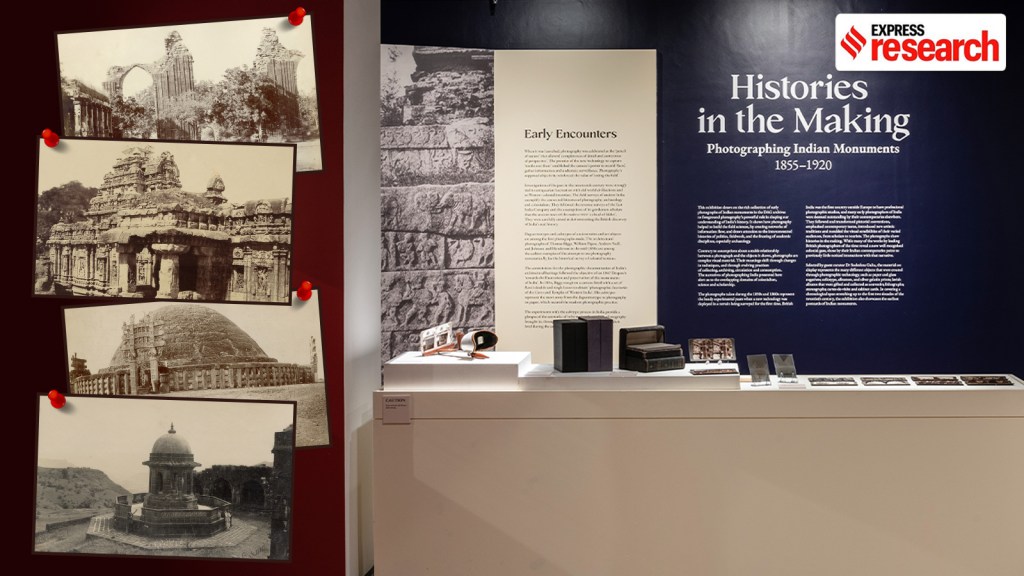 “I wanted to show the power of photography in creating histories,” says historian and archaeologist Sudeshna Guha, who has curated the exhibition. (DAG)
The camera shared a complex relationship with the Indian subcontinent. It arrived in the region within just a few months of its invention in Europe and at the very beginning was a device through which the outsider could capture, frame and inspect the historical and ethnographic terrain of the subcontinent. The recent exhibit ‘Histories in the Making: Photographing Indian monuments, 1855-1920’ by DAG, an art gallery in New Delhi, tells the story of how these earliest photographs of India were instrumental in writing the history of India.
“The year 1855 is not an arbitrary date,” explains Giles Tillotsan, senior Vice-President (Museum Exhibitions) at DAG, as he walks through the exhibit. “The photographs from the 1850s that you see here are among the earliest ones taken in India, but they are also the earliest photographs taken anywhere in the world,” he says. The Vitthala Temple at Hampi and the Chamundi Temple at Mysore taken in 1856 by William Henry Pigou, Andrew Neil’s photographs of the the temples at Beloor, and Thomas Biggs’ shots of the Chalukya Temples at Aihole and Pattadakal taken in 1855, are among the first images welcoming the visitor to the exhibition, curated under the section ‘Early Encounters’.

“I wanted to show the power of photography in creating histories,” says historian and archaeologist Sudeshna Guha, who has curated the exhibition. It must be remembered that early photography in India was focused on both people and monuments. While the former created the discipline of ethnography (anthropology), the latter gave birth to the field of archaeology in India. Being a scholar of archeology herself, Guha wished to focus on the connected histories of photography and archaeology for this exhibition.
 The exhibition by DAG tells the story of how these earliest photographs of India were instrumental in writing the history of India. (DAG)
In 1862, Sir Alexander Cunningham established a one-man Archaeology Department in the Government of India, which later became the Archaeological Survey of India (ASI) in 1871 with Cunningham as its first director-general. “In the beginning, the Archaeological Survey of India was a lot more ‘survey’ than ‘archaeology’,” says Tillotsan. Initially, Cunningham was mapping monuments, rather than carrying out digs, which happened much later in the early 20th century and led to the discovery of early historic sites such as Harappa and Mohenjo Daro. Photography was instrumental in the early archaeological process of surveying.
The early photographers surveying India
The camera, right from the moment of its invention, was seen to be of immense practical value to the colonisers. Historians Diva Gujral and Nathaniel Gaskell, in their co-authored book Photographing India (2018), note that photography was seen as the most plausible visual solution to the colonial aspiration towards orders and administration. “In England preparations were made as early as 1840 to send the camera to Bombay, where its primary role was to be used as an instrument in the assistance of the empire, a sequel invention to the telegraph or the railway line,” write Gujral and Gaskell. Similar developments were taking place in other parts of the colonised world as well. In North Africa, for instance, the camera had arrived by October 1839.
Guha in her edited book for DAG writes that the earliest corpus of photographs in India were taken in 1847 by a German lithographer called Frederick Fiebig. His shots of Calcutta’s topography collected in a Panorama of Calcutta in six parts followed a despatch from London in January of the same year. The despatch asked for a “general, comprehensive, uniform and effective plan of operations based on scientific principles” to fulfil the “great objective towards the illustration and preservation of monuments of India”. It started the official documentation of monuments and sites of pre-colonial India.
Given the camera’s role as a colonial apparatus in South Asia, the earliest photographers in the subcontinent were soldiers, administrators, civil servants and missionaries, who were chosen at random, and commissioned either by the British East India Company, the British government or the amateur photographic societies that had emerged in several parts of India by the mid-19th century.
One of the first such photographic societies was established in Bombay in October 1854. They commissioned Thomas Biggs, a military officer serving in the Bombay Artillery to obtain photographs of the caves and temples of Western India. Guha in her writing notes that although Biggs was called back to regimental duties within a year, “he produced more than a hundred paper negatives of Bijapur, Aihole, Pattadakal, Badami, Belgaum and other sites in Western India.” He displayed his photographs at the first exhibition of the Photographic Society of Bombay in January 1855.
 Thomas Biggs’ Plate LV. Purudkul, Nearer View of the Great Sivite Temple (The Virupaksha Temple, Pattadakal), 1855 (DAG archives)
Biggs was followed by William Pigou, a surgeon from the Bombay Medical Service. He too was a member of the Photographic Society of Bombay and photographed at Halebid, Hampi, Srirangapatna, and Mysore. Then there was Andrew Neil, best known for his photographs of Hampi.
Yet another pioneer in Indian photography was the firm Johnson and Henderson, established by William Johnson and William Henderson in the early 1850s. Both worked as clerks in the Bombay Civil Service, before they began experimenting with the camera. Between 1856 and 1858, their firm published a monthly series, ‘The Indian Amateur’s Photographic Album’, which showcased photos of both people and architecture of the Bombay presidency.
Following the experiments of the Photographic Society of Bombay, similar societies emerged in Calcutta and Madras. In Madras, one comes across the photographic brilliance of Linnaeus Tripe, who had joined the East India Company in 1838 and was part of the Madras Infantry. He began experimenting with photography in the early 1850s while he was on leave in England and made his first photographs of India upon returning to Bangalore in 1854. He began his work in Madras in 1857, photographing Srirangapata, Tiruchirapalli, Madurai, Pudukkottai and Tanjore. He also photographed the ruined Buddhist Stupa at Amaravati. In 1859, Tripe entered 50 of his photographs in the annual exhibition of the Madras Photographic Society where they were judged as being the “best in the exhibition”. “They illustrate admirably the architecture of the Hindoo Temples and places of Southern India,” the jury is known to have said, as cited by Gujral and Gaskell. Interestingly, in 1859, Tripe was barred by the British government from undertaking further photography-related work, questioning his ability to create photographs in line with the colonial agenda.
 Linnaeus Tripe (Wikimedia Commons)
“It must be noted that these amateur photographic societies were open to membership of both Indians and ladies, two sections of society considered to not be scientific in their temperament,” says Guha. “Photography in that sense was a great leveller,” she adds. Narayan Daji, for instance, was an important member of the Photographic Society of Bombay and won medals in their exhibitions. Several Indians were among the founding members of these societies as well, such as Vinayak Gangadhar Shastri, Ardaseer Cursetjee and Bhau Daji of Photographic Society of Bombay, and Rajendralal Mitra and Raja Ishwar Chandra Singh of Bengal. As Guha explains, while British photographers employed Indians in their service, the latter too had Europeans working for them. Lala Deen Dayal, for instance, had two Europeans working for him in his studio at Secunderabad.
The colonial bias of the early Indian photographs
“The problem with photography is the illusion of objectivity it tends to provide,” says Tillotsan, as he moves across to the next section of the exhibit. “The idea is that just because it’s a mechanical process, it does not matter who is behind the camera and there is no active interpretation involved in taking a photograph,” he says, adding that such an interpretation of the camera would be naive. In the case of the 19th century photographs, for instance, the imprint of the colonial gaze would be hard to ignore.
Tillotsan points to the photographs of the temples in Madurai taken by Tripe and published in the album, ‘Photographic Views in Madura’. “They may look innocent, until you read his inscriptions,” says Tillotsan. What Tripe did was placed the image in the context of the beneficence of British rule or against the horrors of the tyranny that had preceded the coming in of the British. He would, for instance, mention that a particular temple was previously in the kingdom of the ‘tyrant Tipu Sultan’, even though Tipu might have very little to do with the temple except perhaps being its patron. Yet another one of Tripe’s photos is that of the fort of Palakoddu which is captioned as ‘The anarchy which generally prevailed’ before the ‘Christian European Civilisation (made) the influences of her government manifest in their social, moral and political advancement’ (as cited by Guha in her book).
Then there is Felice Beato, an Italian-British photographer who arrived in Calcutta in February 1858, when the Uprising of 1857 had just come to an end. Hoping to make commercial gains through his photography, he set to document the Mutiny in cities such as Delhi, Lucknow, Kanpur and Agra. As Guha notes, the idea was to “memorialise the unfolding of events with a clear focus on British travails and victories.” There is, for instance, an image that Beato took of the China Bazar in Lucknow, which he captions as, ‘The place in which General Neil was killed in the China Bazar’, referring to the murder of the British military officer James George Smith Neill in September 1857.
 Felice Beato’s The Place in which General Neil was killed in the China Bazar (Lucknow), 1858 (DAG Archives)
Tillotsan speaks about the Beato’s most famous image, that of Sikandar Bagh in Lucknow where a mass slaughter had taken place during the Mutiny. “He finds a heap or bones from rotting corpses at one corner of the garden, and gets his assistants to spread them out in front of the building and takes a photograph of it,” narrates Tillotsan, explaining that it created the image of these people being killed then and there.
Beato’s speciality though, was the photographic panorama, which consisted of two or more overlapping photographs. His most famous panoramas are those of the topographies of Lucknow and Delhi. The most striking aspect about them is the absence of any people. While it would be far-fetched to believe that Delhi and Lucknow had no people at the time, it is true that a large number of the city’s population had been expelled following the Mutiny. What Beato’s skillfully taken panoramas did was create the impression of a purged city, or a city emptied of its people.
 Felice Beato’s General View of Hoseinabad (Hussainabad, Lucknow), 1858 (DAG Archives)
The question arises that how were these photographs being used to create the history of India. To begin with, most of them were used in publications. Among the DAG exhibits are a couple of magnificent publications on Indian monuments by James Fergusson, the Scottish indigo planter, who later turned into an architectural historian. As Tillotsan notes, he was the first art historian of India in the modern sense. Yet, when he wrote the history of Indian and Eastern architecture which was published in 1876, he was in London. He had in fact left India decades ago. He managed to write the history of Indian architecture through a collection of 3000 photographs. Photography, as both Guha and Tillotsan note, could compress millions of temples and other monuments in India into something that can be spread out on one’s carpet.
Guha in her book underscores that the reduction in the size of the photograph from the 1860s, “enhanced the value of photographs as currencies of information.” Henceforth, they were collected with much enthusiasm for making encyclopaedic repositories. The one at the India Office in London, for instance, was established in 1869, and continues to be a key reference point for India’s historical domain.
Apart from archaeology and history, the early photographers of India were also creating disciplines. They were, for instance, mapping out the heritage and tourist map of India. A key name in this regard is that of Samuel Bourne, known to be one of the most successful photographers of the 19th century. Bourne lived in India for a brief period in the 1860s, and photographed extensively across the country. He also established a photographic studio called Bourne and Shepherd which closed down only as recently as 2016. Unlike the previous photographers who were keenly capturing the monuments of India, Bourne made a name for photographing exquisite landscape. He is best known for his picturesque shots of the Himalayas and Kashmir. Eventually, he published a catalogue with his image titles, and people visiting India started ordering his images as souvenirs to take back home.
 Samuel Bourne’s A view on the Dal canal in Kashmir. 1860 (DAG Archives)
Bourne’s photographs of the scenic beauty of India gained such popularity that Indian photographers were quick to jump into the fray. Lala Deen Dayal, for instance, was especially successful in this regard. The DAG exhibit dedicated an entire wall to Dayal who photographed extensively from the 1870s in Jaipur, Shimla, Sanchi, and more.
Guha in her book writes that “throughout the nineteenth century, Indian photographers drew upon the picturesque for creating urban views.” A large number of photographs of Banaras through its ghats, for instance, came to represent it as ‘the city of ghats’.
“Deen Dayal’s albums could fetch anything from Rs 50 to Rs 200, which was a lot of money at that time,” says Guha. “These were often gifted as souvenirs. For example, when the Prince of Wales came to India, he was given a few,” she adds, saying “these were probably the first tourist souvenirs of the country.”
 Babu Jageshwar Prasad’s Munikarnika Ghat (Varanasi). 1880s (DAG Archives)
Yet another Indian name that emerged in photography’s heyday was that of Narayan Vinayak Virkar, whose photographs are striking in that they show nationalist sentiments. Virkar worked as an X-ray photographer before moving to photographing some of the early nationalist leaders, such as Bal Gangadhar Tilak. He also photographed monuments of heroic importance in the Bombay presidency. “He has been resurrected as a nationalist photographer in recent years,” says Guha. Virkar was best known for his images of the Jallianwala Bagh in its immediate aftermath. At the DAG exhibit though, it is his photograph of Shivaji’s fort at Raigad with the latter’s samadhi that is put on display. “It was a deliberate act of the veneration of a nationalist hero,” says Tillotsan.
 Narayan Vinayak Virkar’s Samathi (Samadhi), Raigad Fort. 1919 (DAG Acrhives)
The DAG exhibition takes one on a journey through the complicated terrain that was traversed by the camera in the early years of its presence in India. “My objective was to tell people that photographs are complex things with a social life of their own,” says Guha.

Adrija Roychowdhury leads the research section at Indianexpress.com. She writes long features on his... Read More
 Share


