To stitch a coalition and form a government in Jammu and Kashmir, which is staring at a fractured mandate, is a difficult proposition for the Peoples Democratic Party, the largest group in the assembly, which has lapsed into silence, aware it has to take a decision where all “the options available have adverse politically implications”. The easiest way to attain a numerical majority is to tie up with the BJP but this option has sharply divided the PDP.
Citing the “fluid political situation”, PDP leaders are declining comment before the party takes an official decision but views on a possible alliance with the BJP are sharp and contentious. In fact, younger leaders within the party are especially worried about the fallout on future electoral prospects if the PDP were to form an alliance with the BJP.

“There will be nothing left for us politically if we join the BJP. It will mean that we go against the very reason whypeople came out in such large numbers and voted for us, making us the single largest party. It will be an arrangement that will only be advantage BJP,’’ a PDP leader told The Indian Express.
“The verdict is clear. The BJP represents everything that we oppose and they detest everything that we believe in. There isn’t a meeting ground.” The leader said the PDP will lose its address in the next elections if it aligns with the BJP. “There are elected members within the PDP who may even resign if the leadership goes ahead with such an arrangement,’’ he said, adding that he doesn’t think Mufti Mohammad Sayeed will go with the BJP.
“Mufti sahib knows that for four decades of his political career, he couldn’t win his own seat in Kashmir because he was with the Congress. An alliance with the BJP will take us all to a worse political situation than that period.” Explaining the reason for his opposition to an alliance with the BJP, the leader pointed out that Mufti’s political journey began from the Congress when “this national party was seen as an outsider and enemy of Kashmir’s special status”.
“He became Home minister of India but had no political standing at home here. He understood it and that’s why he left national politics and launched a regional party with an agenda representing our collective aspirations. Why would he make PDP commit political suicide at the fag end of his long political career,’’ he said.
“For PDP, it isn’t about being in power for the next six years alone. We reached 28 seats in 15 years, growing in every election since 2002. It will be politically naive to go with the BJP and rock our boat”.
Story continues below this ad
But there are several other PDP leaders who think that the party must go with the BJP to form a government and they have their own reasons. “It is the only pragmatic way to come out successfully from this situation. We didn’t get a majority, so it is the voters who have thrown us into such an alliance. We may have different political agendas but a PDP-BJP alliance will lead to a very stable government. The Central government will also be an alliance partner which will ensure generous funding for the state,’’ a PDP leader said.
He said there is no chance to form a government with the Congress because “the smaller parties and independents needed to reach the majority number are already with the BJP”. “Then what type of a government will you give if its survival is dependent on a single member’s mood? Even if we manage to form a government with Congress and four independents, it will be a very weak government. The Centre will be at your throat, choking you financially. We will have a strong BJP opposition in Jammu while the NC will make life difficult for us in the Valley,” the leader said. He said staying in opposition is not a pragmatic political decision because “nobody knows what sort of a political situation awaits us in the next election”.
Apart from the BJP and Congress, the PDP has an opportunity to stitch an alliance with arch rival National Conference which has 15 members in the House and has made an offer. J&K’s caretaker Chief Minister Omar Abdullah told The Indian Express that his offer to have his party’s alliance with the PDP to form the next government is a “serious proposition”.
He said the two parties may have differences because they are rivals but there are bigger reasons to come together in an alliance. “We have much more in common between us that either one of us has with any of the national parties — BJP and Congress. We have a similar stance on removal of AFSPA. We both are on the same page on the issue of safeguarding the special status of the state. PDP’s self-rule demand is very similar to our autonomy demand. It is autonomy plus as it provides an economic aspect to the political autonomy that we seek,’’ he said.
Story continues below this ad
“Mufti sahib has been promising big things to Kashmiris. He has said that if he gets the numbers, he would help solve the Kashmir issue. We are ready to join them in an alliance if they wish. Now is the time to show that intent,” Abdullah said.
He said it would not be possible to change anything on the ground if the PDP is in an alliance with a national party. “I know that because we were in an alliance with one national party. We could move a bit on AFSPA in these six years,’’ he said. “If Mufti sahib wants, we can do that together”.
Though Abdullah didn’t completely rule out his party’s alliance with BJP, sources in NC call it an “unlikely proposition”. The sources said that BJP wouldn’t agree to less than a four-year long chief ministership for the party if it goes with NC. “The fallout of this alliance would be suicidal politically. But if we take that risk, we will have to agree to have a BJP chief minister for at least four years,’’ the source said.
Though the PDP doesn’t seem to take Abdullah’s offer seriously — it feels the party will cede political space to NC — it is officially silent on the offer because “a blanket no” will show them in poor light within their own constituency in Kashmir. “We all know Omar Abdullah only wants to corner us. A PDP-NC alliance is like incest. After all, we are siblings, so how can the two marry and form a coalition,’’ a PDP leader said.
Story continues below this ad
Sajjad Lone, whose Peoples Conference has two seats, too isn’t ready to say which coalition is he ready to support. But he said his party would like to sit in the opposition if they are approached by a PDP-Congress alliance. On joining an alliance where the BJP is involved, Lone said his party is meeting in a few days to take a call. But he questioned the “untouchability” of the BJP in Kashmir, saying this line of thinking is based on stale arguments.
“What is difference between Congress and BJP when it comes to us? Those who oppose BJP say they have killed Muslims in Gujarat. What about those who have been killed here in Kashmir? Isn’t Congress responsible for that? Aren’t Mufti sahib and Farooq Abdullah responsible for that?’’ Lone said.
“People are not interested in ideologies. They are interested in jobs and bread and butter issues. If you go to them with ideology, they won’t reward you with votes. They will vote for you, if you promise them jobs,” he said. “Ideology isn’t an issue during elections. I met Modi before elections and won two seats, more than what my father ever won.”


 8 min read


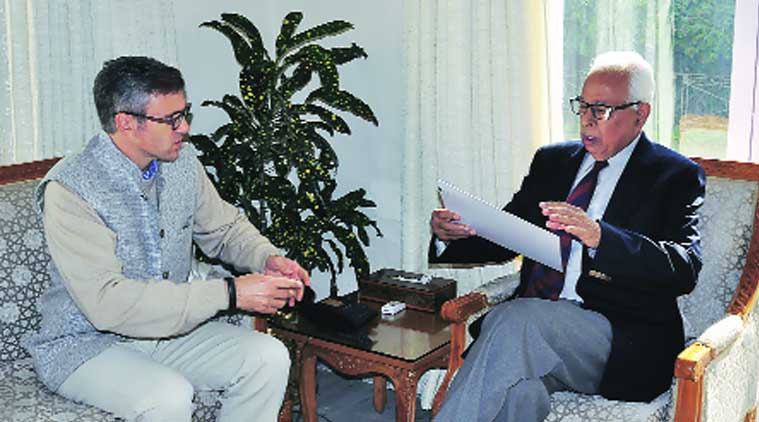 Omar submits his resignation to J&K Governor N N Vohra in Jammu on Wednesday. (Source: Express photo by Shuaib Masoodi)