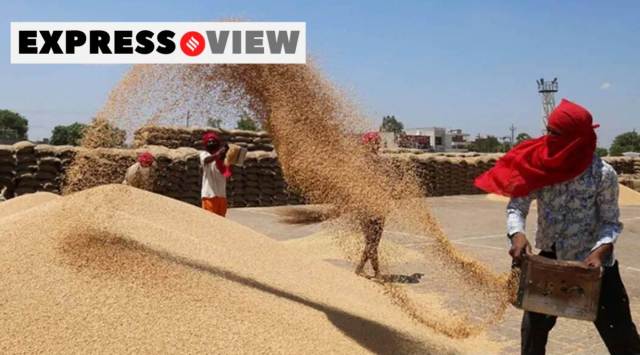

Last July, the Narendra Modi government imposed stockholding limits on pulses, going against the farm reform laws it had enacted only in September 2020 and before their formal repeal in November 2021. That move, and the latest decision banning wheat exports, constitutes not just a knee-jerk reaction to inflationary pressures. Of more concern is their long-term impact on the farm trade and policy credibility. Building export markets, establishing warehousing infrastructure and creating supply chains take both time and money. Investments in these — whose necessity for Indian farmers and consumers alike is not in doubt — are predicated on a stable policy framework. Which agri-business will have the confidence to put up large processing and storage facilities or search for new buyers for Indian produce if the government does abrupt policy about-turns — by telling them they cannot stock more than 200 tonnes of pulses or contract fresh exports?
The flip-flops in government actions is evident from the department of commerce, on May 12, issuing a statement about the Centre sending trade delegations to nine countries “for exploring possibilities of boosting wheat exports from India” and, a day later, prohibiting shipments “with immediate effect”. True, the country’s wheat production has fallen due to the sudden spike in temperatures from mid-March, resulting in premature ripening and shrivelling of the grains. But this was known by early April, when most ground reports pointed to farmers harvesting 15-20 per cent less yields compared to last year. How was the Minister of Commerce Piyush Goyal, then, talking about Indian farmers “feeding the world” and projecting exports of 10-15 million tonnes (mt) in 2022-23, breaking last year’s record 7 mt, even in mid-April? This was indicative of either poor crop intelligence — inability to gauge yield losses from the heatwave — or refusal to admit that production has been significantly lower than the “record” 111.32 mt estimate made in mid-February.


This column first appeared in the print edition on May 16, 2022, under the title ‘Caught with chaff’.


