

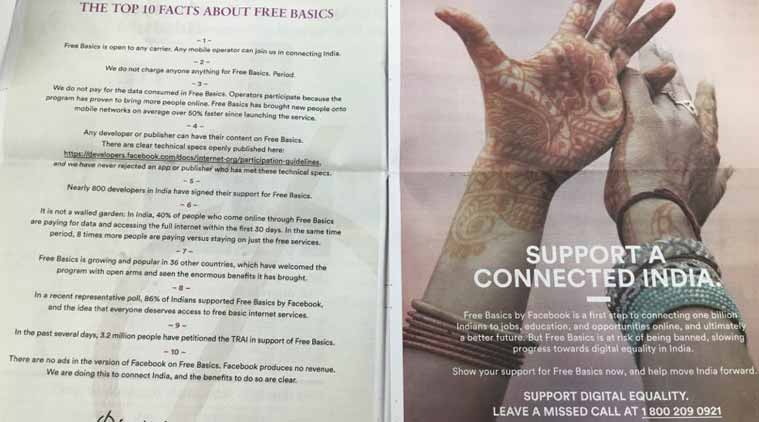
This summer saw a full-throated battle over a notional toss-up between two goals: Network neutrality — the principle that internet service providers must treat all data on their networks equally — and access for those who cannot afford it, a battle that net neutrality advocates appeared to have fortunately won. But Facebook, having changed the nomenclature of its platform from Internet.org to Free Basics, has made a renewed push in recent weeks to persuade the telecom regulator, Trai, to frame net neutrality rules in a way that would allow mobile carriers to exempt certain applications from counting towards data usage. It has launched a massive publicity campaign that appeals to connected Indians to petition Trai to save Free Basics — arguing that the platform would bring those people online who find the cost of using mobile data prohibitively expensive.
In a country where the growth of fixed internet infrastructure has stalled and hundreds of millions remain offline, this is a persuasive argument. That a lack of internet access widens inequality and limits opportunity is an increasingly accepted notion, and a scheme that purports to narrow, if not bridge, the digital divide is likely to resonate. Yet, creating gatekeeping systems — which a programme like Facebook’s does, even if it claims all developers can be part of it as long as they meet certain criteria — has material consequences for how people perceive and experience the internet. The “free” in Free Basics, for instance, is subject entirely to Facebook’s, and its mobile operator partners’, discretion.


