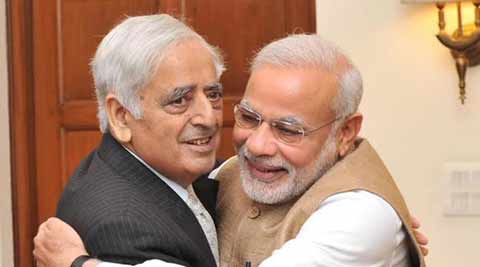

In Jammu and Kashmir, the unimaginable is here — “soft separatist” PDP and “Hindu nationalist” BJP, two extremes of the mainstream ideological spectrum, have come together to form government. Sunday’s swearing-in showcased remarkable frames of political distance travelled, and of orthodoxies forsaken or at least shelved. BJP ministers pledged fealty to the J&K constitution, once the object of such ardent agitation by the party. People’s Conference leader Sajjad Gani Lone was inducted into the council of ministers, tracing an arc from separatism to participation in the electoral process to holding stakes in government. Whatever the calculations of political profit and loss by each party, this is a moment larger than them. It is about the democratic opportunity that contributes to the making of, and is itself made up of, such a coalition of extremes.
An “agenda for alliance” has been hammered out, allowing both the PDP and BJP to claim victories. On Article 370, the BJP has ceded ground, with both parties implicitly agreeing to status quo while recognising the “different positions” of each on the “constitutional status of J&K”. On the Armed Forces (Special Powers) Act, it is the PDP that has climbed down, with the coalition government only agreeing to “examine the need for denotifying Disturbed Areas”. On including the Hurriyat in the dialogue to settle the “outstanding issues of J&K”, the agenda takes shelter in ambiguity. Recalling Atal Bihari Vajpayee’s policy of engaging “all political groups, including the Hurriyat”, it says the coalition would follow the same principles, speak to “all internal stakeholders”.


