
Opinion Step up, strike down
On Section 377, SC has a deficit to atone for. And the constitutional promise of equality to live up to.
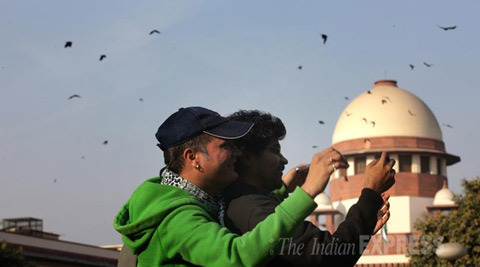

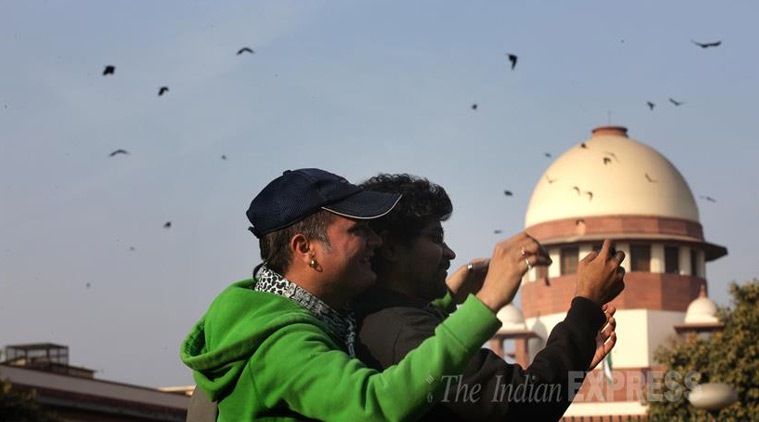 Members of the Gay community take selfies during the Supreme Court ruling on the Article 377 in the capital New Delhi. (Source: Express Photo by Neeraj Priyadarshi)
The Supreme Court has referred the curative petition on Section 377 to a five-judge Constitution bench, preparing the ground for closure on the question of the legality of Section 377 of the Indian Penal Code, which criminalises sex “against the order of nature” and has been at issue since 2001. The public expectations of a make-or-break ruling on Tuesday were unrealistic, and this is a welcome outcome. The referral acknowledges that serious constitutional questions are at stake. Besides, rectification by a Constitution bench would be authoritative, deciding the issue for the foreseeable future. This was precisely why the eight petitioners, led by Naz Foundation, had sought such a referral.
However, it is possible for the bench to uphold Section 377, and that would unfortunately be as durable as a strike-down. As it deliberates, it is to be hoped that the

court will be conscious that while it is the defender of the law, its fundamental duty is to the people and the ideals of democracy. And it has a deficit to atone for. In 2013, the Supreme Court had overturned the 2009 ruling of the Delhi High Court, which had found Section 377 in breach of the fundamental right to equality. In doing so, the apex court had disappointed a nation which believed that it had finally shaken itself free of a colonially imposed morality of Victorian vintage, decades after the UK had cast it off. Further, the bench which re-criminalised homosexuality had passed the buck to the legislatures, calling upon them to debate the issue. However, in democracies the world over,
the courts have been known to be reliable custodians of minority rights and interests, more so than legislatures. This is only to be expected. Issues which affect significant sections of the population are more likely to be raised in legislatures by members whom they have sent to the House. Conversely, smaller sections of society may find it expedient to petition the courts, which are persuaded by the validity of their pleas rather than their numbers.
Besides, minority rights frequently involve questions of law, alongside political issues. Questions of equality versus discrimination have proved to be decisive in many matters, most notably in issues of race, gender, colour and ability, and will decide the constitutionality of Section 377 later. The law is not immutable but must be continually re-interpreted to keep it up to date with society and its evolving needs. Much of the public debate on Section 377 suggests that the nation would prefer to jettison the archaic law. As the legal matter heads for closure, it is hoped that the apex court will support the aspirations of the people whose interests it guards.
 Share
Share


