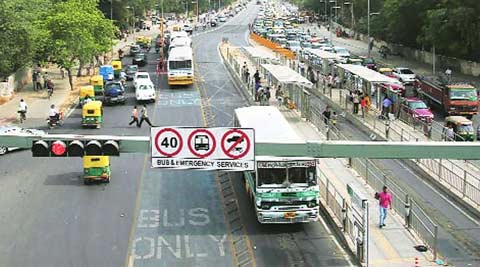

The Delhi cabinet has finally given an in-principle approval to dismantle the city’s bus rapid transit (BRT) corridor. First implemented in 2008 ahead of the 2010 Commonwealth Games, the BRT was envisaged as a way to incentivise the use of public transport, buses in particular, and also as a way to improve air quality in the long term. It drew inspiration from a sheaf of similar — and acclaimed — mass urban mobility projects in developing cities like Bogota, Colombia and Curitiba, Brazil. Yet, from the beginning, it faced several operational challenges and suffered from design errors, such as the placement of the bus lane. Heavy traffic jams had a devastating impact on public opinion, and after the initial criticism, the embattled BRT was not extended beyond its initial 5.8 km pilot length, which minimised its benefits.
[related-post]


It is, therefore, imperative for the government to find a way to discourage people from using private transport as the city continues to grow and for this it must consider a range of options, from congestion taxes to a retooled — and rebranded — BRT. Ahmedabad’s BRT system, called Janmarg, eschewed the limited pilot model in favour of a full-scale corridor and is an unqualified success. Despite the Commonwealth Games-occasioned facelift, Delhi buses remain overcrowded, inconvenient and uncomfortable. Bus frequency will have to be increased to reap the benefits of a dedicated lane and more will have to be done to link the bus service to the metro. Most importantly, all these measures must come together into a coherent and interlinked urban transportation strategy.


