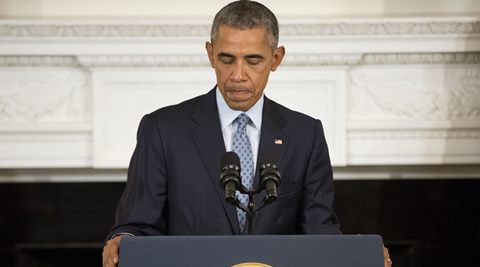

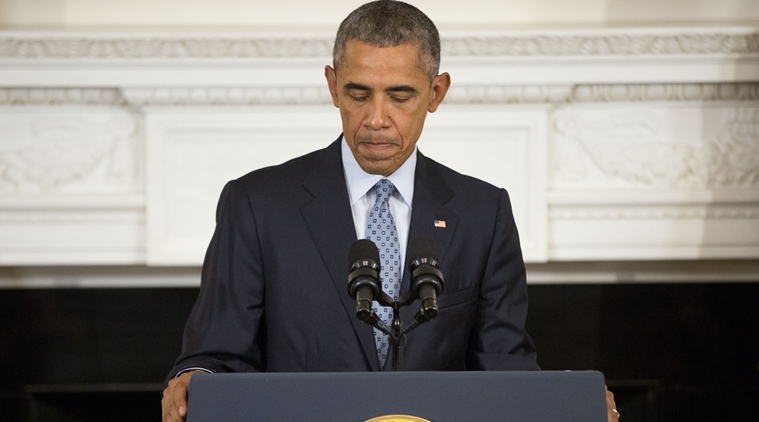
Last week, Barack Obama condoled the United States for the 15th time during his seven years as president after another gunman opened fire at a group of civilians, this time in a community college in Oregon, killing at least nine people. When he took to the lectern, the president looked visibly frustrated, issuing a direct call to the American people to finally push for gun control laws. It was an impassioned attempt to puncture a cycle of tragedy and response he characterised as “routine”, where the shock and outrage after every such massacre prompts a call to action that is shouted down by gun rights advocates almost immediately after it is issued. Obama acknowledged that he would be accused of politicising the incident, that his critics would dismiss his proposed, and modest, policy changes as leaving ordinary Americans more insecure and less able to defend themselves.
This oddly rich twilight of his presidency has seen a more combative Obama than the one elected on a platform of hope and change in 2008. It was this Obama who pre-empted criticism that he was playing politics by arguing that such incidents — by some accounts, this was the 994th mass shooting in 1,004 days — should be politicised, especially when a common-sense legislative solution is within reach and has been repeatedly stalled by the allegedly implacable grip exercised by the gun lobby over a gridlocked and polarised Congress. In his words of anger and despair, he spared no one, not even himself. “This is a political choice that we make to allow this to happen every few months in America,” he said. “We collectively are answerable to those families who lose their loved ones because of our inaction.”


