
Opinion Making peace
There is light at the end of the tunnel for India’s oldest insurgency. It will require more work to make it a new dawn.
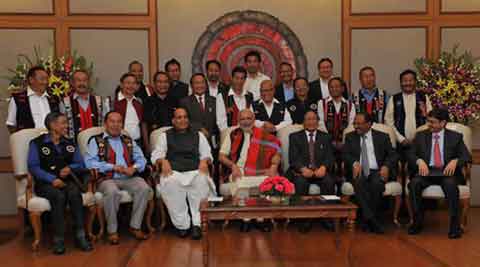


 Prime Minister Narendra Modi with Union Home Minister Rajnath Singh, NSCN (IM) General Secretary, Thuingaleng Muivah, NSA, Ajit Doval and others at the signing ceremony of historic peace accord between Government of India & NSCN, in New Delhi on Monday. (Source: PTI)
The Framework Agreement signed by the government of India and the National Socialist Council of Nagaland’s Thuingaleng Muivah and Isak Chisi Swu-led faction offers an historic opportunity to bring to an end India’s oldest insurgency. Negotiated in the greatest secrecy over the past six months by Prime Minister Narendra Modi’s envoy, R.N. Ravi, the framework agreement promises recognition of the cultural identity of Naga tribes, without engaging in a redrawing of state frontiers that could have set off violence in Manipur.
[related-post]

There’s little doubt the accord will be assailed by rival Naga insurgent groups, like the S.S. Khaplang-led faction, which recently withdrew from a ceasefire with India. New Delhi and its Naga partners hope months of patient consensus-building, involving Nagaland’s powerful civil society groups and tribal organisations, will prove adequate to withstand the inevitable onslaught. In the long term, figures like Muivah should find political space within Nagaland — initiating a process of genuine democratisation. For Modi, this is a personal vindication: Having promised to address a problem whose resolution eluded so many of his predecessors, he has delivered on his word.
Light at the end of the tunnel, though, isn’t quite the same thing as a new dawn. It is important to recognise that the framework agreement is the former. For one, the Northeast’s recent history is littered with agreements with ethnic militia that have failed to yield peace. For every successful agreement, like the Mizoram Accord of 1986, there are several others, from Assam to Tripura, that failed to put an end to bloodshed. The reasons vary. Enriched by income from extortion, many of the Northeast’s insurgent groups have developed a vested interest in the status quo. Then, deals with one group have often set off new problems with embedded minorities in their territories, or created new categories of the disenfranchised. The Indian state itself, having arrived at a negotiated deal, made no real effort to put in place a mechanism for conflict management, let alone real governance.
Yet, there is real reason for hope this time round — and not because of a piece of paper. Naga society itself has evolved, developing real equities in India. Thousands of young people in the state now study and work elsewhere. Their concerns centre around fighting for equity in a giant nation, and are not confined to the ethnic-regional agendas that drove the political lives of their grandparents. Few would trade the opportunities on offer for the prospect of independence, devoted as they might be to their linguistic and cultural heritage. Indeed, India is witnessing the birth of a diasporic Northeast identity — forged, sadly, in the crucible of discrimination many face in the cities that are now their homes. Peacemaking is hard business, but every life Nagaland’s lost decades have claimed is a reason for all Indians to make the effort.
 Share
Share


