
Opinion In the hot seat
Amit Shah will be in for testing times in his second term as BJP president
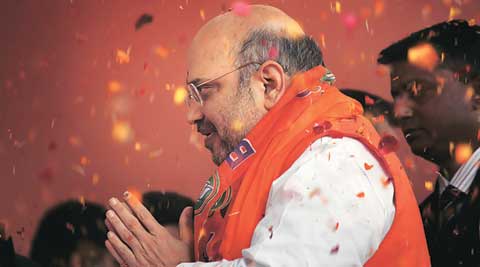 At the BJP headquarters, Sunday. (Express Photo by Oinam Anand)

 Amit Shah’s second term as BJP president . (Express Photo by Oinam Anand)
Even as the Modi government completes a third of its term in office today, Amit Shah begins a new inning as the BJP national president. The party heads for elections in Assam, West Bengal, Tamil Nadu, Kerala and Puduchery assemblies in the next few months, after suffering humiliating defeats in Delhi and Bihar. The BJP had initially sensed a victory in Bihar, only to be outsmarted in strategy and campaign by Lalu Prasad and Nitish Kumar. Shah’s skills as an organiser and strategist will be tested in the poll-bound states, especially in Assam where the BJP has seen spectacular growth and fancies its chances. Success in these elections will also influence the outcome in the politically crucial state of Uttar Pradesh, which votes in 2017. Shah’s ascent to power coincided with Narendra’s Modi’s rise to power.
His election management was credited as one of the reasons for the BJP’s unprecedented success in the 2014 general election. Wins in Maharashtra and Haryana followed and Shah grew in influence and stature. The BJP benefited from the momentum derived from the general election outcome and anti-incumbency in these states. Delhi marked the tapering of the upward curve. The success in Jammu and Kashmir apart, the party and the government have not had much to celebrate in recent times. The economic slowdown, agrarian distress and controversies triggered by fringe groups and second-rung leaders have overshadowed the politics of hope Modi wishes to ride. With Modi’s leadership unchallenged, Shah could become the fall guy if the party falters. The evident discontent among party seniors towards his leadership could spread in the event of more electoral failures. In his last term, Shah talked about a Congress-mukt Bharat and started an aggressive campaign to make the BJP the largest cadre party in the world. The party claims membership has risen from 30 million to 110 million under Shah’s watch. But can he transform this large flock into a disciplined political force that can win elections? And, can he do so without falling back on emotive slogans or divisive campaigns? The party’s attempts to broadbase its cadre and build a unified Hindu vote-bank threaten to unravel in the face of India’s social and regional diversity. The ideological moorings of the Sangh Parivar are also at variance with the aspirations of the youth who do not wish to be tied down to tradition at the risk of losing out the gains from a modern economy. While Shah’s long-term challenge is to enable the BJP’s transition to a party of governance, his immediate task is to craft state-specific campaigns for the assembly polls. A national political template or an overtly centralised campaign may not necessarily work in an assembly election, as Bihar showed.

 Share
Share


