When you look into the void, the world takes you seriously as a space power.
October 1, 2015 12:01 AM IST
First published on: Oct 1, 2015 at 12:01 AM IST
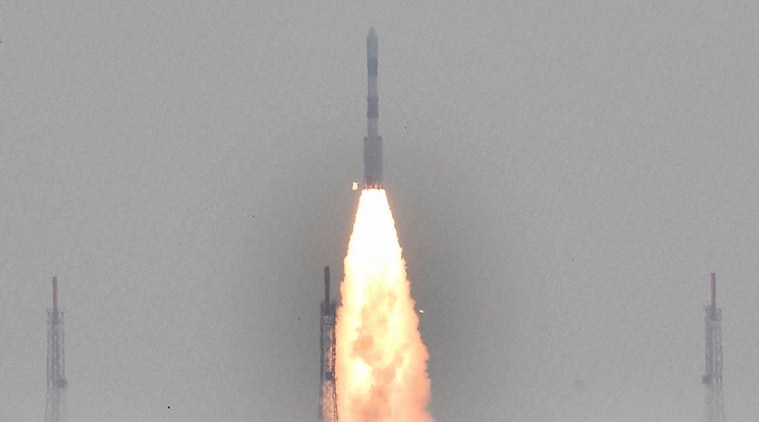
Indian Space Research Organisation (ISRO)’s PSLV C 30 carrying India’s Multi Wavelength Space Observatory ASTROSAT, lifts off from Satish Dhawan Space Center in Sriharikota on Monday. (Source: PTI)
Isro’s Astrosat has been hurled into space with a cloud of Canadian, Indonesian and American satellites by the organisation’s workhorse polar launch vehicle, which has established a track record for cheap but reliable launches. An astronomy satellite operating across multiple frequency bands, Astrosat invites comparison with the Hubble space telescope, which has been out there for 25 years and whose data established, for instance, the speed at which the universe is expanding. Though furbished on a smaller scale, Astrosat bears instruments looking at the cosmos in five frequency bands: the near and far ultraviolet, soft and hard X-rays, and the visible spectrum.
Having staked out a position in the commercial launch vehicle market, the Indian space science establishment is now intent on establishing a reputation for disinterested research. The Chandrayaan project was instrumental in confirming the presence of water on the lunar surface. The Mars Orbiter Mission, which completed a year in orbit last week, is an expression of India’s interest in planetary science. Even Aryabhata I, India’s first vehicle in space in 1975, was scientifically inclined and had gathered data in the X-ray spectrum. Astrosat marks a significant step in the direction set at the beginning of the satellite programme — it is the first multi-band observatory in space, whose data will be made available to the research community.
You’ve Read Your Free Stories For Now
Sign up and keep reading more stories that matter to you.
After rapidly establishing its marketworthiness with launch vehicles and taking the indigenous cryogenic engine to maturity, the Indian space establishment set a scorching pace during the declining years of the UPA government and the change of guard to the Modi government, with missions to the moon and Mars. This heralds a new era in which India will cease to be regarded only as a provider of scientific talent and cheap launch services to the world’s space efforts, to become a scientific partner and a contributor to humanity’s understanding of the universe.