
Opinion Passing of a reformer
The death of Ayatollah Rafsanjani has implications for reforms in Iran and India’s prospects there .
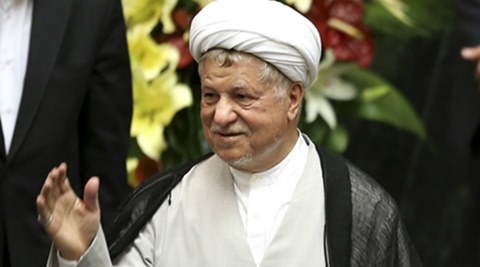 FILE -- In this Aug. 4, 2013 file photo, Iranian President Hassan Rouhani., right, and former President Akbar Hashemi Rafsanjani, wave, as they arrive for Rouhani's swearing-in ceremony at the parliament, in Tehran, Iran. Iranian state media said Sunday, Jan. 8, 2017 that Rafsanjani has died at age 82 after having been hospitalized because of a heart condition. Rafsanjani, who served as president from 1989 to 1997, was a leading politician who often played kingmaker in the country's turbulent politics. He supported President Rouhani. (AP Photo/Ebrahim Noroozi, File)

The passing of Ayatollah Ali Akbar Hashemi Rafsanjani, former president of Iran, and patron-in-chief of its political reformers, comes as a moment of decision looms for the Islamic republic. Faced with president-elect Donald Trump’s threats to roll back the process of normalisation that kicked in with the nuclear deal negotiated last year, Iranian hardliners, hostile to the agreement, have been preparing to reassert their influence. As head of the Expediency Council, a body which is intended to resolve disputes between the elected parliament and the Guardian Council of clerical jurists, and the Assembly of Experts, the clerical body that selects Iran’s supreme leader, Rafsanjani was uniquely placed to resist the hardline campaign, and assert the importance of pragmatism. This pragmatism would have been critical in addressing tensions with Iran’s regional neighbours, and the West. His presence will be missed even more, though, in an Iran divided bitterly on its foundational values.
Inside Iran, politics is fundamentally divided over the role of republicanism in the Islamic republic. In 2014, Rafsanjani revealed his arch-rival, Ayatollah Mohammad-Taghi Misbah Yazdi, éminence grise of the religious right, had rejected joining in the broad front which fought the Shah of Iran, on the grounds that it included the Left. In turn, Yazdi alleged Rafsanjani had funded the Mujahideen-e-Khalq, a cult of revolutionary terror that was outlawed after the Iranian revolution. The discussion was a thinly-veiled debate over whether the 1979 revolution was pluralist or not — with Rafsanjani leading the republican cause. The debate has direct implications for a welter of issues: Women’s rights, freedom of speech, political pluralism. In essence, Rafsanjani believed the revolution had to be reformed to survive; his rivals believed it had to impose its core values harder.

For India, the years ahead could prove exceedingly challenging. Prime Minister Narendra Modi, realising that Iran holds the keys to India’s trade with Afghanistan, central Asia and near-Europe, has invested heavily in the Chabahar project, hoping to Indian industry through the port with a network of roads and railways leading north and west. These plans, however, could hit a brick wall if President-elect Trump’s election-time threats against Iran are realised in coming months. It will take a deft hand at the helm — and more than a little luck — to ensure India’s interests can been steered through the treacherous currents sweeping through the Persian Gulf.
 Share
Share


