
Opinion Don’t neglect the domestic worker
Amidst the pandemic, the economic and healthcare needs of the domestic worker has gone unnoticed
 Nearly a third of the applications were rejected due to duplications, as more than one family member of a patient had applied for the compensation. (Representational/File)
Written by Shruti Batra, Nandita Bhatt and Nitya Sriram
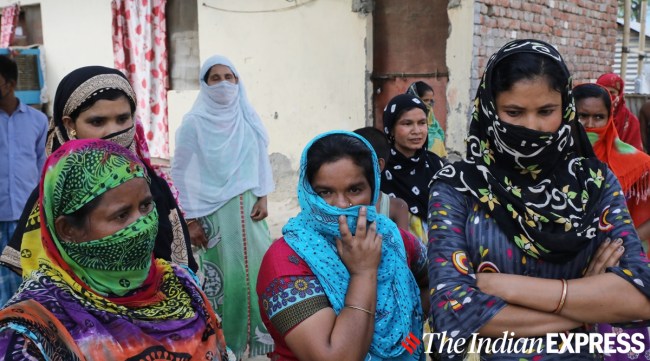
“Didi, hum toh apni kamayi se ghar chalate the, ab lag raha hai bheek maang rahe hain (Sister, we used to run the house with our income. But now it feels like we’ve been reduced to begging),” says a domestic worker left stranded in the second wave after losing her job with little to no savings and an exponential increase in the risk of contracting Covid-19. A fresh tide of fear gripped communities of women in the informal sector, including domestic workers (DWs), around India as states returned to lockdown conditions. The near-complete collapse of the healthcare system and shortage of oxygen, ICU equipment, plasma and even crematoria, have consumed everyone’s attention. The needs and rights of women in the informal sector are left unrecognised and uncared for.

The lockdown triggered severe economic distress among DWs, who have still not fully recovered from the impact of last year. DWs from areas of Delhi where Jagori works despair at the lack of money to pay rent or even buy ration. “We are worried that they will need to borrow more money this time but how many women have relatives who will keep lending them money? DWs will need to borrow from private money lenders and interest rates could be much higher this time, adding to the burden of existing loans,” notes the Covid Relief Team of the organisation.
Social security measures for DWs are extremely critical at this moment. Under the Unorganised Workers Social Security Act (UWSSA) 2008, state governments are mandated to establish welfare boards, register all workers (including DWs) and formulate/notify social security schemes. However, despite a 2017 Supreme Court direction, the Delhi government is yet to constitute a welfare board. The Code on Social Security 2020 introduced by the Centre has also excluded DWs from its ambit. As a result, DWs remain outside the purview of government welfare schemes.
Paucity of data is often cited as an excuse for non-registration of DWs. However, records existing in mechanisms such as police verification forms, resident welfare associations, union memberships or letters from placement agencies/ civil society organisations have thus far remained unutilised.
The Delhi government has announced relief schemes, including free ration to ration card holders, e-coupons for non-ration cardholders and schemes for families who lost someone due to Covid-19. Relief announcements have also been made for construction workers and auto rickshaw and taxi drivers. The Haryana government is offering medical aid and insurance relief for Covid-19 affected families living below the poverty line. Specific measures to support DWs, however, are conspicuously absent.
While markets have begun to open and construction will pick up again, a lot of private homes are not likely to call DWs back to work as quickly. This, at a time when hunger is a major challenge. “There are no state-run community kitchens and tiffin centres are beyond reach. Ration shops in communities are shut. The women infected with Covid have no strength to cook,” says Anita Kapoor, founder of Shaheri Mahila Kamgar Union.
DWs shared their lack of access to maternal, prenatal and postnatal health services. Trapped in their homes, some also reported an increased risk of domestic violence.
For several DWs, the situation is different from last year. There have been no bans/circulars by Resident Welfare Associations (RWAs) in Delhi-NCR restricting DWs from going to work. In fact, the State Disaster Management Authority, Government of Haryana has released an order allowing DWs and other caregivers to work during the lockdown period.
But all this hasn’t made the situation better for a lot of them. Anecdotal evidence collected by MFF reveals that some DWs are being called to work in homes with Covid positive patients. Parallelly, DWs working with MFF have shared that stigma and discrimination are more pronounced than the last time. The term “Covid Super Spreaders” is being used to describe DWs, prompting employers to withdraw support at this time. “In Gurgaon, some families are pushing part-time DWs to work full-time,” says Elizabeth Khumallambam, founder of Community for Social Change and Development, adding that those who refuse are dismissed from their jobs.
The pressure on DWs to get tested has intensified as employers fear infection but DWs’ access to Covid-19 testing facilities is severely restricted. Fear of discrimination and job loss are only part of the reason. Affordability and access to far-off testing centres are bigger concerns. Even at capped rates, tests are a luxury.
“Aath sau rupay lagta hai test karvane ka. Humari madam ne kaha hum sabko test karvana padega. Test karvayenge toh khaayaenge kya? (It costs Rs 800 to get tested. My employer has made it mandatory for me and my family. If we spend money on tests, how will we eat?)” says a DW from Gurgaon.
Getting vaccinations requires an online registration and most DWs either don’t have smartphones or find the online process complicated. Drive-through vaccinations in malls or parking lots are not spaces they frequent.
The need for relief and support specific to DWs can no longer be sidelined. Vaccinations at their doorstep and recognition of DWs as essential/frontline workers is non-negotiable. Transportation support and RWA-led initiatives to ramp up vaccinations must be planned. Moreover, DWs should be provided an unconditional cash transfer of Rs 7,500 per month for at least three months, and immediate relief packages of food and other essential items such as sanitary products and condoms should also be provided.
Mohalla clinics should be made functional immediately to provide public healthcare (including essential medicines and access to doctors) for non-Covid needs and for information and referral for testing and hospitalisation for Covid care. Day-care facilities for DWs’ children and linkages with local ICDS centres need to be set up and made accessible. Most importantly, employers, RWAs and the government need to come together to support DWs with end-to-end Covid-care – beginning with information sharing, referrals for testing and support with hospitalisation if needed. See more demands here.
The writers are associated with Jagori and Martha Farrell Foundation and represent the Network for the Rights and Voices of Domestic Workers in Delhi-NCR, a coalition of 17 organisations, with an outreach of 15,000+ women domestic workers across 70+ locations in Delhi-NCR.
 Share
Share


