
Opinion Ensuring women’s right to the city
The journey towards equity, inclusion and safety will require us to be innovative and bold. Our cities must be measured by the dignity afforded to every person in them
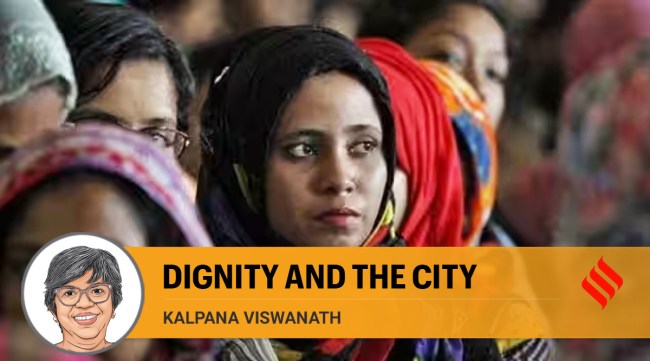 Over the past 20 years of working on women’s safety and inclusion in cities, I have realised that they rarely feel a sense of freedom or autonomy. (Representational Image)


Cities are spaces of opportunity and well-being, but not everyone can flourish equally. Women are constrained by fear, violence and exclusion. Urban planning and management often do not address women’s economic and social realities or foster their “right to the city”. India’s urban population is about 35 per cent. By 2050, it is projected to be around 60 per cent. It is crucial to address inequities as we imagine an urban India at 100.
Over the past 20 years of working on women’s safety and inclusion in cities, I have realised that they rarely feel a sense of freedom or autonomy. One of the key reasons is the lack of gender-responsive urban planning, design and governance. When cities are designed for able-bodied, heterosexual men, many realities are not reflected — including those of women, children and older persons. There are two key factors that prevent women from equitable access to the city — violence and fear, and the unequal burden of care work.

In a 2021 ORF study across 140 Indian cities, 52 per cent of women highlighted that they turned down opportunities for education and employment due to lack of safety. A 2017 World Bank study in Delhi showed that women were willing to travel for 27 minutes more daily to take a route that was perceived to be safer. A 2019 Ola study revealed that only 9 per cent of women from 11 cities felt it was safe to use public transport. In Mumbai, an MMRDA study revealed that women commuters spent 21 per cent more on transport than men because they had multiple activities and concerns for personal safety. This has a widespread impact, especially on access to opportunities. Women’s employment in India is currently under 20 per cent compared to over 70 per cent for men. Further, lack of safety affects women’s sense of well-being.
While women’s safety is on the agenda of many, solutions are predominantly posited with a technocratic approach — more CCTV cameras, policing or emergency apps. Safety though linked to inclusion and equity, cannot be subsumed under a security perspective alone. It is only when these linkages are translated into urban policies that we will find meaningful and sustainable solutions.
First, we need to accept that this is not a “women’s” issue but an urban issue of equity and inclusion. Change is needed in many arenas including physical and social infrastructure, safe spaces, services such as transport and response to gender-based violence. The public domain needs to be made more gender friendly and inclusive of all people of diverse ages, socio-economic statuses, genders, abilities and ethnicities.
Further, the unequal burden of care shapes women’s everyday reality in the city. Care work is central to any society and economy, but is invisible. A 2018 ILO research points out that Indian women spend 297 minutes on housework a day, while men spend 31. A 2021 Oxfam report showed that Indian women and girls put in 3.26 billion hours of unpaid care work daily. We need to imagine our cities differently to foreground the work of care in policy and planning. Childcare, healthcare, housing, play, parks, leisure spaces should be designed for the participation of a wider section of city residents, especially the most vulnerable and excluded groups. Privileging care offers an opportunity to transform our cities into places of well-being, not just production and consumption.
Some cities have begun addressing these concerns with women-only transport and parks, free buses, and helplines. But more needs to be done. This requires a holistic approach to people’s social and economic realities. Diverse voices must inform policies. In the words of the famous urbanist Jane Jacobs, “cities have the capability of providing something for everybody, only because, and only when, they are created by everybody”.
The journey towards equity, inclusion and safety will require us to be innovative and bold. Our cities must be measured by the dignity afforded to every person in the city. The writer is the co-founder and CEO of Safetipin and an expert on gender and urbanisation. This article is part of an ongoing series, which began on August 15, by women who have made a mark, across sectors

 Share
Share


