
Opinion Why India’s youth is chasing the sarkari naukri
It isn't the money but perks, respect and job security that drives people to seek public sector employment
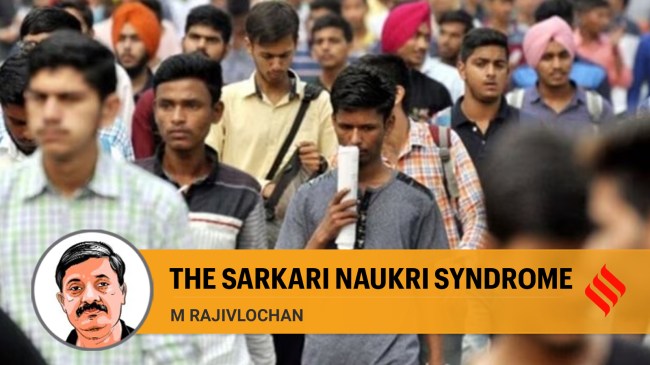 If the government were to provide equitable access to good and reliable facilities in education, health, housing and public transportation for all people at nominal rates or free of cost, it would go a long way to make self-employment an attractive option.



In some 40 years of teaching postgraduate students, discussions have always veered towards their aspirations. Invariably, all of them hope to get into some regular government employment. The certainty of having a wage through their entire working life seems to be most attractive to them. Associated with this are other unstated benefits of a government job, which come by way of access to good and cheap healthcare, subsidised housing and a belief that such a job provides access to power. The ones who could not land a government job often felt genuinely disheartened.
Those who did get into government employment would complain that they were underpaid. To make sense of these moans and groans from the young, we checked out the details about earnings that are available in the Periodic Labour Force Survey (PLFS). It has been carried out every year since 2017-18 and covers over 4,00,000 people in roughly 1,00,000 households.

Just about 11 per cent earn enough to be able to pay income tax. Among those who do earn, about 57 per cent are self-employed, 21 per cent earn a wage or salary and 22 per cent earn episodically from casual labour. The number of those employed in government service is 9 per cent and 12 per cent are in private employment. The average income of a salaried employee in India is about Rs 20,000. The average income of someone self-employed is about Rs 13,347. Digging deeper into the data shows how this income varies across different income groups.
Among the lowest three deciles of all earners, income from wage or salaried employment far outstrips income through self-employment. Similarly, among the big earners, the ones who are part of the top two decile of income earners in India, (once we exclude the outliers such as those earning more than Rs 8,00,000 per month), working in a salaried job brings in more income than does having a business. It is only in the two highly urbanised states of Delhi and Goa that the self-employed earn more than the salaried. At the other end of the spectrum are small enclaves like Puducherry, Ladakh and the North Eastern states where salary earners make more money than the self-employed do.
In other states, broadly speaking, in money terms, for the bottom deciles where monthly income is in the range of Rs 4,000 to Rs 10,000, the salary earners make more money than the self-employed do. For monthly incomes in the range of Rs 11,000 to Rs 25,000, the self-employed earn more. And for monthly incomes above Rs 25,000 in general, it is the salary earners who earn more money.
States show significant variation in the numbers. Punjab, for instance, is the only state where the average earning for farmers is similar to others who are self-employed. The monthly middle income for farmers in Punjab (the value that divides the group into two halves) is Rs 15,000, which is the same as for others who are self-employed. However, in Punjab, traders earn more than farmers. For monthly incomes between Rs 4,000 to Rs 22,000, the self-employed earn more money than wage/salary earners. For the lower deciles, both groups earn similar incomes which is also unique.
In Tamil Nadu, for the lowest three deciles with incomes below Rs 14,000 per month and also for the highest three deciles with incomes more than Rs 22,000 per month, it is the salary earners who earn a higher income than the self-employed. For the middle four deciles, the self-employed earn more. The median income that divides the values for self-employed into two halves is Rs 15,500. The self-employed who are engaged in manufacturing activity, earn about 55 per cent of this, which is Rs 8,550. In most states, incomes for the self-employed in manufacturing are considerably lower than what the self-employed engaged in trade or construction earn.
Are government salaries disproportionately high? What seems to make government service so attractive is the availability of various facilities for health, housing, education and transport. Everyone else, irrespective of their income level has to bear a disproportionately high cost to access analogous facilities.
If the government were to provide equitable access to good and reliable facilities in education, health, housing and public transportation for all people at nominal rates or free of cost, it would go a long way to make self-employment an attractive option. After all, we already have the experience of how much the government helped people during Covid times when it provided free grain.
The writer teaches history at Panjab University, Chandigarh

 Share
Share


