

As soon as the government took the decision to release India’s first genetically-modified (GM) food crop — Dhara Mustard Hybrid-11 (DMH-11) — for “environment release”, some activists approached the Supreme Court to ban it for various reasons. The Supreme Court has ordered the status quo to be maintained till the next hearing on the matter on November 17. The opposition to GM food crops is not new. There has been a global campaign in this regard by many activists. Yet, in reality, GM crops have spread around the world since 1996. By 2019, roughly 190 million hectares were under GM crops, led by corn and soyabean in the US, Brazil, Argentina, and canola (rapeseed/mustard) in Canada, with no harmful impact on human or animal health or the environment per se (see infographics). There is ample evidence in support of that. Even Bangladesh has marched ahead with Bt brinjal. More than 70 countries have accepted the use of GM crops.
Even within India, we had our first GM crop, Bt cotton, released in 2002 by the Vajpayee government. Atal Bihar Vajpayee envisioned that science could transform agriculture. He extended the original slogan of “jai jawan, jai kisan” (salutation to the soldier and the farmer), given by Lal Bahadur Shastri, to include “jai vigyan” (salutation to science). Are there any lessons from the Bt cotton decision for the case of mustard today?


The success of Bt cotton holds many lessons for policymakers but it is not free from controversy and debate. Several concerns have been expressed by NGOs, civil society groups and farmers’ groups from time to time to emphasise the risks associated with GM crops. Some of these include — enhanced sucking pest damage in Bt cotton; increase in secondary pests such as mired bugs and Spodoptera; emergence of pest resistance; environmental and health implications in terms of toxicity and allergenicity that can cause hematotoxin reactions in the human body and, of course, farmers’ exposure to a greater risk of monopoly in the seed business. Based on largely unproven fears that unite the ideologues of the Left and the Right, commercial release of herbicide-tolerant (Ht Bt) cotton, Bt brinjal and now GM mustard have been held under moratorium. This is despite the official clearance from the country’s biotech regulator, the Genetic Engineering Appraisal Committee (GEAC).
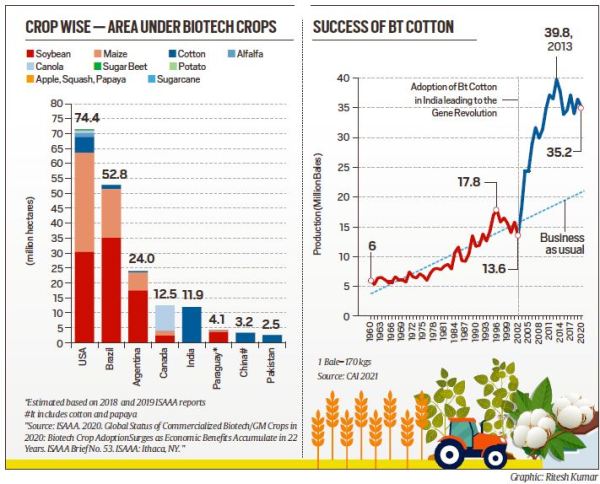
This is so ironic because GMOs have been in our food systems for years. India heavily depends on imported edible oils (55-60 per cent of India’s domestic requirement is imported). A large portion of this — about three-four million tonnes every year — comes from Argentina, Brazil, Canada, the US, etc, which is all from GM technology (in soybean and canola). We eat plenty of our own cotton seed (binola) oil, and about 95 per cent of our cotton is now GM. Cotton seed is also fed to cattle which gives the milk its fat content. Even poultry feed, such as soya and corn, is being imported. So, one thing is clear: GM food is already in our food chain, and has been there for quite some time.
By not allowing GM mustard or for that matter even Bt brinjal for so long, one is denying the basic rights of farmers who want to increase their incomes. The best way to do so is by raising productivity in a sustainable manner. And that’s where science comes in. The field trials of GM mustard at different locations showed 25-28 per cent higher yield and better disease resistance compared to indigenous varieties. This can go a long way in augmenting domestic mustard oil supplies and farmers’ incomes.
It was expected that India would be at the forefront of the gene revolution and emerge as a major export hub to other Asian and African countries. What the IT revolution has done in computer science, the Bt revolution could have done in agriculture. Unfortunately, our policy paralysis on GM technologies from 2003 to 2021, under pressure from activists and ideologues, has cost the farmers a lot. India is no longer at the forefront. But it is still better to be late than never to catch up vis a vis the gene revolution. Dissent is a good sign in any democratic society and forms an essential part of checks and balances. But once the safety tests are done and the scientific body (GEAC) has given the green signal, what is needed is political leadership to keep the decision-making science-based.
The agriculture of tomorrow is going to be science-based, and the winners will be those who adopt it and develop it further today. Innovation is the name of the game, and “Jai Anusandhan” is a good slogan given by PM Modi. But it will have meaning only when the government goes ahead with not just GM mustard but also fast-tracks Ht Bt cotton, Bt brinjal, and even GM soya and corn.
Gulati is distinguished professor and Juneja is fellow at ICRIER