
Opinion Where’s the follow-through?
Modi understood the strategic importance of Uzbekistan. Yet, India ignored President Karimov’s death, jeopardising its interests in Central Asia.
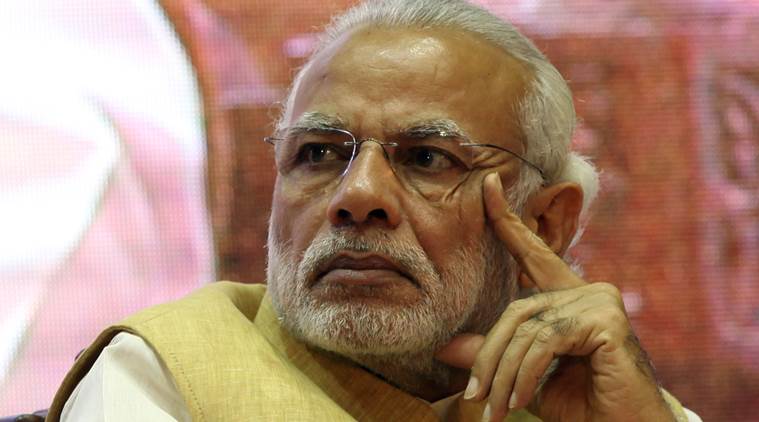 PM Narendra Modi at the 100 years celebration of Gaudiya Mission at Netaji Indoor Stadium on Sunday in Kolkata. Express Photo by Partha Paul. Kolkata. 21.02.2016. *** Local Caption *** PM Narendra Modi at the 100 years celebration of Gaudiya Mission at Netaji Indoor Stadium on Sunday in Kolkata. Express Photo by Partha Paul. Kolkata. 21.02.2016.

 PM Narendra Modi. (Express File Photo/Partha Paul)
“Salom O’zbekiston!”, tweeted Prime Minister Narendra Modi as he landed in Tashkent in July 2015, beginning his very productive journey through all five Central Asian states. On hand to receive him was Uzbek Prime Minister Shavkat Miromonivich Mirziyoyev, a measure of neighbouring Uzbekistan’s interest in India’s growth. With flights between Delhi and Tashkent barely three hours long, Uzbekistan’s removed geographical location is surely a state of the linear mind.
Certainly, Modi understood the strategic importance of Uzbekistan as well as President Karimov’s own link with India. With access to the files he loves to read, the PM knew that Karimov was visiting Delhi when the Soviet Union was breaking up in August 1991, and the Indian government sent him to Agra to put him out of potential harm’s way.

The pièce de résistance of Modi’s visit was a specially commissioned folio he gifted to Karimov, a reproduction of the elegant Khamsa-e-Khusrau, written in Persian by none other than the inimitable Amir Khusrau and “illuminated with colours, including gold and ultramarine.”
The PM, never one to miss a connection with the home audience, this time with Uttar Pradesh, from where he is elected, said, “Amir Khusrau, himself born in UP, has a link with Uzbekistan — it is the land from where his father hailed.” He also promised cooperation in IT, energy and agriculture.
So what happened? On September 2, when Karimov finally passed away after having ruled Uzbekistan with an iron hand for the last 25 years, there was no one to mourn his passing in many-splendoured Delhi.
The ministry of external affair’s (MEA) newest find, junior minister M.J. Akbar, was photographed signing the condolence book in the Uzbek embassy in Delhi. But no one — not the PM, not NSA Ajit Doval, not foreign secretary S. Jaishankar, not the joint secretary in charge of the region — no one thought of finding an IAF plane, putting someone respectable like Vice-President Hamid Ansari on it and flying him to Samarkand to condole with a nation with an umbilical, historical link to India.
Mystified? If the MEA was a Harry Potter book, it would surely be called the Ministry of Events & Affairs.
It’s nobody’s fault, of course. Kashmir had been burning for more than 50 days when Karimov died — it still is — and the government was preparing to send the all-party delegation to Srinagar two days later. NCP boss Sharad Pawar had attacked Maharashtra’s anti-terrorism squad for “terrorising” Muslim youths on “mere suspicion” and detaining them illegally, upon which Maharashtra Chief Minister Devendra Fadnavis attacked him.
On September 2, Modi welcomed Egyptian President Abdel Fattah el-Sisi, promising to “build on multiple pillars of our cooperation and deepen the economic and people-to-people ties between our nations.” The tweet sounded ominously like the one @narendramodi’s handlers had used after his happy handshake with Karimov last year.
Soon enough, the PM had jumped into an Air India plane for Vietnam — where he condoled the passing of Karimov in a single tweet — whose rising importance is linked to its location on China’s periphery. The whirlwind followed.
In Hangzhou, China, for the G-20 meeting, Modi met Xi Jinping, Malcolm Turnbull of Australia, Mohammed bin Salman of Saudi Arabia, Theresa May of the UK, Francois Hollande of France, Erdogan of Turkey, Mauricio Macri of Argentina, and Barack Obama. Then off to Vientiane, Laos for the ASEAN & East Asia summit meetings, where he met Shinzo Abe of Japan, Thongloun Sisoulith of Lao, Aung San Suu Kyi of Myanmar, Dmitri Medvedev of Russia, Li Keqiang of China and Obama again.
Time for India’s all-important neighbourhood? The fact is, Uzbekistan is the only Central Asian state which touches each of the other four Central Asian states as well as Afghanistan — whose president Ashraf Ghani arrived in Delhi on Wednesday. On Afghanistan’s southern border lies Iran, where India is interested in building a port at Chabahar, cheek-by-jowl with Pakistan’s Gwadar.
Perhaps too much is happening for Modi to concentrate his mind on the jigsaw puzzle that is foreign policy. That means that India’s interest — or lack of it — in Pakistan is intimately connected with Afghanistan, Iran as well as Uzbekistan. Waiting patiently in the picture is China, which has been building road and rail links across the region since the Soviet Union broke up in 1991, like a tiger patiently plotting to capture its prey. In fact, the first cargo train left from the eastern Chinese city of Nantong on August 25 and reached Hairatan, on the Uzbek-Afghan border on September 9.
With the US increasingly wrapped in its own political transition, Xi Jinping sent vice-premier Zhang Gaoli as his special envoy to Karimov’s funeral in Samarkand. That’s the kind of strategic risk Modi is capable of, and must learn to emulate.
Perhaps the PM needs a few more advisers to whom he can delegate key priorities. One retired diplomat recently remembered that Delhi sent no one to Riyadh to condole the death of the first king and founder of Saudi Arabia, Abdul Aziz Ibn Saud, in 1953 — and how India lived to regret that omission for decades to come when the Saudis refused to forget.
It’s unlikely the Uzbeks will forget either. But the question is a larger one : Will India’s unwillingness to follow through brilliantly begun initiatives become its undoing? The world is a big place, but it’s clearly impossible for Delhi to do several things at the same time. Two years on, the half-baked ‘chapati’ still tastes terrible.
 Share
Share


