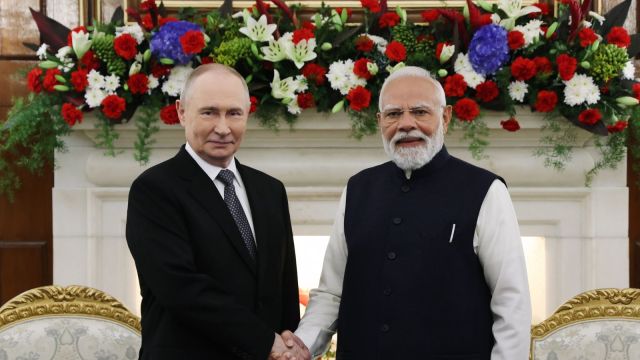

The 23rd India-Russia summit held on December 5 was a showcase of contrasts. It looked like an undeniable success, demonstrating the proverbial durability of strategic partnership at a time of global turmoil. One thing, however, was missing: Outcomes. Two new joint ventures in pharmaceuticals and fertiliser supply are significant, as are growing exchanges between media and civil societies. But it is hard to pick out any significant deal. Instead, New Delhi and Moscow opted for low-hanging fruits and ostensibly agreed to leave high-value items for the future.
Is the current dynamic a continuation of the decline in the relationship that has lasted since the early years of the previous decade, or is it a renaissance of the strategic partnership that would probably require further efforts to get back on track? Although the relationship cannot be in decline and on the rise simultaneously, the recent summit provided sufficient evidence for both scenarios.


There are several possible reasons for the absence of new defence deals, ranging from the ongoing negotiations requiring coordination of technical and financial details, to a sensitive geopolitical moment necessitating a low profile. Military cooperation is currently placed in a closed box not accessible to the public, and its true nature, like Schrödinger’s cat, is hard to determine. The verdict on its potential could be easier to make following the end of the war in Ukraine when the environment might become more conducive to announcements.
The India-Russia relationship is paradoxical. While it is sustainable thanks to long-standing connections in traditional spheres, it is also stagnant since new areas have not been clearly defined. It has withstood the fallout from the war in Ukraine, but has also lost momentum and has encountered additional barriers. Although it has seen a record rise in trade, this has been imbalanced and transactional, and has been entirely a by-product of oil shipments. As the relationship is contingent on many external variables, it will remain in a state of uncertainty.
The writer is a fellow, Strategic Studies Programme, Observer Research Foundation, New Delhi


