
Opinion What the optics of a visit can’t hide: India-Russia relationship is paradoxical and stagnant
While it is sustainable thanks to long-standing connections in traditional spheres, it is also stagnant since new areas have not been clearly defined
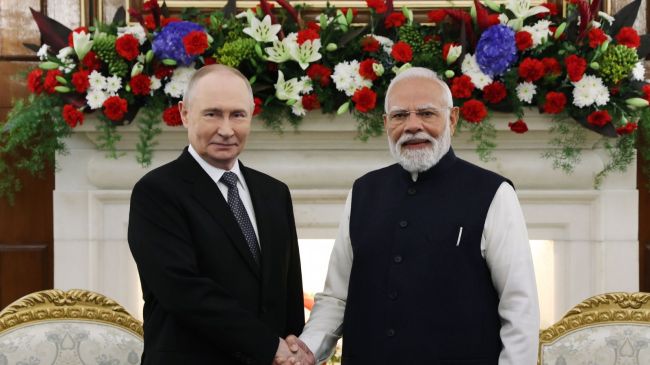 Russian President Vladimir Putin, left, and Prime Minister Narendra Modi. (Photo: AP)


The 23rd India-Russia summit held on December 5 was a showcase of contrasts. It looked like an undeniable success, demonstrating the proverbial durability of strategic partnership at a time of global turmoil. One thing, however, was missing: Outcomes. Two new joint ventures in pharmaceuticals and fertiliser supply are significant, as are growing exchanges between media and civil societies. But it is hard to pick out any significant deal. Instead, New Delhi and Moscow opted for low-hanging fruits and ostensibly agreed to leave high-value items for the future.
Is the current dynamic a continuation of the decline in the relationship that has lasted since the early years of the previous decade, or is it a renaissance of the strategic partnership that would probably require further efforts to get back on track? Although the relationship cannot be in decline and on the rise simultaneously, the recent summit provided sufficient evidence for both scenarios.

There is a clear upward trajectory with regular political contact and rekindled interest in expanding economic cooperation, particularly on the Russian side. The latter was on full display during the summit, with a sizeable Russian delegation predominantly comprising top officials from the Russian government’s economic bloc and banking officials. While previously India was more of an attraction for national security officials in terms of defence and security cooperation and was rarely heeded by the upper echelons of the Russian financial circles, it is now being rediscovered as a country of economic opportunities and a “safe harbour” for Russian businesses left with no choice but to explore new markets. One such sign is the growing integration in the banking sector. Currently, five Russian banks are operating in India with some of them eyeing expansion by opening new offices. The Russian Central Bank is also set to open a branch in Mumbai in 2026. The rupee-rouble settlement mechanism has ballooned in recent years.
There are several possible reasons for the absence of new defence deals, ranging from the ongoing negotiations requiring coordination of technical and financial details, to a sensitive geopolitical moment necessitating a low profile. Military cooperation is currently placed in a closed box not accessible to the public, and its true nature, like Schrödinger’s cat, is hard to determine. The verdict on its potential could be easier to make following the end of the war in Ukraine when the environment might become more conducive to announcements.
The India-Russia relationship is paradoxical. While it is sustainable thanks to long-standing connections in traditional spheres, it is also stagnant since new areas have not been clearly defined. It has withstood the fallout from the war in Ukraine, but has also lost momentum and has encountered additional barriers. Although it has seen a record rise in trade, this has been imbalanced and transactional, and has been entirely a by-product of oil shipments. As the relationship is contingent on many external variables, it will remain in a state of uncertainty.
The writer is a fellow, Strategic Studies Programme, Observer Research Foundation, New Delhi

 Share
Share


