
Opinion What Indians eat, and how being unhealthy is easier and cheaper
Food companies must invest in affordable, culturally appropriate, healthy products matching Indian tastes and lifestyles. It requires a whole-of-society engagement.
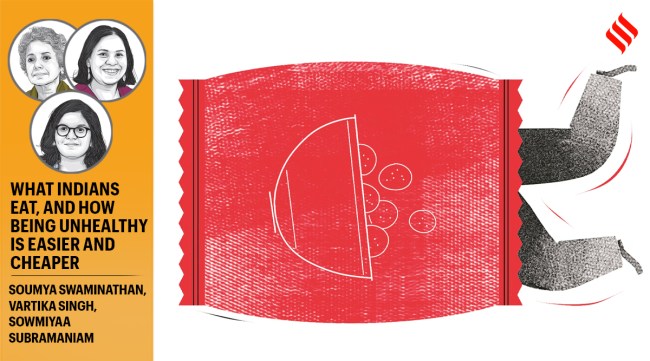 57 per cent of the total disease burden in India is due to unhealthy diets. (Illustration: C R Sasikumar)



From a famine-hit nation in the 1970s, India is one of the world’s leading food exporters today. However, based on the findings of NSSO’s latest quintennial survey, its journey to nutrition security is incomplete. The Household Consumption Expenditure Survey (HCES) 2022-23 presents information on the monthly per capita expenditure (MPCE) on food, consumables and durable goods. Collected periodically over the past 23 years, it offers insights into food expenditure. Overall, food expenditures have risen in real terms. Expenditures on protein sources such as dairy, eggs and meat, fruits, vegetables and nuts have risen while expenditures on cereals have dropped, despite recent evidence that shows more than half the plate is composed of carbohydrates.
While lower expenditure on cereals is consistent with the economic theory of consumption, the quantities consumed appear to be higher. The most recent ICMR-INDIAB Dietary study shows that 62 per cent of total energy in Indian diets comes from low-quality carbohydrates (refined cereals and sugar). This has been identified as the leading cause of the obesity (and other metabolic diseases) epidemic. In India, while per capita incomes have shown an exponential increase over the last two decades, and real per capita GDP has more than doubled, spending on cereals has declined by almost half compared to 1999 in both urban and rural areas. On average, Indians now spend Rs 40 more than they did on animal-sourced foods, including dairy products. Similarly, for fruits and vegetables, people spend approximately twice as much, driving expenditures away from grains to diverse foods.

While the National Food Security Act is a key driver of cereal consumption, we find that the top 5 per cent of the rural population spends almost eight times more than the bottom 5 per cent on food, while the top 5 per cent of the urban population spends almost 10 times more. Urban consumers seem to be prioritising quality and variety, reflecting changes in lifestyle and dietary habits and a move away from simple grains.
Notably, spending on processed or packaged foods shows a steep rise, increasing by 353 per cent in rural areas and 222 per cent in urban areas since 1999. The increase demonstrates shifting consumer preferences for ready-to-eat meals because of work-life balance and the reduced availability of home-cooked meals that depend on women’s unpaid domestic labour. Our observation is supported by the reduction of price elasticity for processed foods by 90 per cent in the last two decades, indicating its shift from a luxury consumption item to a necessity.
We attribute many key poor-health outcomes in India, including obesity and malnutrition, to this changed dietary behaviour. As per the Global Burden of Disease 2023, India has witnessed an exponential rise in non-communicable diseases (NCDs) and the largest number of years of life lost (YLL) is attributed to poor diets. India faces alarming health risks if current dietary trends continue. The Indian Council of Medical Research has pointed out that 57 per cent of the total disease burden in India is due to unhealthy diets. A study supported by the Food Systems Economics Commission for India projects that diet-related health risks and weight issues will drive YLL from 50 million to 72 million between 2020 and 2050. This increase stems from the rising burden of NCDs, with projected surges in cancer cases (148 per cent), Type-2 diabetes (229 per cent), and respiratory diseases (40 per cent). India may be becoming wealthier, but not necessarily healthier. The World Obesity Atlas 2025 shows that currently, one in eight people globally lives with obesity.
Studies have shown direct linkages between obesity and malnourishment, with the consumption of high-fat, salty and sugary foods. Mapping the HCES consumption quantities to healthy diet recommendations by the National Institute of Nutrition (NIN) reveals that energy requirement from cereals in terms of grams per day is adequately met across all deciles and sectors, but there is a significant gap in the consumption of vegetables and pulses. While vegetable consumption does increase with income, there remains a gap against the target of 400 grams per day. On average, the protein intake falls short by around 20 per cent (14g/day) against the recommended 70g/day, with the deficit ranging from ~26g/day in the poorest decile to around 5g/day in the richest.
Global conversations on sustainable diets also revolve around shifting away from animal-sourced foods to plant-based ones to reduce the environmental impact of food production. Following NIN’s dietary guidelines could reduce methane emissions by 36 per cent and nitrous oxide by 35 per cent by 2050, while simultaneously cutting food prices by up to 24 per cent and household food expenditures by 23 per cent.
Yet, bridging the gap between evidence and action requires confronting hard truths. The root of this crisis lies not merely in what Indians eat, but in the ecosystem that makes unhealthy choices easier and cheaper. Shifting consumption patterns demand bold, coordinated interventions across multiple fronts. Fiscal measures like strategic taxation on ultra-processed foods and sugary beverages must work in tandem with front-of-package labelling (FOPL) that empowers consumers to make informed choices. But regulation alone cannot succeed without transforming the supply side. Small-scale farmers need targeted support, training, resources, and market linkages to cultivate nutrient-dense foods at competitive prices. Subsidies for harmful fertilisers and pesticides must be repurposed to reward farmers for growing nutritionally dense crops, using regenerative agricultural techniques. Equally critical is investment in both R&D and scaling of low glycemic, high-protein rice, higher-yielding millet, pulse varieties and expansion of cold storage and processing facilities for fruits and vegetables in rural areas. Underutilised sources of protein (especially from aquatic and marine sources) must be explored and made available.
Food companies must invest in affordable, culturally appropriate, healthy products matching Indian tastes and lifestyles. It requires a whole-of-society engagement, including the government, industry, farmers, research agencies, and citizens working together to redesign a food system where the healthy choice becomes the easy choice.
Swaminathan is chairperson, M S Swaminathan Research Foundation and former chief scientist, WHO. Singh is senior research analyst, IFPRI. Subramaniam is research scholar at Centre for Management in Agriculture at IIM, Ahmedabad

 Share
Share


