
Opinion View From The Right: Temple Entry
Although there can be genuine concerns regarding the space for women in religious matters, the arguments of “rationalist protesters” in support of defying tradition are wrong as this is “a matter of faith”.
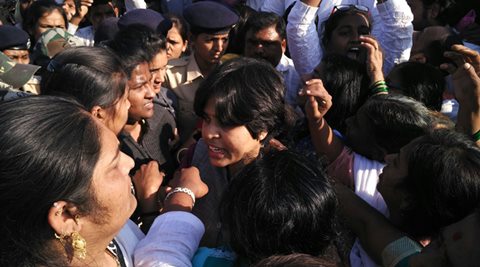 As many as 500 women and men heading for Shani Shingnapur were stopped on their way by Ahmednagar police in Supa village, about 70 km from the temple. (Source: Express photo)
 As many as 500 women and men heading for Shani Shingnapur were stopped on their way by Ahmednagar police in Supa village, about 70 km from the temple. (Source: Express photo)
An editorial in the Organiser, “From Sabarimala to Shani Shingnapur”, slams “liberals, seculars, rationalists, feminists”, who “are on [the] run against the alleged discrimination against women in religious affairs”. It says that, in Sabarimala, “entry is banned… [for] all women between the ages of 10 and 50… [to the] temple precincts, citing ritualistic practice and tradition”, whereas in Shani Shingnapur, “there is a 400-year-old tradition of banning women from entering its sanctum sanctorum”. Although there can be genuine concerns regarding the space for women in religious matters, the arguments of “rationalist protesters” in support of defying tradition are wrong as this is “a matter of faith”.
“Rationality has no place for faith or tradition,” it says, contending that the rationalists have to explain whether they want to forcibly worship the god they do not believe in or respect the sentiments of the people who do believe. Legally, the “temple is not a public property where anybody can barge in and do whatever she/ he wants…” Customs and traditions are guided by local feelings, just as there are temples that allow
only women, the editorial says.

Uplifting Movie
A review of the recent Hindi movie Airlift in Panchajanya says that it reflects the spirit of India “in true form”. The movie confirms that “when we Indians get united and concentrate all efforts in a direction, we can achieve anything”. The story of this mission in which 1,70,000 Indians were rescued from Kuwait “evokes love for the country” but “does not veer towards blind nationalism”.
It also notes the “rigidity of [the] bureaucracy” in the entire episode and says that the movie has “benefited from the director’s decision to avoid depicting spectacles” and emerged as a “credible human story”. There are “a few pardonable mistakes, like a joint secretary of the external affairs ministry is shown seated on a chair amid the crowd”, but the director has “avoided melodrama”. The review also comments on the “new form of narrative stories of patriotism”, and says that “the changed stance actually reflects the perception of society towards patriotism and nationalism”.
New Brotherhoods
An article in the Organiser probes the suicide of Rohith Vemula and says that “many new facts have emerged” since his death. “What is important is to see the transition of the boy as is evident from his Facebook wall…” It says that “during the last few years, he was being mentored by some people who first drew him to the Ambedkar Students’ Association from the SFI and then to the AIMIM lead by the Owaisi brothers”. It says “the Owaisi brothers have been trying to bracket the Muslims as under-privileged sections along with the SCs and stating that Muslims and Dalits are bhai-bhai.”
Contending that “this is a strategy to create confusion among the Scheduled Caste Hindus”, it says that a “senior professor from Osmania University has been going around stating” that “marriages between SCs and Muslims have been common and that it must continue”. The article says that this “is an utter lie, a propaganda campaign”. It also argues that the “SC brethren must remember that Dr Ambedkar himself had warned about the danger of this alliance.” It quotes Ambedkar: “The brotherhood of Islam is not the universal brotherhood of man. There is a fraternity but its benefit is confined to those within that corporation. For those who are outside the corporation, there is nothing but contempt, slavery and enmity.”
 Share
Share


