
Opinion View From The Right: Science & India
The cover story in the Organiser, “Bharat and Science: The Unsung Legacy”, talks about the “great tradition” of “knowledge, inference, logic” in India and notes that many believe that “science is the gift of Western Europe”, but it “is not true”.
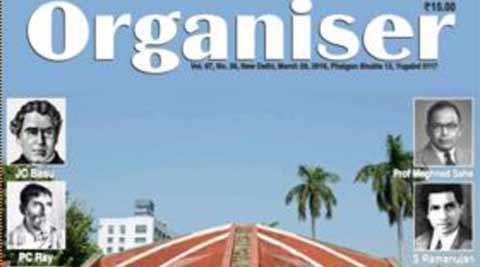

The cover story in the Organiser, “Bharat and Science: The Unsung Legacy”, talks about the “great tradition” of “knowledge, inference, logic” in India and notes that many believe that “science is the gift of Western Europe”, but it “is not true”. The article cites “famous mathematician Dr Manjul Bhargav”, who said that “without the reference to the Aryabhatiya and Bhaskaracharya’s Leelavati his understanding of mathematics would not have been complete”. It contends that India has viewed science “with integral perspective while [the] Western approach is fragmented”.
“Western science focuses on physical reality as Man vs Nature or Subject Vs Object approach, while for us it is holistic perspective from Individual to the Universe,” the article says, and adds that “fortunately, modern science after research in Quantum Mechanics is adopting this perspective”. It says that classical Western science focused on understanding outside reality, but ignored the person or subject who experienced this reality. Without considering the “consciousness of that subject and its relation with the cosmos… one cannot understand the complete reality,” says the article, adding that “Indian thinking has considered that factor from the beginning”. It adds, “Our contribution from mathematics to metallurgy is immense”, as the Mohenjo Daro and Saraswati civilisation suggest that “our ancestors had definite knowledge in the fields of geometry, civil engineering, town planning, etc”.

Armed China
An article in the Organiser, “The Dragon’s Teeth”, analyses China’s 2016 defence budget of around $150 billion and quotes a Chinese official: “China needs to consider its defence needs, economic development and the country’s fiscal position in drafting the defence budget”. The defence budget increased 10.1 per cent last year, despite falling growth, raising concerns about whether such spending was sustainable.
The article notes that the “Chinese official budget is not a full story”, as “many segments of the defence areas” are not included in this budget. The Pentagon and global arms bodies estimate that China’s actual military spending may be 40 to 50 per cent more because the official budget doesn’t include the costs of weapons imports and R&D. In the last few years, China has become an arms supplier for many countries as “it is expanding its tentacles in the sub-Saharan Africa to South Asia”. Noting that China’s budget is nearly four times that of “its rising Asian rival Bharat”, the article analyses its impact on India and mentions China’s arms exports to “Pakistan and other South Asian countries”. It underlines the “installations of its nuclear missiles [on the] Tibetan Plateau”, as well as “road constructions in the Himalayan terrain” that facilitate the Chinese PLA’s manoeuvres in the Bharateeya security areas”.
Who’s Intolerant?
An article in Panchajanya comments on freedom of speech and says that “no freedom is absolute, but the experience of this absoluteness can only be had on the land that has Hindus as majority”. This is possible only in this country, where one can be a theist or an atheist, but no one would object or declare one a Kafir. Arguing that no freedom can remain indifferent to the Constitution, the article says that “the country that established standards of tolerance and respect towards different opinions” is being tarnished by those whose “hands
are stained by barbarism”.
“Organisations like the ABVP should be congratulated that they taught Jai Hind to anti-national sections in the JNU,” it says. It adds that tolerance faces maximum threat from those ideologies which suppressed others’ ideas in the world. Mao Zedong’s Cultural Revolution in China killed over four crore persons, one-third of Cambodia’s population fell victim to the cruelty of its Communist ruler. The article slams those raising the intolerance debate and says that they were “silent when more than 3,000 Sikhs are massacred in Delhi, when lakhs of Kashmiri Hindus are forced to leave the Valley”.
 Share
Share


