
Opinion Ustad Rashid Khan’s legacy of perfection
Among his various recordings and performances, there is little one could describe as being less than very good. And one almost started taking for granted some of these qualities, like fidelity to sur, which is, in the end, what makes one a singer
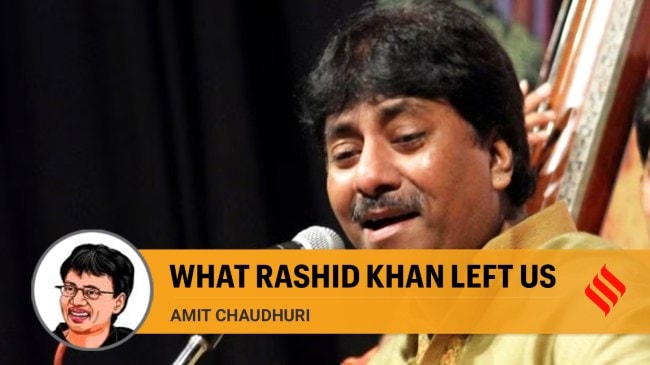 Ustad Rashid Khan (Express File Photo)

I must have first heard Rashid Khan sing in 1991, when he was emerging as a singer of note and repute. I was living in England at the time, and, while visiting my parents in Kolkata, I would go sometimes to the ITC Sangeet Research Academy. I performed there and made a connection with a singer I greatly respected, Pandit A T Kanan. That was where I heard Rashid Khan perform, singing either a Madhuvanti or Multani, at one of their evening recitals. He sang beautifully. We were introduced to each other one afternoon outside the SRA library by Ustad Aslam Khan, who used to accompany me on the tabla and knew him well. Pandit Ananda Gopal Bandhopadhyay, who often played tabla with Rashid Khan, was present too, chiding him affectionately. Rashid Khan was about 23 at the time, but looked even younger, probably because he was so thin. I was 29. Around the same time, I had also got hold of a commercially released cassette of two ragas he’d sung, including, I recall, Raga Lalit.
In those first encounters with Rashid Khan’s singing, I was struck by a few things. He sang in the style handed down by Ustad Amir Khan, of exploratory development: A particularly modern way of imagining the khayal. I see Rashid Khan not so much as an experimenter as a superlative inheritor of the experiments of the early to mid-twentieth century. Amir Khan’s impact was especially evident in the aalap as well as the complexity of his taans, while his rhythmic way of approaching the tarana owed a great deal to his grand-uncle, Ustad Nissar Hussain Khan. His tayyari, his virtuosity, was remarkable. He was a great taankar, the taans beautifully integrated into his aesthetic. They were startling, but not ostentatious. Finally — or perhaps primarily — I was struck by his tunefulness: There was a veracity to the way he embraced each note.

This is Rashid Khan’s legacy — to make achieving a sort of perfection a matter of dailiness. Even during his lifetime — cut off so tragically — one could hear young singers around Kolkata trying to emulate his style, his skill, and even his consistency. He was — I mean this as high praise — reliably excellent. Among his various recordings and performances, there is little one could describe as being less than very good. And one almost started taking for granted some of these qualities, like fidelity to sur, which is, in the end, what makes one a singer.
Such excellence was not so rare even in the 1970s. By the time Rashid Khan started singing, it was becoming increasingly hard to come by. It’s not just that talent disappeared. Perhaps the habitat that allowed such excellence to flourish was narrowing. No doubt Rashid Khan would have been celebrated even in the 1960s and 1970s when there were many other great singers around. But it isn’t easy to find a singer among his contemporaries who became a part of our consciousness quite in the way he did. We owe a debt to the milieu in which he emerged, with mentors like Pandit A T Kanan and Vijay Kichlu: An environment still genuinely respectful of new talent.
For practitioners and listeners of Hindustani classical music, it feels like something formative in our time has ended. It’s not as if it will not come again or that it isn’t already there among us. It’s just that in our period, for one reason or another, listeners have had access to that immersion in sur largely through Rashid Khan. Now, we find ourselves in a place where we need to rethink what we want from Hindustani classical music. Rashid Khan cannot be our sole go-to when we need first-rate khayal singing from the present day, though his recordings will continue to perform that function. We need to be able to not only foster talent, but to be open to it and identify it as we once could: Our own capacity for discernment made Rashid Khan possible. If we aren’t doing this, we have to ask ourselves why. We mourn Rashid Khan today, but we need to ask ourselves whether there are other kinds of passing that this untimely death alerts us to.
Chaudhuri is a novelist, essayist and musician. As told to Pooja Pillai

 Share
Share


