
Opinion Under PM Nehru, India’s first Atomic Energy Act
India has made progress after the first atomic energy law. Currently, the government-owned Nuclear Power Corporation of India Limited (NPCIL) operates 24 nuclear reactors, with a total capacity of 8,180 megawatts of electricity.
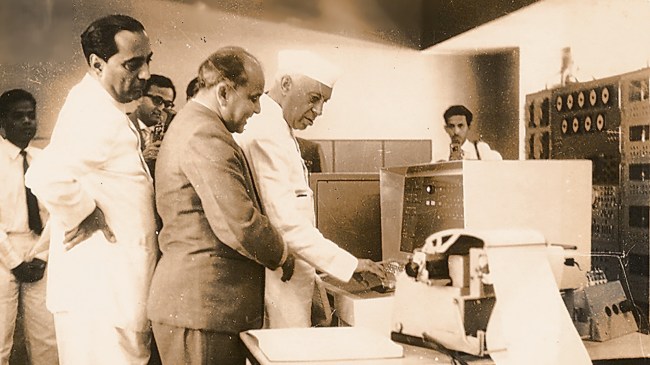 (From left) Nuclear physicist Homi Bhabha, professor MS Narasimhan and Prime Minister Jawaharlal Nehru at the Tata Institute of Fundamental Research. (WIKIPEDIA)


Parliament passed a new atomic energy law towards the end of 2025. The legislation, titled the Sustainable Harnessing and Advancement of Nuclear Energy for Transforming India, opens the atomic energy sector, previously the exclusive domain of government entities, to private players. Opposition MPs urged that a parliamentary standing committee scrutinise the Bill. But the government pushed for its passage in the last two days of the Winter Session, with the debate lasting 11 hours and 64 MPs participating.
One year after the United States dropped atomic bombs on Hiroshima and Nagasaki, the US Congress became the first legislature to establish a framework for regulating nuclear energy in 1946. The provisions of this law were refined over several months, during which scientists and military personnel involved in the atomic sector actively lobbied to influence its content. The law transferred control of nuclear technology from the military to civilian authority.

The US Congress created a civilian Atomic Energy Commission, a congressional oversight committee, a military liaison and a general advisory committee composed of scientists. Following the US, Canada, and the United Kingdom made their own statutes in quick succession. The British legislation gave the government absolute control, with limited parliamentary oversight mechanisms or consultative bodies.
In India, government intervention in atomic energy began with the control of the export of raw materials for such purposes. After World War-II, the US and Britain tried to stockpile nuclear raw materials. The princely state of Travancore had sizable reserves of Monazite, a reddish-brown mineral containing rare-earth elements such as thorium and uranium. Just before Independence, Travancore was going to export a large quantity of Monazite to Britain. The government stepped in to stop the export.
After Independence, India’s Constituent Assembly made atomic energy and mineral resources for its production the responsibility of the Centre. In 1948, Prime Minister Jawaharlal Nehru introduced a Bill to control and develop atomic energy. The Bill mirrored the British law and put every aspect of nuclear energy under government control.
In his opening remarks, PM Nehru said the government was bringing the Bill for the future progress of the Indian people and the world at large. He mentioned that if India did not start working on atomic energy, it would be left behind and forced to follow others, which was not acceptable for a country with vast potential and strength.
Six members of the Constituent Assembly participated in the debate on this Bill. All of them supported the Bill and made key points. One of them, K Santhanam, urged that the entire atomic energy sector be a state monopoly, with no private participation. Next, Dr B Pattabhi Sitaramayya, who later that year would become the Congress president, cautioned, “I doubt very much whether after all this monopoly and this element of secrecy, which is sought to be associated with progress in science, is not destined to promote the war spirit and preparation for war, more than of peace”.
And finally, S V Krishnamoorthy Rao, who holds the distinction of having served as Deputy Chairman of the Rajya Sabha and the Deputy Speaker of the Lok Sabha, sought that Parliament circulate the Bill for public opinion. He was of the view that the focus of the Bill was on the control of atomic energy, rather than its development.
The government did not circulate the Bill for public opinion or refer it to a committee for scrutiny. The PM stated that there was a two-fold urgency for passing the Bill. The first, was to preserve the country’s mineral deposits and the second, to enable it to enter into cooperative agreements with other countries. The Constituent Assembly, functioning in its legislative capacity, passed the Bill with less than two hours of debate. After that, the government would set up the Atomic Energy Commission and the Department of Atomic Energy, under the direct supervision of the PM, to direct India’s atomic energy programme.
Over the years, MPs and parliamentary committees would exercise some control over the government’s handling of atomic energy. For example, Meghnad Saha, a noted physicist elected to the first Lok Sabha from Calcutta, questioned the government for failing to fulfil its promise to set up a nuclear reactor for six years after the passage of the law. Parliament’s financial committees would also draw public attention to poor planning in procuring raw materials for nuclear power plants, resulting in revenue losses.
India has made progress after the first atomic energy law. Currently, the government-owned Nuclear Power Corporation of India Limited (NPCIL) operates 24 nuclear reactors, with a total capacity of 8,180 megawatts of electricity.
The writer looks at issues through a legislative lens and works at PRS Legislative Research

 Share
Share


