
Opinion Single, and singled out
Looking at myself, I felt cheated. “You said you didn’t want to go,” she said, holding my hand.
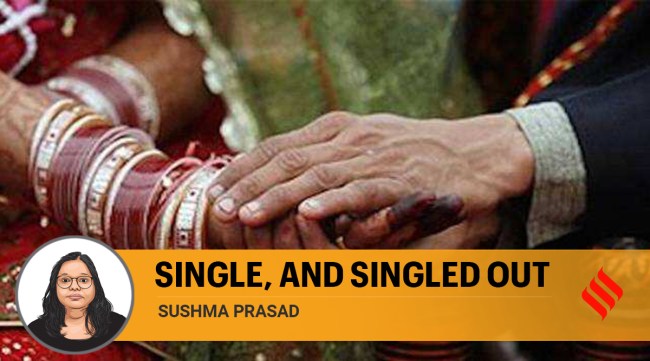 Juta chhupana (hiding the groom’s shoes) was not a part of marriage ceremonies in my family till Hum Aapke Hain Kaun became a wedding template for Indians. (Representational/File)

I was never a fan of marriage rituals, especially those borrowed from Bollywood. Juta chhupana (hiding the groom’s shoes) was not a part of marriage ceremonies in my family till Hum Aapke Hain Kaun became a wedding template for Indians.
I was in principle against the concept of demanding money from my elder sister’s groom for a pair of shoes he had already paid for. So, when my cousins insisted on hiding my brother-in-law’s mojari, I decided to guard it instead. My cousins had the last laugh as they negotiated the shoes for Rs 5,000 and divided it among themselves. My failed attempt to protect the shoes became a family joke, but I never regretted my decision to not be a part of that “extortion” bid. My non-participation was my will.

That year was 2005. The next wedding in my family took place over a decade later, in the month PM Narendra Modi made the demonetisation announcement. My brother’s wedding was fixed on November 24, 2016. That wedding, I spent almost entirely waiting in bank queues in my hometown in Bihar, hoping to withdraw Rs 10,000 per day from four different banks.
I watched my brother from a distance as women, mostly married aunts and cousins, applied haldi on his face and body. My mother, given her ‘widowed’ status (my father had passed away in 2011), did not want to take part in the ritual and I, the unmarried elder sister in charge of organising the wedding, had several other things to manage — decorators, gen sets, halwais, bandwallahs and wedding shopping.
Not many missed me. They needed a byahta (married woman) to perform the rituals and my sister was the obvious choice. My single status left them confused. Should I be allowed to take part in the ceremonies? I, too, didn’t volunteer, perhaps in the same fix as my mother when it came to marriage rituals. How could I convince her when I lacked clarity myself? Being single isn’t easy and explaining your status to others is worse. It’s this awkwardness, I guess, that pushes most single women away from crowded family functions.
On the day of the wedding, my sister decided to stay home to prepare for the bride’s welcome the next day. My mother had already declared that she won’t go with the baarat and I volunteered to stay with them. There were too many relatives ready to “represent” us at the wedding.
In the afternoon, as the baarat preparations began, an uncle told me we could withdraw Rs 25,000 by showing the wedding card at the bank.
I ran to the nearest branch, but a crowd had already gathered there, a wedding card in each hand. I don’t know how many of those cards were fake, but the bank soon ran out of cash. I was worried about getting late for the baarat. I wanted to see if my brother’s sherwani had been altered correctly and if the mojari matched it. I wanted to be there when he wore the maur (headgear) and protect him from overenthusiastic aunts trying to ward off evil eyes with extra coats of kajal.
By 5 pm, a bank employee handed me a bundle of Rs 500 notes and I ran to my home, barely 500 metres away. At the door, my uncle told me the baarat departure had been advanced by an hour due to traffic issues. Standing on the stairs, sweating on a cold November evening in a cotton salwar-kurta, I felt like an outsider at my brother’s wedding. I hugged him and slipped the cash into his pocket. The baarat left with our relatives. My sister and mother stood at the door, teary-eyed.
Looking at myself, I felt cheated. “You said you didn’t want to go,” she said, holding my hand. My eyes fell on our hands. Those were the only palms without henna colours. I guess this time my non-participation was everyone’s will.

 Share
Share


