
Opinion Ranchi is a city that does not need to be yours to be yours
Dotted with a Hanuman mandir, a masjid and a church in a row, Ranchi’s main road doesn’t boast of syncretism, it flexes coexistence. It is not a melting pot, but a salad bowl — where none is forced to assimilate.
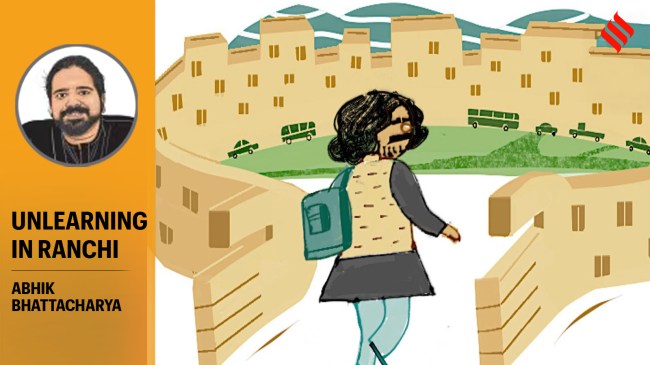 To be driven solely by curiosity and letting oneself float in serendipity is a method in itself. But in Ranchi, it comes naturally. (Express illustration)



Memories often betray us. Splinters of imagination crowd what we think of as “real”. The essence of a city lies between this fragile bond tying memories and imagination. It feels almost like a fleeting hint of a wind on a sultry evening. This is the norm here. It is never unbearable. Either petrichor or the smell of desi ghee dripping from flavourful litti will heal you. If not, someone unbeknownst to you will initiate a conversation, temporarily making you forget that you are away from home. This is Ranchi, a city that does not need to be yours to be yours.
The unattended pages of the diary that I carried to Ranchi during my ethnography have grown old. The yellowish, crinkly papers still carry the untold story of a departure. I did not grow up in Ranchi, nor had I spent my formative years there. The first time I went there, it was with a teaching job at a private university. Being no Delhi, Mumbai, Bangalore or Chennai — considered to be the cities of the aspirational middle class — Ranchi was different in every aspect. As I came out of the airport, with the baggage of metropolitan presumptions — inherent snobbishness toward small cities — I was not very convinced by my own decision. Any form of transition comes with anxiety. For me, it was rooted in Ranchi’s “uncannily” welcoming behaviour. Uncanny, not because of the city’s emotive geography, but rather for the Bengali bhadrolok’s imagination of the stubbornly masculine Hindi heartland. In contrast, Ranchi is a city of many “lacks”: Lack of high rises, lack of spruced up shopping malls, lack of flyovers, lack of broadways, lack of stubbornness. It flows like the Swarnarekha that traverses through the city carrying its multifaceted convictions.

While most cities across the country were busy renaming their streets to either change the memory or to reassign a new meaning to it, my new host didn’t bother much. She was happy with a “main road”. Her stories were not etched in the hot asphalt that, with every new layer, covers up old wounds; rather, they live on — sometimes as oral history, other times, through common refrain, as local jibes. It is the story of her struggle to achieve a separate identity, to embrace her jal, jungle, jameen.
A few years’ stay in Ranchi as a teacher didn’t quench my thirst. I went back again, as an ethnographer, as a journalist. For a trained ethnographer, the most difficult task is to unlearn presumptive notions. To be driven solely by curiosity and letting oneself float in serendipity is a method in itself. But in Ranchi, it comes naturally. Its crisscrossing alleys laced with tulips and hyacinths in spring, the unusual coldness of the cemented rock in front of Resaldaar baba’s mazar in winters, incessant monsoon rain sweeping dingy lanes of Doranda told me the unheard, unsolicited accounts of the many Ranchis — one that takes pride in its Jharkhandi identity, one that upholds Birsa Munda’s values, that celebrates Asmat Ali’s bravado, that finds solace in Tana Bhagat’s reformism and many more. Dotted with a Hanuman mandir, a masjid and a church in a row, Ranchi’s main road doesn’t boast of syncretism, it flexes “coexistence”, what Zubair bhai — an “andolankari” who sacrificed his youth to carve out a separate identity — once compared to a guldasta. Sounds of unnamed streams crawling through slopes of uneven alleys in Resaldarnagar reflect the inherent ambiguity of Ranchi’s urbanity. It is not a melting pot, but a salad bowl — where none is forced to assimilate.
I had to leave Ranchi again — this time for the real Hindi heartland, whose distance makes me long for the city I left behind. Ranchi embraces outsiders with all their diversities, but stands against them if they try to snatch theirs. From a variety of kebabs at Karbala chowk to Bhola’s litti; from Tagore Hills’ tranquil morning to Dhurva dam’s sunset, Ranchi offers you everything: You just need to know how to unlearn.
abhik.bhattacharya@expressindia.com

 Share
Share


