
Opinion Adventurism on I-Day
Linking PoK with Balochistan is a myopic move, could undermine India’s high moral ground vis a vis Pakistan.
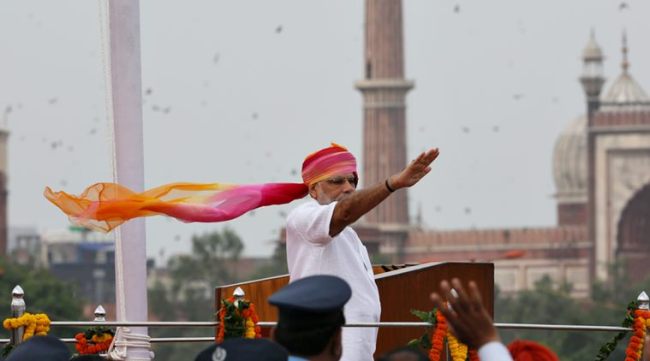 Prime Minister Narendra Modi at the Red Fort on the 70th Independence Day in New Delhi. (Express Photo by Renuka Puri)

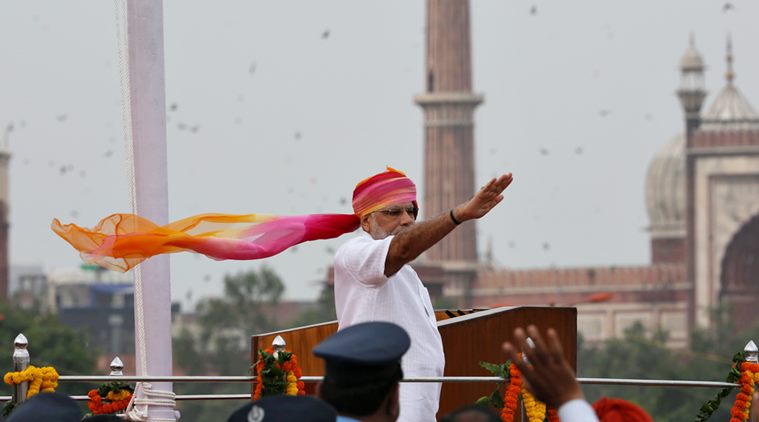 Prime Minister Narendra Modi at the Red Fort on the 70th Independence Day in New Delhi. (Express Photo by Renuka Puri)
The speech by India’s prime minister from the ramparts of Red Fort on Independence Day is meant to be different from the usual town hall events in contemporary politics. More than anything, it is a moment for raising national sentiment to the level of the “freedom at midnight” speech of Jawaharlal Nehru. Of course, there are elements that show concern for the life of the common citizen, but unlike other speeches it is an expression of lofty aspirations and accomplishments, a statement of India’s view of the world. It is neither a manifesto nor a performance-report to the nation and certainly not a partisan election oration. However, Prime Minister Narendra Modi seems unwilling to see it as a national event rather than an opportunity to enthuse party cadres. He certainly did a commendable job of the latter, though he seems to have missed the former completely.
Foreign policy is an apt subject for a Red Fort speech. But PM Modi preferred not to venture across the globe he trots often and placed his focus on Pakistan. We have enough cause for concern about Pakistan rudely and obdurately seeking to interfere in our internal matters, not to mention continuing to provoke and support heinous terrorist attacks on our citizens. The PM had little of substance to say about that beyond parroting general phrases of indignation. He refrained from telling the world how his attempts at outreach have been repudiated and what, if any, promises to him have been broken.

There must have been many promises that he procured during several of his smug meetings with the Pakistan PM. He did not say that he was being forced to change over to Plan C (Plan A was before getting elected, Plan B after becoming PM). But he abruptly launched a PoK-Gilgit-Balochistan verbal assault to the immediate cheers of uninformed jingoists across the electronic and social media.
The prompt refrain one heard was: “Thou shall not question the PM on pain of being called anti-national.” I understand the sensitivity of questioning the PM on Independence Day but that never stopped him from making competing speeches when he was only a prime ministerial aspirant. Be that as it may, given the impudence of Pakistan on the tragic events in the Valley and the insistence on interfering, our PM’s riposte on PoK was apt and justified. PoK (including Gilgit) remain part of India forcibly occupied by Pakistan. Our Parliament has unanimously resolved to get it back long before Modi was heard of. Of course, PM Atal Bihari Vajpayee had different ideas when he tried to find a solution with President Musharraf. Be that as it may, PoK is and must be a priority even if the practical ground situation might be favourable to Kashmir politicians in 1948 as indeed now. No one will have the slightest hesitation in supporting the PM’s statement (even if as a bargaining issue). But speaking of Balochistan is quite another matter.
We all know that there is a Baloch struggle for freedom of considerable vintage and with a history of ruthless oppression by the state. We have been repeatedly accused of supporting it and we have forcefully rejected that. When at Sharm el Sheikh, to break a deadlock, we agreed to consider any legitimate concerns, the BJP raised a howl of protest and stalled Parliament. Now the PM has virtually announced support for the Baloch struggle though he has refrained from saying how he intends to do it.
That will need to factor in several dimensions: The Chinese presence in Balochistan, including development of the Gwadar port; the Chinese Economic Corridor from Gwadar to PoK and beyond; the Afghan and Iranian reaction, given that their territories are included in the Baloch aspiration.
It is not surprising that Baloch dissidents have grasped India’s hand. There is no reason why we should not feel their pain as we do for people elsewhere. But to link that with PoK/Kashmir at the present juncture is a myopic move that might seriously undermine the high moral ground we have always held on Pakistani interference in our internal matters. Not only does this also give the go-by to Panchsheel principles but it also makes us vulnerable to international concern that we have successfully warded away over the past decades. The world has fortunately moved away from the redrawing of boundaries and it is silly for us to invite them to do so for Balochistan with no certainty that it will stop there.
While we grapple with the larger question on the situation beyond our border and the LoC, we can hardly play ostrich at home. More than 40 days of curfew in J&K and a depressingly long list of casualties with dozens of young persons fighting to save their eyes, faces pockmarked with pellets, and the government has nothing to say or do. Bad as sentiments are in the Valley, it has not helped that the PDP has become a helpless puppet in the hands of RSS functionaries posted in the state. All that we get in answer to questions about the intent to solve or resolve the stand-off are some patriotic exhortations and the blame game from 60 years of misrule.
Any concern for the misguided youth pelting stones in the streets is sadly seen as insensitivity for the brave young men in uniform who find themselves in a situation not of their making. The killing of Burhan Wani reminds us that killing a man is easy but killing a legend impossible. Yet we have to think of the living rather than one who chose his path of death. We have to win these hearts at home in the Valley, not in the harsh mountains of Balochistan. But the divisive agenda is already entrenched when differences on fighting the enemy are turned into a bloody political slugfest at home. Were we promised such an independence?
 Share
Share


