

Speaking at the 37th foundation day celebrations of the NABARD, Arun Jaitley gave food for thought to the audience when he said, “If there is any area in the economy where we can give an example to the world and to ourselves of cooperative federalism, it is the agriculture sector. It can benefit people more than what GST has done”. Coming from a political leader who had steered GST to its conclusion, Jaitley’s recommendation is not only commendable but worth implementing. We may add a footnote that similar coordination is needed amongst Union ministries that deal with agriculture, food, food processing, fertilisers, water, rural development and trade. This will enable a holistic approach to agriculture and farmers’ incomes. The process can start with the creation of an agri-council/cabinet.
The need for such coordination was also echoed in the recently released OECD-ICRIER (2018) report on “Agricultural Policies in India”. This should involve a focus on long overdue agri-marketing reforms and revisiting the Essential Commodity and APMC Acts to “get the markets right”. The Atal Bihari Vajpayee government tried to usher in such reforms through the model APMC Act, 2003. It would be fitting that the Narendra Modi government completes the unfinished agenda of these reforms. Getting the markets right will ensure better and stable prices to farmers, as well as consumers, and also augment farmers’ incomes in a sustained manner.


Madhya Pradesh and Chhattisgarh have recently announced “political MSPs” of wheat and paddy. Madhya Pradesh also offers a hefty bonus of Rs 265 per quintal for wheat while Chhattisgarh has offered Rs 300 per quintal bonus for paddy for the 2018-19 season. Both states are headed for assembly elections. However, when professional bodies start recommending what the government of the day wants, bypassing their own ToR, two things happen: First, the credibility of the institution takes a hit, pushing it to irrelevance; and second, the government never gets the right professional advice, and in the political cacophony, it becomes prone to making economic blunders. The case of the kharif MSPs is somewhat similar for reasons which will we explain later
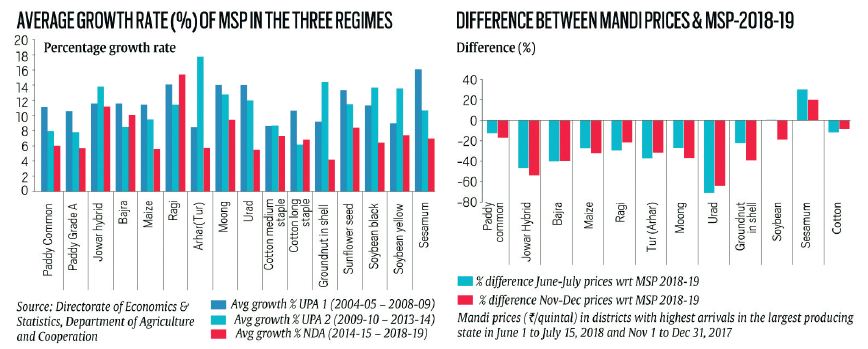
But let us first examine which political regime — UPA-1, UPA-2 or the Modi government — has offered the highest MSP increases. Figure 1 shows that despite the so-called historic decision of the Modi government, the average annual increases in MSPs have been the lowest (except that of ragi) during its tenure.
The next question is whether these MSPs can be effectively implemented. Figure 2 shows that market prices of most kharif crops are well below the announced MSPs. Ensuring that farmers really get these MSPs will require a major coordination between the Centre and states, a point highlighted by Jaitley. Our take on this is that no matter how hard the government tries, it cannot procure even 25 per cent of the production of various kharif crops, except in paddy and cotton, as a robust procurement system does not exist for other crops.
Third is the cost of this scheme. In the case of paddy alone, the government will incur an extra food subsidy bill of Rs 12,000-15,000 crore due to increased procurement, which we expect to be anywhere between 38-40 million metric tonnes (MMT). The grain stocks are already brimming and the Food Corporation of India is saddled with 65 MMT as on July 1. This is 58 per cent higher than the current buffer stock norms. It is widely recognised now that higher MSPs are likely to make our rice exports globally uncompetitive, leading to further accumulation of stocks at home, and greater economic inefficiency. For other crops, the costs will depend upon how much the government procures.
It is worth recalling that setting procurement prices higher than global prices is not a new phenomenon in global history. The European Economic Community (EEC) has done this earlier leading to a glut of butter and milk in EU countries. Lately, China also raised MSPs of wheat, rice and corn substantially above world prices, leading to grain stocks piling up — they touched 300 MMT in 2016-17. But China is learning from its mistakes and since 2014, it has been reducing its MSPs for rice and wheat. It has removed corn from price support. On input subsidies, it has moved towards direct income support on a per hectare basis. Does India want to burn its fingers first and then learn? Wisdom lies in learning from the mistakes of other countries.
India needs to recognise that adressing farmers’ woes by raising procurement prices can have a limit imposed by global prices, especially in a situation of surplus production. The moment one crosses that limit, domestic stocks will start accumulating. Time has come for India to devise an income policy (DBT) for farmers. In that context, Telangana’s Rythu Bandhu scheme with direct investment support is interesting. It can be refined and made WTO compatible.
The bottom line is switching from price policy to income policy approach to redress farmers’ distress.
Can India do it? Only time will tell.


