
Opinion The rearming of Europe: India must tap opportunities for exports and joint research
It is not merely a tactical hedge, but a strategic alignment grounded in shared economic interests, democratic values, and the pursuit of enhanced national security
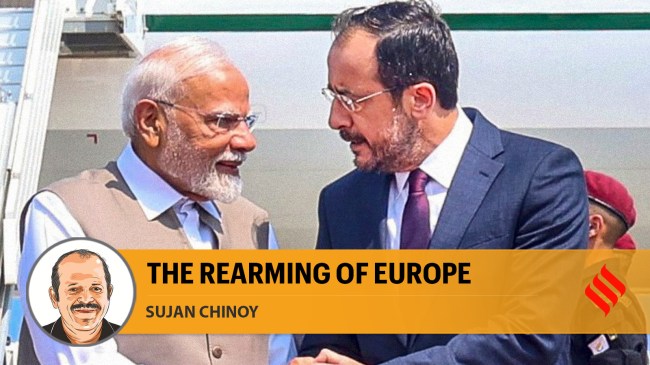 In this image released by PMO on June 15, 2025, Prime Minister Narendra Modi being received by the President of Cyprus Nikos Christodoulides upon his arrival at the airport, in Larnaca, Cyprus. (PMO via PTI Photo)

Prime minister Narendra Modi’s visit this week to Cyprus and Croatia, members of the European Union (EU), was preceded by External Affairs Minister S Jaishankar’s visit to France, EU and Belgium last week and to the Netherlands, Denmark and Germany earlier in May. Bilateral relations are rapidly evolving, anchored in the India-EU strategic partnership.
In February, during the visit of Ursula von der Leyen, president of the European Commission, and the EU College of Commissioners to India, the two sides had welcomed growing defence cooperation, including joint exercises and collaboration between the Indian Navy and EU maritime security entities. The two sides had also committed to exploring a security and defence partnership. In this context, one must closely examine the opportunities for deepening the partnership provided by the Joint White Paper (WP) on European Defence — Readiness 2030, issued by the European Commission in March.

The new policy approach outlined by the WP has undoubtedly been occasioned by the protracted war in Ukraine and recent stresses in the transatlantic partnership with the US. The main thrust of the WP is to support member states in achieving full defence readiness by 2030. The target is to mobilise additional defence expenditure of up to 1.5 per cent of the GDP. Based on projections of gradual progression, defence investment could reach at least €800 billion over the next four years.
The scope of the WP points to opportunities for Indian defence industries to acquire or establish start-ups and small and medium enterprises (SMEs) in Europe.
Both Europe and India have recently been tested for their defence preparedness. In the short term, the emphasis in Europe is on replenishing stocks of ammunition, weapons, and military equipment. This may provide an opening for India to export ammunition to Europe.
The Indian defence sector has received a boost in the aftermath of military tensions with China and, more recently, with Pakistan. India’s defence exports have surged to a record high of approximately Rs 23,622 crore (US$2.76 billion) in the financial year 2024–25. A foundation has been laid for a higher quantum of exports in the future.
In the wake of the high-level visits this year, India should endeavour to explore sales of Advanced Towed Artillery Guns (ATAGs), the Pinaka Multi-Barrel Rocket Launcher, air defence missiles, and radars that meet NATO standards. The focus in the WP on critical and foundational technologies — such as artificial intelligence, quantum, biotechnologies, and hypersonic technologies — and their classification as dual-use with both economic and military implications offers India a chance to collaborate with EU member states.
The strong undercurrent of commitment in the WP to enhancing Ukraine’s defence and security capacities is noteworthy. The new policy is oriented toward sharing the EU’s military mobility corridors, space assets, and services with Ukraine. The key, therefore, lies in Indian companies being part of the landscape in the EU, and perhaps in Ukraine as well, at an early stage in the process of internal integration and harmonisation of the regulatory framework. India should explore opportunities for acquisitions and joint research in defence technologies. As such, the EU has welcomed India’s interest in joining projects under its Permanent Structured Cooperation (PESCO) and in engaging in negotiations for a Security of Information Agreement (SoIA).
India should closely study the evolving EU model of defence preparedness and adopt best practices to refine its own roadmap toward atmanirbharta in aerial mobility — particularly the development of domestic civil transport aircraft manufacturing and maintenance, repair, and overhaul hubs. The EU’s defence omnibus package offers India a chance to collaborate with the EU on cross-certification of defence products and mutual recognition of certification, creating the basis for a future market for India’s military and dual-use products.
The changes in the EU may also provide job opportunities for Indian skilled professionals to work in the defence industrial complex across the EU. It is vital for India to engage each of the EU members on migration and mobility issues in the context of the ongoing FTA negotiations.
The EU’s harmonisation of rules and procedures for defence procurement could lead to some changes in export regulations. Major European producers of defence equipment could find their capacities committed to national needs or to the ReArm Europe Plan. India would have to examine the impact, if any, on its supply chains originating in Europe.
India could explore the possibility of joining the EU Defence Innovation Scheme (EUDIS), drawing from its experience in initiatives such as the INDUS-X with the US — though this may require some special arrangements, since entities participating in EUDIS projects are generally required to be located in the EU or Norway with local legal identity and control. Further, with the emphasis on infrastructure in the WP, Indian engineering, procurement, and construction companies should explore the potential for securing contracts for the expansion of EU multimodal corridors, including ports and terminals.
The emergence of the EU defence union will mark a scaling up of all existing European defence and security structures. The rapid rearmament of Europe is seen as a bulwark against Russia, reasserting Europe’s strategic autonomy in securing itself as well as Ukraine, and strengthening the EU’s defence contributions to the still valid transatlantic partnership. As an aspiring global power and strategically autonomous pole, India should invest strongly in the partnership with the EU.
The writer is the director general of the Manohar Parrikar Institute for Defence Studies and Analyses

 Share
Share


