
Opinion People like them
There can be no greater form of political violence than Haryana’s panchayat law.



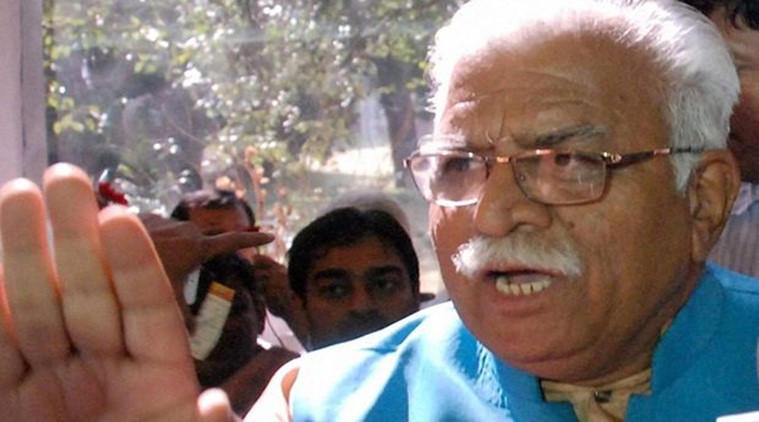 Haryana Chief Minister Manohar Lal Khattar. (Source: PTI)
The Haryana government recently enacted legislation limiting people’s rights to contest local body elections based on, among other things, the candidate’s educational qualifications, outstanding debt to agricultural cooperatives and electricity bill dues. The act has withstood legal challenge. Arguments against the restrictions have been based primarily on the unconstitutionality of limiting a person’s right to fight an election, especially when they are likely to represent the most marginalised sections of society. This is a serious concern. Elections have concluded in Haryana but the law is likely to inspire similar legislation in other states. The thinking that inspired this act is against universal suffrage at a fundamental level. It impacts not just those who seek to fight elections but every one of us who votes.
By restricting who can contest an election, the Haryana law limits voter choice: Over half of all rural women, 68 per cent of SC women and 41 per cent of SC men were debarred by just the educational clauses.

The law also ensures that people from the most marginalised sections of society will find no one on the ballot with a life journey similar to their own. If I am illiterate or debt ridden, and feel that my interests would be best served by someone who is going through something similar, I will find no one on the ballot who fits the bill. I will, instead, have to settle for someone who is educated and debt-free but may understand nothing of my pain and even judge me as less worthy. By limiting choice, this act directly attacks the value of the vote as an instrument of social change.
But universal adult franchise has a deeper role in Indian democracy than just electing representatives. The framers of our Constitution realised that our central challenge was to awaken every Indian to the idea that freedom and dignity are, as Tilak said, our rights by birth and not for someone else to hand down. This was a challenge they had to surmount in an India with life expectancy of 32 years, adult illiteracy of 84 per cent and institutionalised discrimination in a variety of forms. These statistics, far from dissuading the framers of the Constitution from universal suffrage, provided the rationale for it. They saw that in a society as politically, socially and economically impoverished as India, the act of exercising unrestrained discretion and appointing someone as one’s political representative was revolutionary. It upturned age-old discrimination and ideas of “one’s place in society”. Unimpeded universal franchise was the only instrument capable of spreading the message of swaraj at the scale required in India.
As Granville Austin put it, universal adult franchise was “the gong, the single note, whose reverberations might awaken — or at least stir — sleeping India”. K.M. Panikkar more directly captures the revolutionary intent behind universal suffrage: “adult suffrage has social implications far beyond its political significance… Many social groups previously unaware of their strength suddenly realised that they were in a position to wield power”.
The Haryana act is muffling that gong. It has circumscribed the choice of the voter with what the state believes are the universal attributes of a “good representative”. What do we tell our people, especially the most marginalised, with acts like this? That we do not see them as trustworthy custodians of their own and the nation’s interest. That “people like them” belong to a lower strata of society. They can cast a vote but are unworthy of even applying to the electorate for a chance to serve in politics. The Haryana law changes the act of voting from an exercise of power to a reminder of servitude. It strengthens the walls that the Constitution seeks to break down.
A person who is repeatedly confronted with the idea that she is unworthy of the most elementary act of citizenship eventually ceases to see a stake in the nation. There can be no greater form of political violence. It is morally indefensible and will engender catastrophic political consequences.
This is not just an attack on the political voice of the marginalised. It is the latest front in the ongoing struggle between those who believe that India must assure an equal stake for all and those who believe that India should be directed by the few who think they know best. The Constitution lies firmly with the former.
 Share
Share


