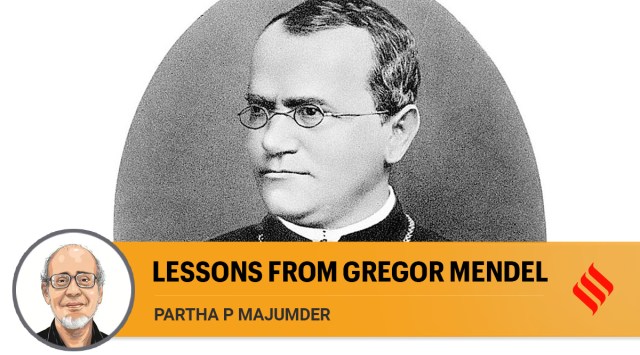

July 20, 2022, marks the 200th birthday of Gregor Johann Mendel, a revolutionary scientist. He propounded that information on “traits” gets passed on from one generation to another as particulate “elements” and that traits in the present generation can be traced back to past generations. The notion was revolutionary because there was no theory about the mechanism of inheritance before Mendel. Mendel’s theory,together with the evolutionary theory propounded by Charles Darwin, laid the foundations of biology.
Mendel completed his schooling from the Gymnasium in Troppau. His physics teacher in the gymnasium, Friedrich Franz, who was impressed with his talents in physics and natural sciences, made a life-changing suggestion to him. Franz, a priest, informed Mendel that the Augustinian Order of the Catholic Church valued intellectual pursuits. He suggested that priesthood could offer Johann a path to learning and teaching. Johann grabbed the suggestion and joined St. Thomas monastery in Brünn (now Brno) in 1843 and changed his christened name Johann to Gregor. Cyril Napp (1792-1867) was the Abbot of St. Thomas, and was also interested in science, particularly plant cultivation and animal breeding. He built a glasshouse (greenhouse) for Gregor to pursue plant breeding. Abbot Napp had said that the questions to investigate are “what is inherited and how?” These questions motivated Mendel in his experiments.


He presented a paper “Experiments in plant hybridisation” containing the results of his experiments to the Society for the Study of the Natural Sciences in Brünn in 1865. A scholar (Loren Eiseley) has written “stolidly the audience had listened.… No one had ventured a question, not a single heartbeat had quickened. … not a solitary soul had understood him.” Mendel’s paper was published in the proceedings of the meeting in 1866. However, there were only three citations of his work in the scientific literature during the next 35 years.
After 35 years of neglect, in 1900, three botanists – Hugo de Vries (Holland), Carl Correns (Germany) and Erich von Tschermak (Austria) – independently confirmed his work. Mendel’s Laws became well-known.
It is remarkable how quickly scientists discovered that Mendel’s results hold not only for pea plants but also for humans. Archibald Garrod announced in 1902 that transmission of the human disease called alkaptonuria – a disease with many manifestations including discolouration of skin and dark sweat – conformed to Mendelian laws.
Unfortunately, the rational basis of Mendelism was completely undermined during Stalin’s (1878-1953) rule. Agronomist Trofim Lysen(1898–1976) persuaded Stalin to believe that environmentally modified characteristics are heritable via all cells of the organism. This offered proof of the Marxist concept of societal evolution. Stalin banned Mendelian genetics in Russia and in all countries under Russian influence.
Even though Mendel provided an evidence-based model of inheritance, his contribution remained unappreciated and buried for 35 years. We can only speculate why. First, his discovery was way too “premature”. Those who make premature discoveries are liable to be ridiculed by peers. Mendel was lucky that he was only ignored. Second, he was a monk and did not formally belong to the scientific establishment. Scientists do not normally accept discoveries by people outside of their establishment. Third, the scientific method that Mendel used was revolutionary for his time. He may have been the first botanist who seriously applied mathematics to biology. Botanists worked by observation, rather than by experiment. The results of experiments done by naturalists, such as Charles Darwin, were judged by observation rather than by calculation. This is unquestionably why Mendel was so successful, but is likely a reason why the world of natural science was not yet ready for his results. And fourth, he was shy and did not loudly promote his discovery.
The historic neglect of Mendel’s scientific contribution has many lessons for us. Our mind should be open to absorb new ideas, even if radical. Today, the words “novel” and “innovation” are so widely used. Yet, I’m not sure that if a Mendel arrives today with a discovery that is “premature”, scientists will warmly welcome him and his discovery. Scientists have certainly learnt to appreciate the importance of interdisciplinary approaches in science, but they are not yet free of bias and not yet friendly to ideas generated outside of their establishment.
The treatment of Mendelian principles by Lysenko, who was director of the USSR’s Institute of Genetics, in the 1940s, also has lessons for us. Lysenko’s attack on Mendelian science and his cunningness to propound a theory (inheritance of environmentally-acquired characters), based not on any scientifically-derived evidence but ideologically attractive to the totalitarian regime, resulted in the persecution – and even death – of many scientists who opposed him or supported the Mendelian theory. We are now witnessing a celebration of pseudoscience that harmonises with ideology, in India and also elsewhere. Disaster is bound to strike when a society abandons reliance on scientific evidence, and ideology and political beliefs take centrestage. Let us loudly support evidence-based science and cry hoarse against ideology-based science. That will be a fitting tribute to Mendel on his 200th birthday.
The writer is National Science Chair (scientific excellence), Government of India


