
Opinion From MGNREGA to RAM G — how the government kills a right
Labourers who rely solely on MGNREGA work will be forced into agricultural labour during this time, at the mercy of private landlords. Is this an employment guarantee or labour control?
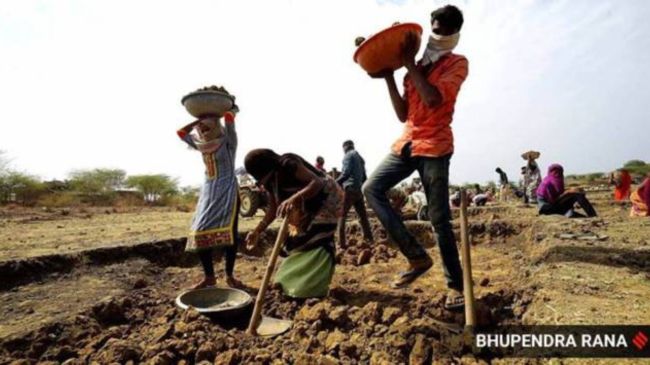 The government’s claim of increasing guaranteed employment from 100 to 125 days is purely cosmetic.


For the Narendra Modi government, which has brought in the Viksit Bharat-Guarantee for Rozgar and Ajeevika Mission (Gramin) (VB-G RAM G) Bill, 2025 to repeal the Mahatma Gandhi National Rural Employment Guarantee Act (MGNREGA), removing Mahatma Gandhi’s name is only the trailer. The damage runs much deeper. The Bill obliterates the soul of a rights-based guarantee law and replaces it with a conditional, centrally controlled scheme opposed to the interests of both the states and the working class.
Under MGNREGA, the Centre was required to meet the full cost of wages for unskilled manual work, and up to three-fourths of the material cost of the scheme, as well as three-fourths of the wages for skilled and semi-skilled workers. Under RAM G, this will be converted into a 60:40 contribution for the majority of states and Union Territories with legislatures; 90:10 for the northeastern and Himalayan states and UTs (Uttarakhand, Himachal Pradesh and Jammu and Kashmir). States will now have to shell out around Rs 50,000-plus crore. Kerala alone will have to bear an additional Rs 2,000–2,500 crore. States pay more, the Centre walks away, yet continues to claim the credit.

Under RAM G, the Centre will determine the state-wise normative allocation for each financial year, based on “objective parameters” as may be prescribed by the central government itself. Any expenditure incurred by a state in excess of its allocation will be borne entirely by the state government. MGNREGA was demand-driven. RAM G replaces this with the Centre’s pre-fixed allocations and expenditure ceilings. When funds run out, rights run out. A legal employment guarantee is reduced to a centrally managed publicity scheme, at the expense of the states.
The government’s claim of increasing guaranteed employment from 100 to 125 days is purely cosmetic. In reality, the Bill opens the door to the exclusion of large sections of rural households in the name of the “rationalisation” of job cards.
Under MGNREGA, the principal authorities for planning and implementation were the gram panchayat, block panchayat and district panchayat. They were mandated to be the principal authorities for both planning and execution. The gram panchayat was responsible for identifying projects in its area based on the recommendations of the gram sabha and ward sabhas, reflecting local needs, and for executing and supervising such works. Under RAM G, the so-called Viksit Gram Panchayat Plans will be prepared by gram panchayats through the compulsory use of GIS-based tools, PM Gati Shakti layers and other digital public infrastructure, and then placed before the gram sabha for approval. Works proposed by the intermediate panchayat, district panchayat or other implementing agencies will similarly be placed before the respective panchayats along with expected outputs and outcomes. These works will then be aggregated into the Viksit Bharat National Rural Infrastructure Stack. Biometrics, geo-tagging, dashboards and AI audits are made statutory. For millions of rural workers, technological failures will mean exclusion without appeal. Decentralisation is replaced by centralised templates; people are reduced to data points.
Under RAM G, states are obligated to notify in advance a period aggregating to 60 days in a financial year during which no works will be undertaken, including during peak agricultural seasons. Labourers who rely solely on MGNREGA work will be forced into agricultural labour during this time, at the mercy of private landlords. Is this an employment guarantee or labour control? Stopping public works to push labour into private farms is not welfare — it is state-managed labour supply, stripping workers of wages, choice and dignity.
Under Section 10 of the MGNREGA, 2005, the Central Employment Guarantee Council (CEGC) was statutorily mandated to ensure social representation, with not less than one-third of its non-official members being women, and not less than one-third belonging to the SCs, STs, OBCs and minorities. However, the corresponding rechristened Central Gramin Rozgar Guarantee Council under Clause 12 of the G RAM G Bill conspicuously omits these reservation criteria.
In contrast, Clause 13 of the G RAM G Bill, governing the rechristened State Gramin Rozgar Guarantee Councils, explicitly retains the representation criteria, exactly as prescribed under Section 12 of MGNREGA for State Employment Guarantee Councils. This selective retention establishes that the omission at the central level cannot be dismissed as an oversight or drafting error, but represents a conscious dilution of social inclusion at the apex level.
The writer is leader of CPI(M) in the Rajya Sabha

 Share
Share


