
Opinion For academic ghar wapsi that endures, India must first fix basics at home
The depressing truth is that India has never invested thought, money or energy to do justice to the human resource pool of a populous post-colonial nation
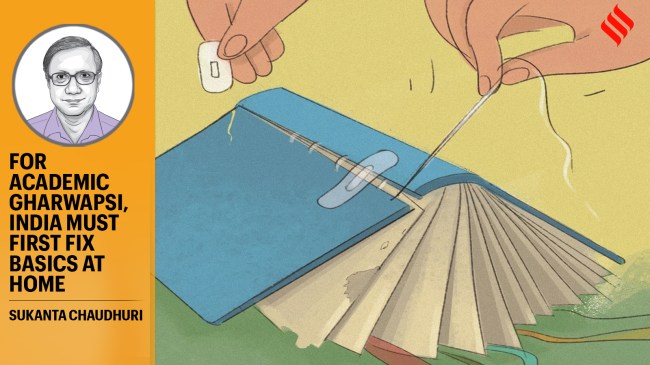 Until we expand our thinking to embrace this inclusive vision, the best-intentioned schemes for academic ghar wapsi will not last to any purpose beyond the opening fanfare. (Illustration: Komal)

Somak Raychaudhury’s piece ‘Bringing Back Indian-Origin Faculty will need changes in policy, culture’ (IE, November 27) plants ideas but also raises concerns. His suggestions are perfectly implementable. They require the Centre to invest big money, which the government is not averse to doing for branded flagship projects. There lies the danger. Too many government initiatives focus on the flagship, or even just the flag, ignoring the rest of the fleet.
Like all such proposals, this one calls for radical departures from current practices. But these reforms will be customised for returning expatriates and not the academic community as a whole. We are not offering the returnees a ready, full-fledged, working academic order where they seamlessly find a place. Rather, we are mulling mechanisms to insulate (Raychaudhury’s term) the returnees from the shortcomings of the current order.

This is the reverse of any globally metropolitan academic system. All major knowledge orders in the West have built themselves up with talent from home or near neighbours, achieving a happy state where they could attract talent from across the world. China, the closest precedent for India, has a flourishing academic agenda to attract returning expatriates, now reaching out to citizens of other countries. But this is the embellishment to a massively funded general consolidation of education and research over decades.
The depressing truth is that India has never invested thought, money or energy to do justice to the human resource pool of a populous post-colonial nation. In the first 50 years of Independence, the public university system partly realised this purpose, hampered by inadequate funds and a grossly deficient school system. The current dispensation, split between an upbeat but go-as-you-like private academic sector and an increasingly anaemic and demoralised public system, has no common purpose at all. The National Education Policy 2020 offers little beyond general principles and all later proposals show no significant focus or impact. Their reforms are selectively targeted and thus, exclusionary.
Expatriation would institutionalise sharp divisions between the returnees and their home-keeping colleagues. It implies a dual system of management, one group of faculty and their programmes allowed funding and freedoms denied to the other. Justice apart, this would create serious fissures in the statutory fabric of the university: Two sets of financial guidelines, two sets of service and conduct rules. These would need tackling through a maze of minor regulations, or by an arbitrary regime eschewing all regulation. Neither will conduce to smooth management, let alone academic morale.
The biggest anomaly concerns free speech and open research. This will be a major determinant for returnees from the US in particular, where recent developments have impacted their institutions, if not themselves personally. In India too, restrictions on free speech and academic interaction grow more rigid by the day. Add to this a byzantine visa regime and foreign contribution laws whereby international collaboration, conferences or even visits by scholars become a bureaucratic ordeal with deeper legal pitfalls. If this academic ecology endures, schemes like that of Raychaudhury cannot find a natural habitat there. They will at best coexist like introduced species, and gradually succumb to the milieu. Earlier schemes to reverse the brain drain have left virtually no mark because the schemes were vitiated by a perverse cocktail of apathy and over-management from external authority and internal execution.
Finally, such a scheme is likely to come up against the worsening caste system in Indian academia. Raychaudhury recognises that India’s finest research centres are divided between the public and private sectors, and in the former between central and state-run institutions. Yet, a consistent policy bias groups these institutions in a hierarchy, with yawning differences in funding and opportunity. All too likely, a well-funded repatriation scheme would be restricted to the uppermost rungs of this hierarchy, and to a favoured group within them.
In all our repatriation schemes, as in Raychaudhury’s, the authorities offer placements to the returnees. That is not what happens in an academically congenial scenario. There, scholars make their own choices, negotiating with individual institutions. Until we expand our thinking to embrace this inclusive vision, the best-intentioned schemes for academic ghar wapsi will not last to any purpose beyond the opening fanfare.
The writer is professor emeritus, Department of English, Jadavpur University

 Share
Share


