
Opinion Exploitation is built into gig work
The response to the strike showed that the urban middle class, which is the biggest beneficiary of their services, is unlikely to come out in support.
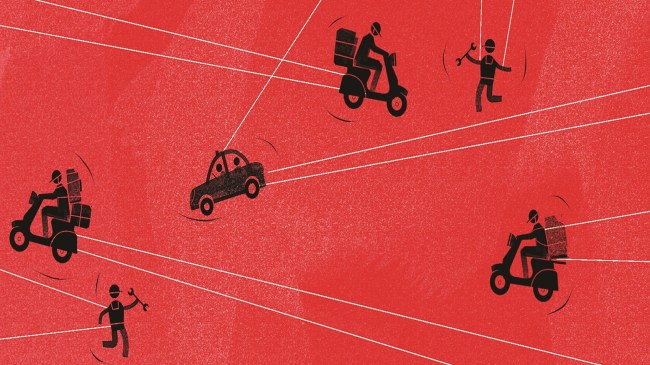 Recent strike by gig workers raises questions about their rights and the responsibility of companies. (Illustration: C R Sasikumar)

On December 31, gig and platform workers declared a strike with a call to log off from their delivery apps in protest against exploitative working conditions, inhuman treatment and lack of social security. While the protest evoked muted response with delivery platforms declaring record deliveries, the issues raised remain relevant. But they are not new. Governments all over the world are struggling to define the nature of work and finding it difficult to regulate the conditions of work and the nature of relationship between workers and large corporations.
At the heart of the matter is the nature of the contract with the app-based aggregators, who refuse to be classified as employers even though they employ the services of these workers for delivery of their goods and services. It is this fundamental refusal to accept the employer-employee relationship that makes it difficult to regulate them using the existing labour laws and social protection measures. Since for all practical purposes the workers are employed by the corporations, the nature of the contract is irrelevant irrespective of the nature of work performed. Unfortunately, in almost all cases, they are treated as self-employed without any explicit contract. Or when there is a contract in technical language, the workers are unable to understand the legalities of such a contract.

It is this opacity of the relationship with the corporations that allows them to exploit the workers without any consequences. It also implies a reward-and-punishment system that puts the workers at the mercy of the corporations. The incentive structure is built around a system of self-exploitation, and any deviation is punished through an algorithm that no one understands. There is no grievance redressal mechanism, with the system designed to keep the workers subservient and docile. Forget about any provision of social security, even basic wage compensation is determined by an algorithm that has zero tolerance even for genuine mistakes.
For corporations, these workers are outside the purview of any labour laws. To make matters worse, they are sought to be glorified as partners even though the partners have no idea of the nature of the corporation, its profits or even its basic functioning. But it is not just the corporations — even government regulations are silent on treating them as workers. Take the case of the recently implemented labour codes, which were enacted in 2020. Among the four labour codes, the most fundamental is the code on wages. While it is applicable everywhere, it excludes gig workers. They are included only in the code on social security, but again without any corresponding rights. The only obligation for the corporation is to contribute to the social security fund with no corresponding commitment on workers’ rights. These workers are neither governed by any limit on the number of hours worked nor are they eligible for any leave or benefits in case of sickness or accidents.
In a country with a significant population living in precarious conditions and with a huge unemployment problem, gig work is unlikely to disappear. These are the new casual workers disguised as self-employed and partners, but their condition is as bad as, if not worse than, that of casual manual labourers. While there is no social security, the uncertainty in case of sickness or accidents is also structured in a way where they bear the entire risk.
The response to the strike showed that the urban middle class, which is the biggest beneficiary of their services, is unlikely to come out in support. It is also not likely that the corporations dependent on these services are going to respond to the workers’ demand. It is here that the role of the government becomes important. A first step in this direction would be to recognise them as workers and corporations as employers. It is not entirely unheard of, and many countries in the Global North have moved towards such status. But even many in the Global South, including Mexico and Brazil, have done so. There have been similar attempts here in the case of Rajasthan, which enacted a law, and Karnataka, which has proposed such a law. But none has moved beyond obligating the corporations to contribute a part of their profits for social security.
With gig workers emerging as the largest group of workers with the most precarious and vulnerable occupational structure, any regulation must begin by recognising them as employees with all the rights available to them.
The writer is associate professor, JNU

 Share
Share


