
Opinion Expansion of BRICS: It’s advantage China
Under the garb of multipolarity, Beijing and Moscow are attempting to undermine the liberal international order. Russian interest in expanding BRICS stems from reducing its isolation due to sanctions, diluting opposition to its illegal occupation of Ukrainian territory and co-opting the Global South to help keep its beleaguered economy afloat
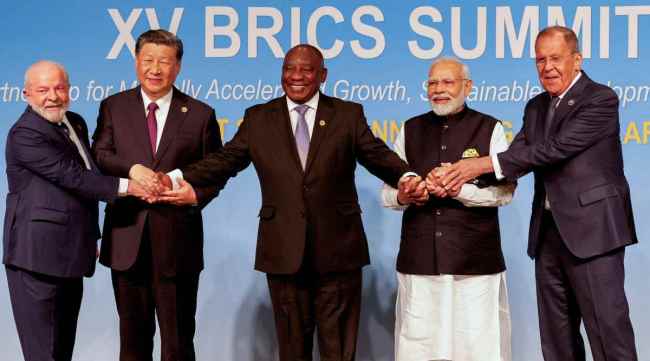 FILE PHOTO: President of Brazil Luiz Inacio Lula da Silva, President of China Xi Jinping, South African President Cyril Ramaphosa, Prime Minister of India Narendra Modi and Russia's Foreign Minister Sergei Lavrov pose for a BRICS family photo during the 2023 BRICS Summit at the Sandton Convention Centre in Johannesburg, South Africa, on August 23, 2023. GIANLUIGI GUERCIA/Pool via REUTERS/File Photo

The 15th annual summit of BRICS leaders was held in Johannesburg from August 22 to 24. In the run-up to the summit, it was disclosed that more than 40 countries had applied for membership in BRICS. China and Russia were eager to expand the group as an alternative to the US-led groupings, especially the G7. There was wide speculation that India and Brazil though not opposed to expansion, were cautious and wanted to first decide the criteria. Ultimately, BRICS decided to include six new members starting January 1, 2024. These are Argentina, Egypt, Ethiopia, Iran, Saudi Arabia and the United Arab Emirates. This is the BRICS’s first expansion since 2010 when South Africa joined at the invitation of China. The clamour for membership has generated considerable interest and hopes for a voice for developing countries. A dispassionate analysis is thus crucial to determine if this is indeed the intent.
In the late 1990s, Russia, India and China came together to form a tri-lateral group at the initiative of the then-Russian Prime Minister Yevgeny Primakov, who called it, “a counterbalance to the Western alliance”. In 2001, Jim O’Neill, a British economist at Goldman Sachs, came up with the acronym “BRIC” – Brazil, Russia, India and China. Despite differences in their political systems, these four nations represented more than a third of the world’s population and a growing proportion of the global GDP. The first BRIC summit was held in 2009 and with South Africa joining in 2010, the acronym changed to BRICS. In 2012, BRICS came up with the idea of setting up a bank. The agreement for establishing the New Development Bank (NDB) was signed during the BRICS summit in 2014 and it started operations in 2015. The stated purpose of the bank is to mobilise resources for infrastructure and sustainable development projects in Emerging Markets and Developing Countries (EMDCs).

The outcome statement on the 15th BRICS Summit envisioned itself as a champion for the Global South calling for beneficial economic growth, sustainable development, and reform of multilateral systems such as the UN Security Council. Expressing concern over ongoing conflicts in many parts of the world, BRICS reiterated its commitment to upholding international law as per the UN Charter and peaceful resolution of differences and disputes through dialogue and inclusive consultation. Its pitch for increasing the use of local currencies, alternative financial arrangements and alternative payment systems can be seen as a move to reduce dependency on the US dollar. The outcome statement acknowledged BRICS as a diverse group of nations with differing views, but sugar-coated it with, “a shared vision for a better world.”
Historically, BRICS has been more about hype and has collectively made very little tangible difference to the world, both economically and geopolitically. Although the combined economic strength of the group has increased substantially, it is mainly to China’s credit, and to some extent India’s. In 2023, global GDP amounted to $112.6 trillion, of which the share of the G7 was $45.915 trillion (40.7 per cent). In contrast, BRICS’s share was $27.653 trillion (24.55 per cent). China with a GDP of $19,373 trillion accounts for 70 per cent of the BRICS GDP and 17.2 per cent of the global GDP. The fact is that although the G7 is often criticised for being elitist, it still commands substantial influence in the world economy and its recent course correction measures have instilled hope and confidence. In contrast, BRICS is characterised by a highly unequal and skewed spread of economic wealth amongst its constituents. Worse, it has two countries that have diluted, degraded and destroyed both geopolitical and economic stability in the world. Up to December 31, 2022, the NDB approved the financing of 96 projects with a miniscule amount of $32.8 billion. The NDB has clearly not been able to substantially amend the global economic landscape. The expansion of BRICS may change the economic dynamics. The six new nations have a combined GDP of $3.113 trillion. The inclusion of Saudi Arabia and the UAE could bring new investment and trade opportunities. Egypt’s strategic location and newly discovered gas fields could be potentially lucrative for BRICS in the economic and geopolitical arena.
Hidden beneath the seemingly benign economic merits of BRICS expansion lies a larger geopolitical game being played by Russia and China. By expanding BRICS, they hope to project an effective counterweight to the US. China has made no bones about the need for a new world order and is working to position itself as its leader. Under the garb of multipolarity, Beijing and Moscow are attempting to undermine the liberal international order. Russian interest in expanding BRICS stems from reducing its isolation due to sanctions, diluting opposition to its illegal occupation of Ukrainian territory and co-opting the Global South to help keep its beleaguered economy afloat. The inclusion of Saudi Arabia, the world’s largest crude oil exporter in a group with the world’s largest crude oil importer (China), has deep ramifications on the geopolitics of the global oil market. The inclusion of Iran will add to the anti-US axis in BRICS. Chinese mediation helped Saudi Arabia and Iran end their mutual hostility paving the way for both to join BRICS. They will be beholden to China. In return, China will extract its pound of flesh — at the cost of the US and India. Four of the six new members are in West Asia where China has expanded its economic, military, and political ties.
The relative power differential between India and China implies India’s relative influence in the expanded BRICS is bound to be adversely affected. In realpolitik, the new members of BRICS will be courteous towards India, but most will align with China’s worldview. To make matters worse, India’s current trade deficit within BRICS will increase from $125 billion to $180 billion in the expanded BRICS. Make no mistake, Xi Jinping’s long-term goal is to change the world order into a Sino-centric one. In the geopolitical chess board, China has made its move by successfully expanding BRICS. India must strategise well and ensure BRICS does not degenerate into an anti-West bloc. To begin with, it must ensure minimal consensus on marginal issues. But for now, it is advantage China.
The writer is a former IAF officer

 Share
Share


