
Opinion Dithering socialists
Why the present regrouping doesn’t offer any hope.


 Socialist politicians have let down this country and are solely responsible for the rise of communal forces.
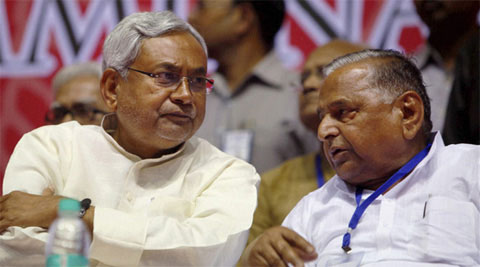
It isn’t surprising to see the remnants of a socialist movement trying to regroup. The coming together of Mulayam Singh Yadav, Sharad Yadav and Nitish Kumar under one umbrella, their efforts to merge their respective parties into one, are not new. This has been done before. They merged and disintegrated like dreams with such silken ease that by now, they have it down to an art form. Recently, Lalu Prasad and Kumar, who fought each other for decades, suddenly came together like old brothers lost in a mela. This regrouping, though, is a purely opportunistic alliance, born out of the survival instinct, to save themselves from decimation and to stop the BJP from coming to power in Bihar and Uttar Pradesh. This is a pathetic tale of egotistical politicians, and the diminution of a movement once known as the most powerful political force other than the Congress. Socialist politicians have let down this country and are solely responsible for the rise of communal forces.
Just after Independence, the great socialist leader Ram Manohar Lohia, in the words of Madhu Limaye, “hoped for the emergence of a two-party system and he thought that socialists would form the main opposition to the Congress in such a two-party system”. Limaye writes that even B.R. Ambedkar had expected the Congress to decay in later years. He thought that socialists would gather strength and present it with a formidable challenge. At the same time, Ashok Mehta, another stalwart of the socialist movement, had also boasted that “the socialist party is the second biggest party in India, that is, it is the principal opposition party in the country. It enjoys more support than all other opposition parties put together. The only organised nationwide alternative to the Congress party is the socialist party”. This was also when the rightwing RSS was down and people did not attach much importance to their ideology. The RSS was reeling under the guilt of the assassination of Mahatma Gandhi and had lost much of its support base due to the ban imposed by Sardar Patel, the then home minister.

Since then, both streams of politics have travelled in different directions. The socialists who dreamt of replacing the Congress as the principal party of India today fight for survival and hardly deserve the label of “socialists”. They are divided into many groups and can at best be thought of as caste parties. Yadav and Prasad, two of the brightest Lohia followers, are Yadav leaders. Kumar is a Kurmi leader. The RSS, on the other hand, has grown in stature and acceptability and its political wing, the BJP, now occupies the central space in Indian politics. Under the leadership of Narendra Modi, the BJP is winning one state after another. One can naturally ask what went wrong with the socialist movement. If I could summarise in one word the difference between the RSS and the socialists, it would be “patience”.
Long ago, Lohia himself had said, “Socialists lose their patience whenever defeated. They get easily disheartened and set out to change their principles and programmes.” Lohia had expected socialist followers to have the “tenacity and courage of Mohammed Ghori, who kept trying even after 18 defeats”. But the tragedy was that the leader who exhorted his followers to have patience was himself not willing to wait. Limaye writes: “Lohia also alternated between bouts of extreme puritanism and idealism on one hand and relaxation on the other. The years between 1950-59 were characterised by experiments in puritanism. Similarly, the period from 1962-67 was one of relaxation of rules. Then, after the 1967 elections, he began to think that the retreat from puritanism was threatening to become rout.”
Even Jayaprakash Narayan, or JP, the socialists’ tallest leader, dithered in his relationship with Jawaharlal Nehru. He could not decide if he should oppose or support Nehru. After Independence, JP thought that any opposition to Nehru would be detrimental to nation-building. But Lohia wanted a strong opposition. The political difference between them created confusion and vagueness in the movement, which finally led to JP retreating from electoral politics. The RSS, meanwhile, was steadfast in its approach. It firmly believed that the Nehruvian outlook would destroy this country. Most of all, it had patience. It built its organisation brick by brick. It never compromised on its core ideology, which was a major attraction for its followers. The socialists had no patience for organisation-building. They revelled in individual brilliance but despite some great leaders, they could never present a grand vision for the future.
Yes, Lohia was the architect of anti-Congressism and backward-caste politics that resulted in an assertion in the early 1990s through the Mandal Commission. But his ideology lingered as stray ideas opposed to the Congress, and they could best be termed electoral strategies. JP also suffered from the same problem. He did not experiment with new ideas, structures or leaders. His Janata experiment was a shortcut to replace Indira Gandhi, despite repeatedly stressing upon Total Revolution. With both Lohia and JP gone, in the absence of ideological glue and a towering leader, their followers bitterly fought among themselves for petty political gain and splintered into many. Most formations degenerated into dynastic parties. So, the present regrouping, in the absence of an ideological foundation, does not offer much hope.
The writer is a spokesperson for the Aam Aadmi Party
 Share
Share


