
Opinion Breaking down news: Free for All
Free speech is not for TV anchors alone. A group of liberals is exercising its right on YouTube
 The damaged interior of Notre Dame Cathedral in Paris on Tuesday, April 16, 2019. The cathedral remains structurally sound after a monstrous fire roared through it Monday night, but the conflagration that destroyed the wood-and-lead roof and lacy spire also left three “holes” in the sweeping vaulted ceiling, officials said after an inspection on Tuesday. (Christophe Petit Tesson/Pool via The New York Times) -- FOR EDITORIAL USE ONLY. --

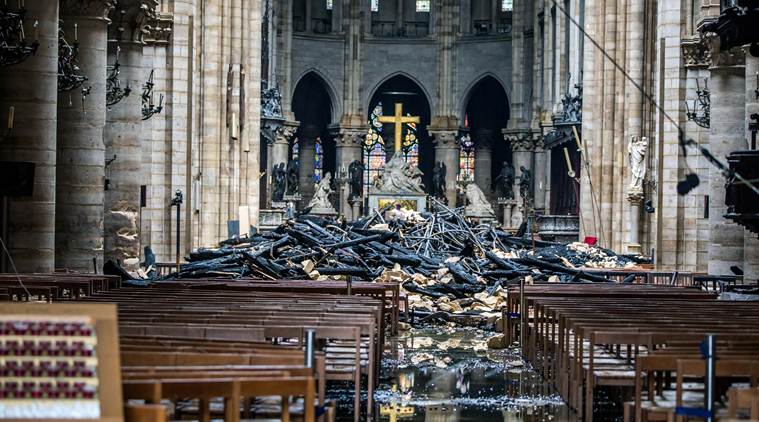 This week’s image is of Notre Dame in flames, and it has sent Victor Hugo’s classic The Hunchback of Notre Dame right to the top of the charts (Christophe Petit Tesson/Pool via The New York Times)
AWAY from the cities, the news is an experience in tunnel vision. People are generally happy watching free-to- air channels and for people from the metros, being trapped for a whole morning with Republic TV, Bharat can be a novel experience. So is the channel’s capacity to make do with the bare minimum. On Thursday morning, it was a split screen, with GVL Narasimha Rao occupying the left half, flinching from a shoe hurled at him in a press conference. Shoes hurled in press conferences generally miss, as George W Bush can testify.
Meanwhile, the right half of the screen showed Hardik Patel flinching from a slap which actually landed, and a relentlessly shrill voice informed viewers that Patel is a poor man who travels by helicopter and is cashing in on the slap by accusing the BJP of trying to have him killed. This tableau kept the channel going for about a quarter of the morning, along with Yogi Adityanath in adoration of Hanuman, as he waited for the curb on his campaigning to be end.

The previous evening, the channel had a show that, at first impression, appeared to be reproduction of Leonando da Vinci’s The Last Supper. On closer inspection, it was revealed to be a huge panel of discussants with Arnab Goswami at the centre, with Shazia Ilmi at his side, and the whistleblower RVS Mani — who had alleged that he was forced to cook up the term ‘Hindu terror’ — in the very last seat. The format, apparently, was to give Mani an opportunity to speak, though he has spoken of his case extensively before and even written a book about it. And the slightest interruption — Goswami’s shows are generally extended interruptions — provided the host an opportunity to leap to Mani’s defence, and then leap to a camera, fill its field and harangue it about free speech.
Free speech is also being exercised by a small group of liberals, including Aruna Roy, Syeda Hameed, Nayantara Sahgal and Wajahat Habibullah, who have launched the Aqal ki Baat series, in reaction to the Prime Minister’s Mann ki Baat. But it is not just a counter, but reminds viewers of the principles on which the Constitution is founded, and of the intricacies of the working of government. It’s on YouTube, but that doesn’t make it alternative, at a time when the world follows the contest between PewDiePie and T-Series, and when one of the oldest TV news channels makes a virtue out of filming on smartphones.
The defining news images are now about fire. Last week, it was the fiery image of the black hole at the centre of Meissner 87, in the Virgo galaxy cluster. It was actually a picture of the dust and gases surrounding the black hole, as they were accelerated by the tremendous gravitational field. And to be absolutely exact, it was a not a visual image at all, but an electronic pattern created by an algorithm from radiation data that was not in the visual spectrum.
This week’s image is of Notre Dame in flames, and it has sent Victor Hugo’s classic The Hunchback of Notre Dame, which is as much about the gigantic cathedral as it is about the hunchback Quasimodo and the gypsy La Esmeralda, right to the top of the charts. It’s a rather dire book which, at a cursory reading, concerns the bleakness of the human condition, but it has sold out in American bookstores and is being reprinted to meet skyrocketing demand in Europe. The survival of Notre Dame’s golden cross and altar has given rise to wonder among the faithful, and will no doubt raise a fresh crop of books and pamphlets about the triumph of faith. Even if scientists are at pains to inform the public that the temperature of your average open fire is about 400 Celsius, while the melting point of gold is 1,063 Celsius.
Much more stirring is the fall of the spire of the cathedral which, in the imagination, competes with the top of the Eiffel Tower as the crowning glory of Paris. Some of the clearest videos of its collapse, like that used by Euro News, was crowdsourced from the many people who filmed it with their cellphones. The move of French booksellers to use profits from the current surge in sales of Victor Hugo’s novel to repair Notre Dame is extraordinary in the history of publishing. Doubly so, because this will be the second time that The Hunchback of Notre Dame will be used to save the 850-year-old cathedral from ruin. In fact, Hugo wrote the book in 1831 partly to save Notre Dame de Paris, which was then in a state of disrepair, and had been vandalised. The fascinating gargoyles were not in tune with the fashion of the time, and the church was deemed to be fit for abandonment. Hugo’s work drew public attention to its condition and had enabled the first restoration, with memorable passages like: ‘Great edifices, like great mountains, are the work of centuries… Time is the architect, the nation is the builder’.
pratik.kanjilal@expressindia.com
 Share
Share


