
Opinion Best of Both Sides: CBSE’s Maths levels will give students more options
By reducing the fear of examinations, a two-tiered evaluation is likely to make the subject more amenable to a large number of students
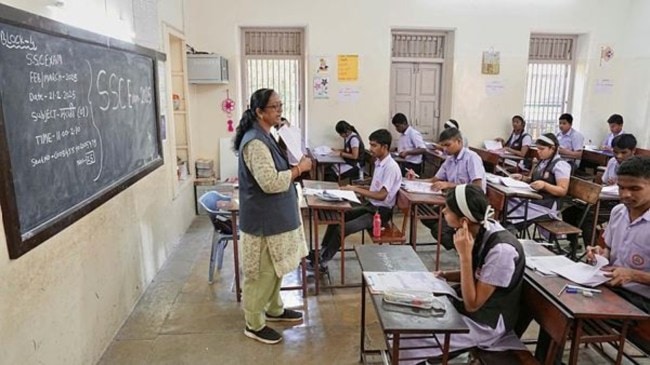 Making a subject more interesting for students is a work in progress and all concerns should be addressed.


The Central Board of Secondary Education (CBSE) has been entrusted to come up with and apply novel and robust methods to assess and evaluate students. For students in Class XII, evaluation takes the form of board examinations. The classroom experience, no doubt, is a critical part of a young person’s academic experience. But so is the examination system. Despite the introduction of CUET in recent years, the board examinations remain a cause for anxiety for a large section of students. In Mathematics especially, the fear of examinations often comes in the way of enjoying the intricacies of the subject.
With a keen eye on students’ welfare — as well as the requirements of the knowledge economy — the CBSE has announced the implementation of a two-tier examination system in Science, Technology, Engineering and Mathematics (STEM) subjects at the senior secondary school level.

At present, a Class XI student may choose to study Standard Mathematics or Applied Mathematics. However, both are flat, dense subjects with scarcely any room for flexibility in the syllabus. In the two-tier system, however, the scenario will be different. A student who chooses to pursue the subject may opt for either basic-level or advanced-level Mathematics. She can take the latter option if she aspires to study Maths at university later, or any other course where Mathematics is expected to play a deep auxiliary role — say, Economics or Engineering. If, however, the student wants to pursue a career in the Humanities, Theatre or Sports, but has an affinity for Mathematics, she can opt for the basic level. The CBSE aims to ensure this choice is available to students no later than the academic year 2026-27. Reportedly, NCERT has already started working on books to meet the intellectual needs of this curriculum.
The idea of offering subjects at two levels is not entirely new. In several Western countries as well as Singapore and Japan, senior secondary students have been exercising these choices for at least a few decades. Since 1975, the International Baccalaureate (IB) Diploma Programme has been the major example of this idea in practice. At the Diploma level (equivalent to classes XI and XII), students typically study six subjects — three at the standard level and three at a higher level. The higher-level course allows one to dive deeper into the subject. The standard level offers breadth, but not much depth. The final exams are designed to go in tandem with the student’s choice. The IB is now relatively established in India, with more than 200 schools having adopted it.
The CBSE’s attempt to implement a two-tier curriculum is a much-needed move given the country’s diversity and the different learning experiences of students. By reducing the fear of examinations, a two-tiered evaluation is likely to make the subject more amenable to a large number of students. If the purpose of a progressive education system is to draw more young people to a subject, the CBSE’s latest move fits this requirement. In addition, STEM subjects are notorious for being intellectually demanding. A Science student in India who passes the Board exam without taking tuition in at least one subject is quite unusual. There is hope that the two-tier curriculum will reduce students’ dependence on coaching classes.
The new scheme opens up new possibilities, allowing students to explore some advanced-level subjects in greater depth while still leaving significant scope for them to learn new things in basic-level subjects; those designing the two-tier curriculum should take such possibilities into account.
The CBSE is not making drastic changes in the reading materials. The significant change will be in the degree of difficulty of the examination. This is not to say there will not be challenges. It is not clear how the examination agency is going to evaluate students taking the same subject at different levels. It’s also not certain that this move won’t create a divide between teachers who handle advanced-level subjects and those who teach at the basic level. Will the student be permitted to change the level of a subject based on her emotional connect with it? Will the student opting for the basic level of a subject feel inferior to another who has opted for the advanced level?
Making a subject more interesting for students is a work in progress and all concerns should be addressed. Even then, a step in the right direction has to be applauded. As Physics Nobel laureate Richard Feynman once said, “I would rather have questions that can’t be answered than answers that can’t be questioned.”
The writer has taught Mathematics in schools in the NCR for almost two decades. Views are personal

 Share
Share


