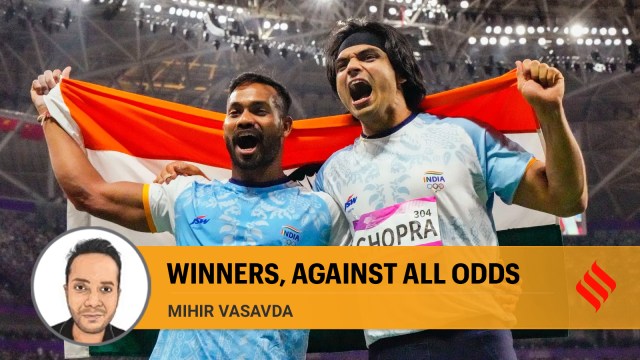

In a way, the backstories of 256 Indian athletes, who won a medal at the Asian Games last year, traced by The Indian Express over the last two months, capture the story of Indian sport.
Those stories, heartbreaking and inspiring in equal measure, show who plays sports, and where; reveal why they play, and how; illustrate the progress made over the years and expose the potential pitfalls.

The trends don’t paint a picture of a sporting nation. They bring out a feel-good factor, no doubt, but also point to the many flaws that have kept the country from realising even half of its true potential.
It’s striking that, despite access to specialised training in some of the remotest corners of the country, there’s no clear-cut pathway yet to make a career in sport unlike in, say, academics where there’s a formal progression from KG to PG. What eventually happens at the end of academic life may differ from person to person. But the parent and the child know what the journey will be like, the important milestones and what to expect along the way.
Ninety-six athletes who medalled in Hangzhou stumbled upon their sport in either school or at a local ground. Many others were introduced to a game, by chance, by an enterprising coach at a basic academy with the bare minimum facilities. Stars, then, have to miraculously start aligning from that moment on.

Essentially, a career in sport is a game of luck — to be spotted at the right age, given there’s no scientific scouting network; to be given the right environment, as a majority come from underprivileged backgrounds; and to be shown the right direction as the athlete, in most cases, enters blindfolded in terms of her career path.
Perhaps, it’s this fear of the unknown that keeps parents with stable, government jobs from being keen to push their child in this direction. As the data showed, only 33 medallists out of 256 had parents who were in the service class. For these parents, the absence of a safety net in case of a sporting career gone wrong seems a far bigger concern than any gains — financial primarily.
Clearly, that’s not a deterrent for aspiring cricketers, who aren’t afraid to put all their eggs in one basket. The data showed that, in order to further their cricketing ambitions, eight players each in the men’s and women’s teams did not study beyond Class 10 or 12, hoping for a life-changing contract with an IPL or WPL side.
As the cricket industry grows, more children will be forced to choose between one or the other, leaving them vulnerable to life after sport.
It is also glaring that big cities like Chennai, Mumbai, Delhi, Kolkata and Bangalore accounted for just 41 medal winners between them. Ahmedabad, which is hyped up as the host city for the 2036 Olympics, had only one.
These disappointing numbers raise questions as to why the privileged or middle class from urban areas who can afford high-nutrition food, have access to the best gyms and state-of-the-art training facilities, do not think of sport as a viable career option.
Shrinking public spaces and a comfortable lifestyle means the participation of people from big cities in sports like hockey — which requires big playing grounds — and wrestling, a hard strength-based sport, is negligible. Likewise, the entry barriers and high cost in sports like squash and tennis mean that those from rural backgrounds — who accounted for one-third of the medalists — can only dream of a career in such sports. The next stage of evolution for Indian sports will be the narrowing of the urban-rural participation ratio in these sports, where India has a proud history.
Despite these imperfections, sport’s ability to change lives in India is undeniable. Money remains the primary motivation for the families to put their child in sports. It’s why a daily wager moved from Varanasi to Sonbhadra; why a petrol pump attendant encouraged his daughter to take up running; and why a tribal belt in Sundergarh has more hockey turfs than colleges.
Indeed, the government — at the centre and in the states — has finally woken up to the benefits of prioritising sports. This is evident from the increasing investment — the central government’s sports budget of Rs 3,397 crore this financial year is nearly double what it was 10 years ago — and ambitious projects announced, including the debatable bid for the Olympics. At the state level, new infrastructure is being built from scratch and sports policies are being revised.
The results, in theory, should only get better going forward. The earlier generations, despite their talent, never benefited from endless resources and customised training at an elite level, as athletes today do.
Simultaneously, however, there should also be an overhaul of a system that has too many webs and uncertainties for a career to flourish. That’s one of the biggest lessons from the 256 stories.
mihir.vasavda@expressindia.com


