
Opinion After the re-election
Brazil faces serious challenges. Is President Dilma Rousseff up to the task?


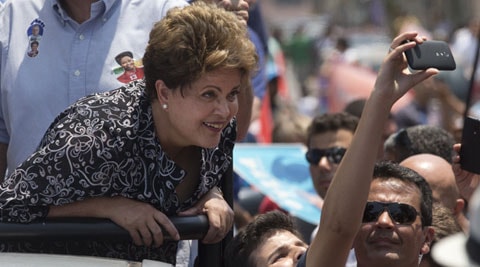 Rousseff faces a daunting set of challenges. First, the country faces an immediate economic problem. (Source: AP)
The presidential election season is over in Brazil and status quo has been reaffirmed, but not without some early surprises, rancour and, even among the victors, a certain amount of disappointment. For roughly 10 years, Brazil enjoyed its status as an emergent global power under the presidency of the charismatic Luiz Inacio Lula da Silva and his handpicked successor, Dilma Rousseff. Then the gloss came off: massive protests in 2013, an economy grinding to a near halt and a growing awareness of critical social, economic and infrastructure problems threatening the gains of the new middle class. In the air of gloom around Brazil this past year, it’s no wonder many expected Rousseff, the incumbent Worker’s Party (PT) president, to lose.
Instead, Rousseff squeaked through on the narrowest margin in Brazilian history — 51.6 per cent to 48.4 per cent for Aécio Neves of the Brazilian Social Democratic Party (PSDB). The election revealed a population more sharply polarised than at any time since the restoration of democracy in 1985, with the PT drawing support from low income voters in the north and northeast, while Neves and the PSDB deepened their base among middle- and upper-class voters in the south and southeast. Neither candidate offered a clear or inspiring message about the future. Rather, this was a backwards-looking election in which the two parties that have dominated presidential politics since 1994 battled over their respective legacies.

While the candidates were uninspiring, on at least one level this was an encouraging election. Brazil’s “new republic” began inauspiciously, with the chaotic economic circumstances only matched by its politics. Observers, foreign and domestic, described the new democracy as “feckless”, “ungovernable”, “drunk” and suffering from “hyperactive paralysis”. This view persisted into the early 2000s, even as the context began to improve both economically and politically. So, deep worries about Brazil’s democracy are not part of some distant past.
Yet, this election showed some hallmarks of a mature democracy. Over the course of the campaign, voters settled into two relatively coherent voting blocs around distinct programmatic offerings. For a while, a sizeable block of disgruntled voters considered Marina Silva’s insurgent quasi-outside campaign. But the absence of a clear platform and tangible responses to the challenges facing the country, coupled with her limited political organisation, led voters back to the most realistic candidates.
Ultimately, they made reasonable “retrospective” choices (that is, voting based on evaluations of past performance of a party or candidate, whether focused on personal circumstances or broader societal judgements). The fact that voters could reliably judge party and candidate reputations says a great deal about the impressive distance Brazilian democracy has travelled in a relatively short time.
In the end, a small majority of voters expressed a preference for preserving a government of social inclusion, despite growing reservations even among party loyalists. The reservations are well founded. Rousseff faces a daunting set of challenges. First, the country faces an immediate economic problem. For the past few years, Brazil’s macroeconomic situation has steadily deteriorated. GDP growth for 2014 is projected at an anaemic 0.3 per cent, with inflation rising to 6.7 per cent. Brazil’s main instrument of macroeconomic stability has been to set primary budget surplus targets as a way to contain spending and inflationary pressure. But, over the course of Rousseff’s presidency, rising spending and falling revenues have forced the government to lower targets each year. Yet, even after substantially lowering targets, the government is due to miss 2014’s goal for 1.9 per cent GDP growth. The country needs to cut spending and/ or raise revenue, but has little real room for manoeuvre in the short term. All paths entail painful political decisions.
The second challenge is that these short-term pressures exist over and above glaring investment shortfalls in areas like health, housing, education and transport that helped stoke the 2013 protests. These are problems that date back decades, and to some extent have become so salient because of the PT’s success in lifting millions out of poverty and therefore increasing demand for services and infrastructure. But the fact that Rousseff didn’t create these problems doesn’t remove the pressure to do something about them. The impending Olympics and attendant spending requirements are unlikely to help matters. A third set of challenges stem from Rousseff’s own policy choices, particularly a wide array of ineffective industrial policies, including active and ultimately destructive intervention in the state-owned oil company, Petrobras.
The final set of challenges stem from her limitations as a leader. The election deepened the dominance of the two presidential parties, the PSDB and the PT. But, at the legislative and sub-national level, it also deepened the fragmentation of the system. The new National Congress will feature 28 parties — the most in Brazilian history — with both the PT and its main ally, the Brazilian Democratic Movement Party, weakened. This kind of system — a fragmented, multi-party presidential system — places a premium on coalition-building. Rousseff is not a particularly skilled backroom negotiator and lacks the charisma that popular presidents are sometimes able to wield (unlike Lula).
Imagining a rocky road ahead for Brazil seems reasonable given the circumstances. However, saying that Brazil has some serious challenges and a government that is perhaps not quite up to the task also makes it like almost every country in the world today. Brazilians may hope for more, but this is a long way from “drunk”, “ungovernable” or “feckless democracy”.
The writer, professor and co-director of the King’s International Development Institute at King’s College London, is author of ‘Crafting Coalitions for Reform: Business Strategies, Political Institutions and Neoliberalism in Brazil
 Share
Share


