
Opinion Why citizens must be wary of attempts to link Aadhaar with voter ID
🔴 Randeep Singh Surjewala writes: The Modi government’s alarming record of encroaching on citizens’ right to privacy should be taken as a warning
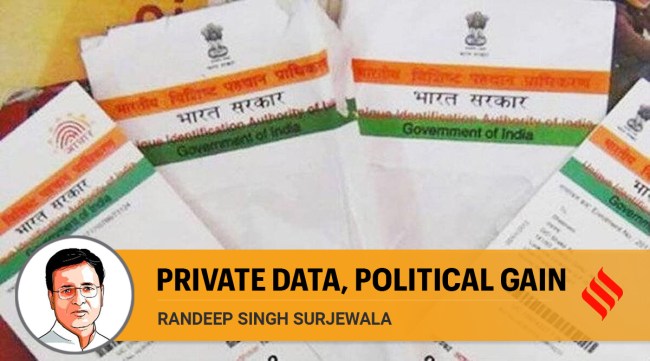 The government’s obsessive addiction with collecting data on its citizens goes back to 2015. (File Photo)

Over the course of the coming weeks, the Modi government is likely to notify the Act that provides for the linking of Aadhaar with voter IDs.
There is no doubt, given the various legal infirmities that are rife with such an exercise, that it will be challenged before the Supreme Court. Several legal scholars have written comprehensively about this act of linkage violating the fundamental right to privacy, the parameters laid down in the Aadhaar judgment and how it represents excessive and unjustifiable executive overreach violating the doctrine of necessity (especially since Aadhaar is not proof of citizenship).

However, there is another area of concern that has gone almost entirely unaddressed in commentary: The massive trust deficit that plagues the Modi government.
It must be remembered that this is a government that vehemently and embarrassingly argued against a fundamental right to privacy for its citizens. It stood before the Supreme Court and attempted to make a clumsy case for why no citizen is entitled to be protected from this government’s all-prying scrutiny. Thankfully, the Supreme Court put such delusions to rest.
The government’s obsessive addiction with collecting data on its citizens goes back to 2015. This government, while continuing to deny it, oversaw the widespread linking of Aadhaar with all manner of services (often without rationale), including but not limited to the use of shamshaan ghats, marriage registration and railway ticket purchases. It was only when the Supreme Court stepped in and restricted the use of Aadhaar for social welfare schemes that the government was compelled to relent.
To compound this concern, the entire period prior to the judgment saw multiple reported breaches of Aadhaar data while the Modi government continued to falsely assure citizens that the data is “safe”. In 2018, the Aadhaar app was found to be vulnerable to hacking. Prior to this, there were reports of Aadhaar numbers being downloaded from close to 210 government websites. In another report by the Centre for Internet and Society, it was revealed that about 130 million Aadhaar numbers were available on the internet (along with other sensitive information). A leading national newspaper published findings that Aadhaar data was available for as little as Rs 500 for purchase. These are just some examples out of many.
When the Supreme Court pressed the government about these and other issues surrounding data security, it responded that the data is kept behind “thirteen-foot-high walls”, highlighting a shocking lack of understanding of data security.
While this can be attributed to negligence, there are other more worrying trends, which highlight a sinister and deliberate intention to continue acquiring private data for political gain. Most recently, the Madras High Court issued notice and termed as “credible”, the allegation that BJP workers had access to Aadhaar data, and that they were able to “profile and target” voters. This is a colossally criminal act if found to be true.
Recently, after the revelations regarding the use of Pegasus spyware to spy on journalists and the political Opposition were exposed, the Supreme Court asked the Modi government to clarify if indeed it was using the software. Predictably, the government dithered and refused to give a straightforward answer. By implication, this demonstrated the government’s complicity in the exercise.
 Even the recent Personal Data Protection Bill seeks to create a regime where the government has carte blanche to collect any data in the name of public interest without a need to justify the same. Justice B N Srikrishna (Retd.) observed that the law has the potential to turn India into an “Orwellian state”.
We presume good faith when it comes to the implementation of laws. However, any challenge on constitutionality must be grounded in the legislating government’s own past actions and whether it gives rise to legitimate concerns of bad faith or mala fides.
Even now, there is no clear explanation of how linking voter IDs will “purify” rolls. A previous exercise undertaken in Andhra Pradesh and Telangana led to tens of lakhs of genuine voters being purged from the polls. Given these risks and amplified by the government’s proven track record of administrative ineptitude, this cannot be accepted as an exercise in good faith.
The singular question that arises from our experience over the last eight years is this: Can we trust a government that has repeatedly misled its citizens on the nature and scope of information it collects on them, that has demonstrated a clear prioritisation of its own petty political interests over the rights of the electorate, that has such a fundamental lack of regard for data protections that it routinely violates them? If we view this latest exercise through the tainted lens of the Modi government’s own history, then the answer is a resounding no.
And that is precisely why it must be opposed. In public interest.
This column first appeared in the print edition on January 7, 2022 under the title ‘Private data, political gate’. Surjewala is the general secretary of the AICC and media and communications in-charge of the Indian National Congress

 Share
Share


