
Opinion At 100 years, the University of Delhi is a ‘Mini Bharat’
Abhishek Tandon writes: Since its inception, the university has cherished the democratic values of free speech and diversity
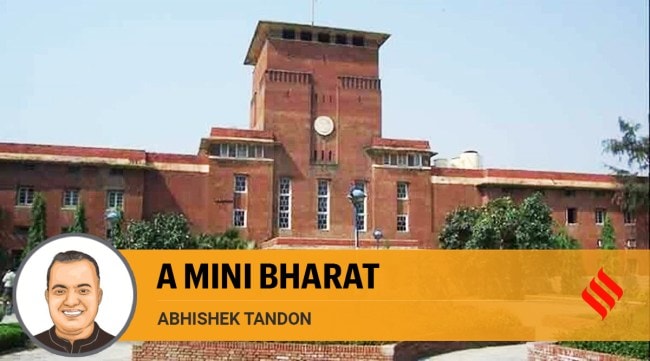 DU also has an excellent gender ratio. While the university had just 82 girls in 1930, its constituent colleges now have 3,24,067 women students — more than 50 per cent of the total student population. (File)

From 750 students in 1922 to over 6 lakh students from across India in 2022, the University of Delhi (DU) has come a long way. Not only has the university evolved with the nation, but it has also played a crucial role in its evolution. With 90 colleges under its umbrella, DU has played an important role in framing the discourses that guide the nation’s growth. Since its inception, the university has cherished the democratic values of free speech and diversity. The atmosphere of free-spirited discussions and camaraderie makes DU a big draw for students across India. Over the years, it has become one of the most sought-after universities in the country.
It is rightly said that a nation is as strong as its institutions. This credo is dear to DU: The university continues to lend support to nation-building by nurturing the finest young minds. It echoes the values of the nation and is a microcosm of our vibrant society: It’s a “Mini Bharat” where students from all financial backgrounds and all regions of the country have always received a warm welcome.

DU also has an excellent gender ratio. While the university had just 82 girls in 1930, its constituent colleges now have 3,24,067 women students — more than 50 per cent of the total student population. The number of departments has increased from eight to 86 in the course of its 100-year journey. DU has the largest pool of seats to offer and its research facilities and infrastructure are among the best in India.
It wasn’t all hunky-dory from the start. In its initial years, the university shuffled between rented buildings. Additionally, DU witnessed intense competition from other colleges and universities. Post-Independence (and Partition), the university also faced the challenge of accommodating students from the then-West Punjab. Nevertheless, DU expanded and new colleges — including Hansraj College (1948), SGTB Khalsa College (1951), Deshbandhu College (1952), and Kirori Mal College (1954) — were started. Subsequently, in the 1960s, several new women’s colleges — Lakshmibai, Kamala Nehru, Gargi, and Janki Devi — were set up under the university.
In 1973, the university got a new South Campus, which became the hub of extraordinary life sciences research — including affordable HIV tests, and genome sequencing of rice, among others — that gave the university global recognition. In the last two decades of the previous century, the university added the Shaheed Sukhdev College of Business Studies, Shaheed Rajguru College of Applied Sciences and Deen Dayal Upadhyaya College to its fold. DU’s School of Open Learning, established in 1962, provides an excellent opportunity to more than 1,50,000 students every year to enrol themselves in graduation/post-graduation courses while preparing for competitive exams or working on the side. Today, five DU colleges — Miranda House, Lady Shri Ram College, St Stephen’s, Hindu, and Shri Ram College of Commerce — rank amongst the top 10 in the central government’s National Institute Ranking Framework.

The university has a rich history of its students participating in the Indian freedom struggle. Revolutionary Chandra Shekhar Azad had found refuge in the students’ hostel of Ramjas College when the British had launched a manhunt to nab him. In 1942, DU students took an active part in the Quit India Movement. In fact, Mahatma Gandhi came to the university to seek the support of students. After Independence, evening classes were started in Ramjas College for students who had come from across the newly-chalked out borders. In 1975, when an Emergency was imposed over the country, former Union minister Arun Jaitley, who was then the Delhi University Students Union president, participated in the movement against the order. Along with several other student union leaders, he was also imprisoned. Students and teachers’ associations have never feared voicing their concerns at DU. The strong support for freedom of expression keeps the university thriving and reaffirms the idea of “unity in diversity” — a principle fundamental to India. DU caters to a significant number of students from the northeast region, who in turn bring their unique values and make the varsity more pluralistic. Similarly, students from the southern states add to the diversity of the institution. This assimilation of cultures bridges the gap between regions, unifies the country, and helps students get a cosmopolitan perspective.
In 100 years, DU has created invaluable intellectual, cultural and social capital for a modern nation. Its alumni have excelled in all walks of life — business, politics, films, and sports. As it enters its 101st year, the university has a lot to look forward to — from the introduction of the Central Universities Common Entrance Test to the implementation of the New Education Policy of 2020. In the coming years, the university will be offering solutions to global problems while continuing to contribute to nation-building. In the next 25 years when India completes 100 years of Independence and DU turns 125, the university could be amongst the top-ranking institutions in the world, proving the mettle of the Indian education system and the country’s intellectual might.
This column first appeared in the print edition on May 18, 2022 under the title ‘A Mini Bharat’. The writer was a student leader and is currently a faculty member at the University of Delhi and State President of Akhil Bharatiya Vidyarthi Parishad
 Share
Share


